


Ably vs Liveblocks: Which Real-Time Collaboration Tool is Better? (November 2025)
Compare Ably vs Liveblocks for real-time collaboration in November 2025. See which platform offers better features, faster implementation, and lower costs.
When your team needs real-time collaboration features, you may be stuck comparing different options. You can go with Ably's powerful backend that requires months of frontend work or Liveblocks' document-focused components that don't cover your broader needs. Both excel in their niches, but each comes with major trade-offs that can slow down your development timeline. Fortunately, there's a better approach to real-time collaboration that gives you complete features without the lengthy implementation cycles.
TLDR:
- Ably provides strong messaging infrastructure but requires months of frontend development work
- Liveblocks offers pre-built components for document editing but lacks broader collaboration features
- Both solutions require major engineering investment and ongoing maintenance overhead
- Velt combines the best aspects of both competitors: strong backend infrastructure like Ably with ready-made components like Liveblocks
- Velt delivers 25+ collaboration features in minutes with full-stack SDK across all frameworks
What Ably Does and Their Approach
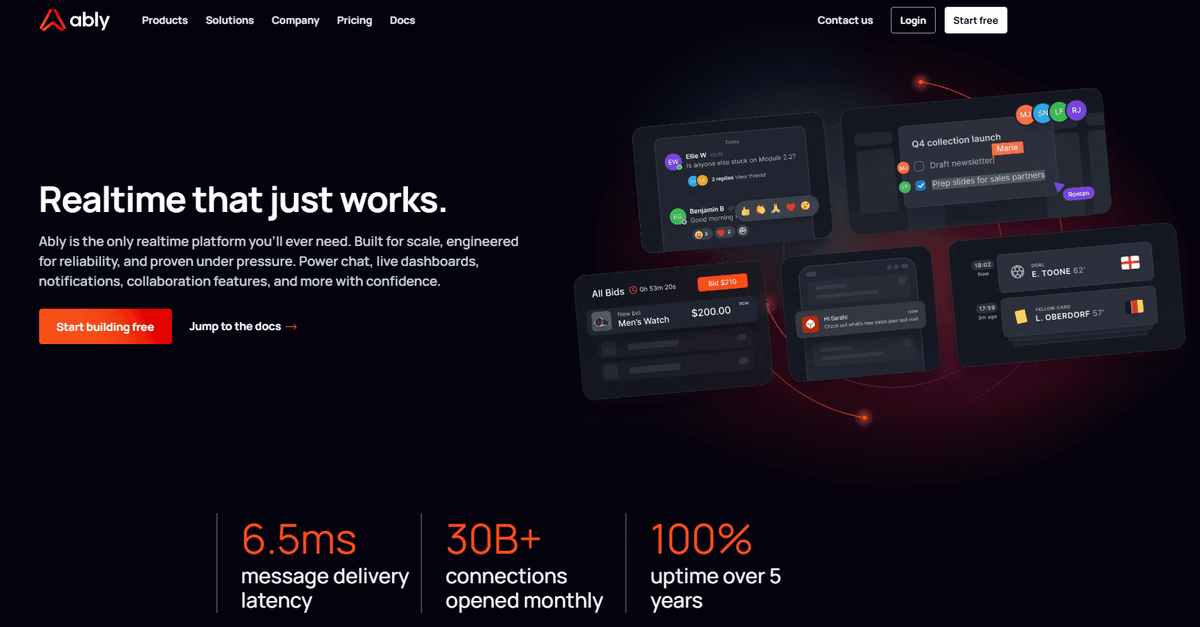
Ably is a real-time messaging infrastructure that provides APIs for building live messaging, chat, dashboards, notifications and collaborative apps. The service lets developers add real-time collaboration experiences with just a few lines of code, without re-architecting from scratch or building infrastructure.
The service operates as a messaging infrastructure layer that handles WebSocket connections, pub/sub messaging, and data synchronization. Ably provides the building blocks for real-time messaging throughout your solution with an integrated suite of products, whether using Spaces for live cursors at the front end or Pub/Sub Channels to sync edits with your backend.
Ably's realtime system is built to scale, engineered for reliability, and proven under pressure with global data centers and automatic failover features.
Their approach focuses heavily on the backend messaging layer. You get solid WebSocket management, presence detection, and message delivery guarantees. But here's the catch: Ably gives you the pipes, not the faucets. You'll need to build most of your UI components from scratch.
This backend-first approach works well if you have a strong frontend team and specific design requirements. However, it means more development time and ongoing maintenance for the collaboration features your users actually see and interact with.
What Liveblocks Does and Their Approach
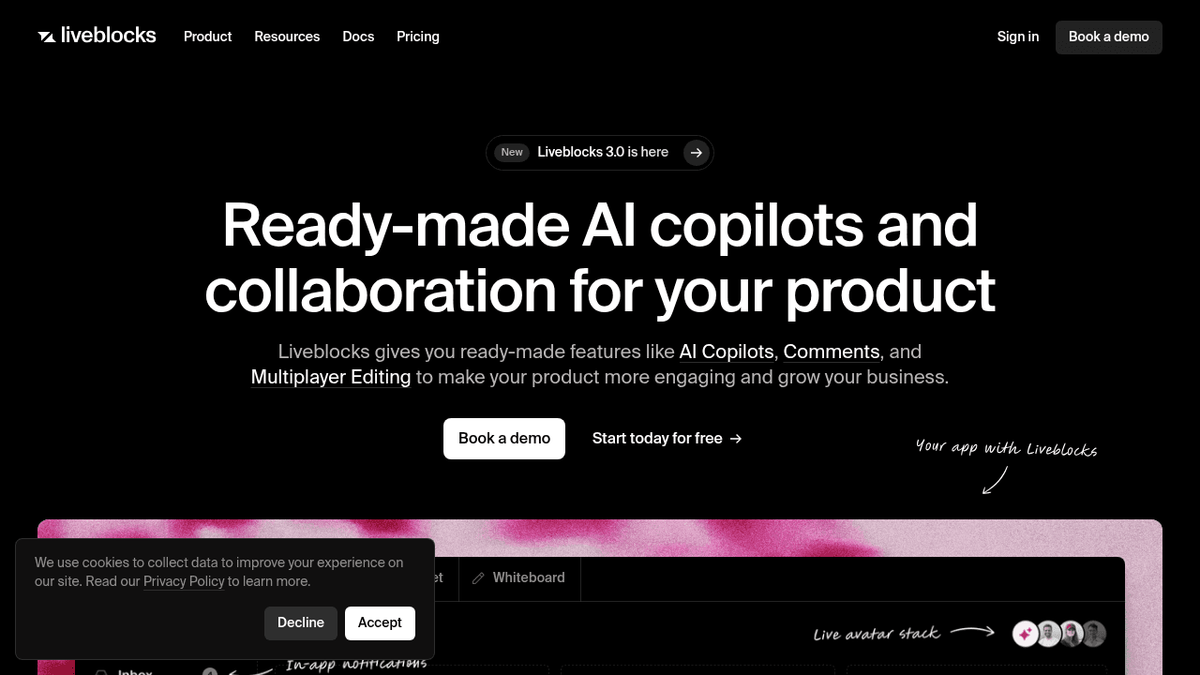
Liveblocks provides real-time collaboration infrastructure with pre-built components for multiplayer editing, comments, presence, and notifications. Their service lets you add collaboration features to text editors and apps without building WebSocket infrastructure from scratch.
The service takes an api-first approach, offering ready-made features like AI copilots, threaded comments, and multiplayer text editing. You get synchronized cursors, user presence indicators, and conflict-free document editing through their CRDT-based system.
Liveblocks handles the difficult parts of building collaborative apps, so you don't have to write WebSocket and state management code yourself.
Their infrastructure includes reliable connection management and automatic reconnection handling. The service integrates well with popular text editors like Lexical and provides hooks for React-based apps. However, Liveblocks primarily focuses on document collaboration and text editing use cases.
The main limitation is scope. While Liveblocks excels at document collaboration, it doesn't cover broader collaboration needs like video calls, screen recording, or contextual commenting on non-text elements. You'll need additional tools for complete collaboration features.
Ably Features and Technical Approach
Ably's technical architecture focuses on a channel-based publish/subscribe model that handles real-time messaging at scale. Their Spaces SDK provides collaborative features like live cursors, avatar stacks, component locking, and member location tracking that developers can implement in just a few lines of code.
The service excels at WebSocket infrastructure management with automatic connection handling, message delivery guarantees, and global data center distribution. Ably's APIs support massive user loads and can reliably publish database changes to millions of clients simultaneously.
Core Technical Components
Ably's approach focuses on three main areas: reliable message delivery, presence detection, and connection state management. Their infrastructure handles the complex networking layer while exposing simple APIs for developers to build on top of.
The service provides flexible SDKs that integrate into both web and mobile stacks. However, most UI components need to be built from scratch, which means more frontend development work for your team.
The main trade-off with Ably is development time versus infrastructure control. You get solid backend messaging but need to invest a lot of time in frontend collaboration components.
Liveblocks Features and Technical Approach
Liveblocks builds on a CRDT-based storage system that automatically resolves conflicts when multiple users edit the same document simultaneously. Their technical stack includes pre-built React components for presence indicators, threaded comments, and multiplayer text editing that integrate directly into existing apps.
The service provides four core products: Storage for document synchronization, Presence for user awareness, Comments for contextual feedback, and Notifications for activity updates. Each component connects through their WebSocket infrastructure that handles connection management and data persistence automatically.
Document-Centric Architecture
Liveblocks excels at document collaboration with built-in support for popular text editors like Lexical, Slate, and Monaco. Their CRDT implementation makes sure that simultaneous edits merge correctly without data loss or corruption.
The service includes AI-powered features like text rewriting and content generation directly within collaborative editors. Users can see real-time cursor tracking and presence indicators that show exactly where teammates are working in shared documents.
Liveblocks handles complex state synchronization automatically, so developers don't need to manage conflict resolution or connection state manually.
Their infrastructure scales to handle large user loads with automatic reconnection and offline support. However, the service primarily focuses on text-based collaboration scenarios instead of broader multimedia or contextual commenting needs.
For teams looking at notification systems, we've compared Liveblocks vs Velt notifications and their approaches to document collaboration in detail.
Infrastructure Complexity and Development Requirements
Ably reduces infrastructure complexity by handling the messaging layer, but you'll still need months of frontend development. Building presence indicators, live cursors, and comment threads from their APIs requires strong React expertise and ongoing maintenance.
Liveblocks shortens development time with pre-built components, but limits your flexibility. Their document-focused approach works well for text editors but falls short for broader collaboration needs like video calls or contextual commenting on UI elements.
The challenge goes beyond building the initial features: it's maintaining reliable performance as your user base grows and requirements evolve.
Both solutions require ongoing engineering investment. Ably demands more upfront frontend work, while Liveblocks may require additional tools as your collaboration needs expand beyond document editing.
The real question becomes whether you want to spend months building collaboration features or focus that engineering time on your core product differentiation.
Performance and Scalability Considerations
Both services handle thousands of concurrent connections, but their approaches differ greatly. Ably focuses on raw messaging throughput and can support millions of simultaneous subscribers across channels. Their infrastructure automatically scales based on demand without requiring configuration changes.
Liveblocks optimizes for document collaboration scenarios with intelligent state management that reduces bandwidth usage. Their CRDT implementation means fewer server requests during collaborative editing sessions, but this optimization primarily benefits text-based workflows.
The ideal real-time collaboration solution is reliable, highly available, and maintains data integrity out-of-the-box.
The choice often comes down to whether you need maximum control over messaging infrastructure or prefer higher-level abstractions that get you to market faster. Both require careful capacity planning as your collaboration features scale.
Velt as the Better Choice for Real-Time Collaboration
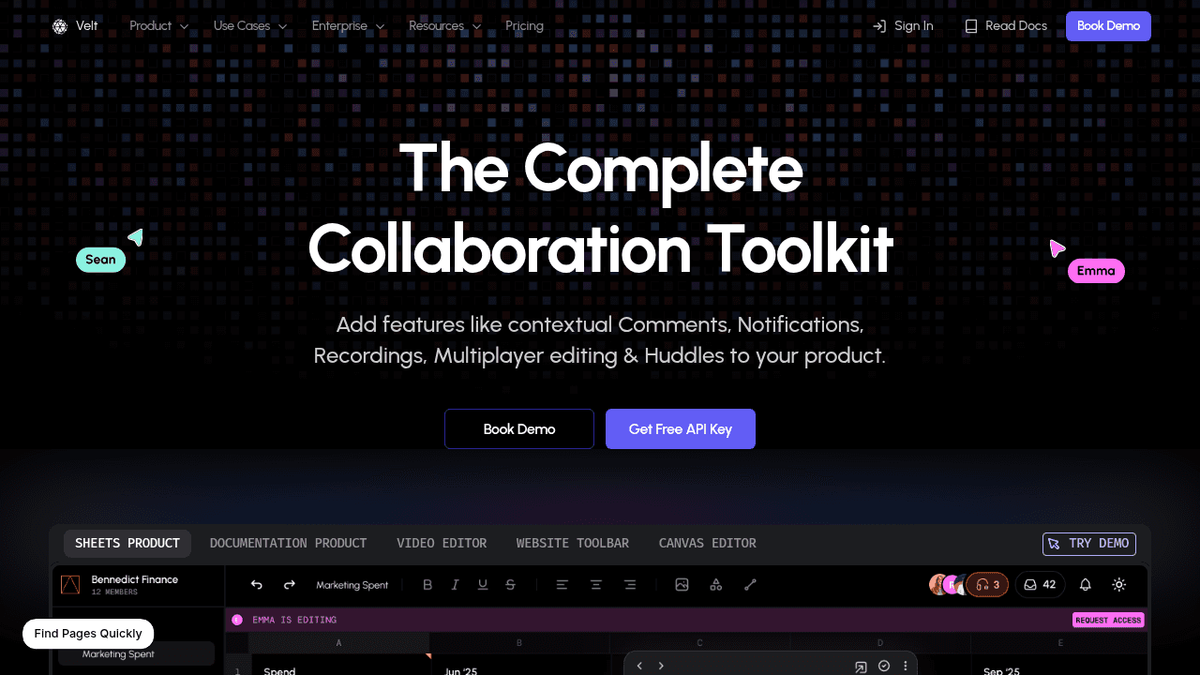
While Ably and Liveblocks each excel in their specific domains, Velt provides a complete collaboration layer that solves the limitations of both approaches. Instead of choosing between infrastructure complexity or limited scope, you get 25+ collaboration features that integrate in minutes instead of months.
Velt combines the best aspects of both competitors: strong backend infrastructure like Ably with ready-made components like Liveblocks, plus features neither offers. You get contextual comments, live cursors, voice/video huddles, screen recording, and AI-powered transcription in a single SDK that works across React, Vue, Svelte, and Angular.
Complete Feature Set Without the Development Time
The difference becomes clear when you consider implementation speed. Real-time collaboration tools typically require extensive development cycles, but Velt reduces integration time in a few hours for most features.
You get basic presence and messaging plus advanced features like contextual commenting on any DOM element, Loom-style screen recording with AI transcription, and customizable notification systems that work across web and email channels.
Velt eliminates the trade-off between development speed and feature completeness by providing enterprise-grade collaboration tools that integrate in minutes, not months.
The service handles everything from WebSocket management to UI customization while maintaining the flexibility to self-host data for compliance requirements. This approach lets you focus engineering resources on your core product instead of rebuilding collaboration infrastructure.
For teams looking at collaboration tools for development, Velt offers the complete feature set and rapid implementation that modern apps require without the ongoing maintenance overhead.
FAQ
How long does it take to implement real-time collaboration with each service?
Ably requires months of frontend development since you only get the messaging infrastructure and must build all UI components from scratch. Liveblocks reduces this to weeks with pre-built components but only for document editing scenarios, while Velt can be integrated in a few hours with 25+ ready-made collaboration features.
What's the main difference between Ably and Liveblocks' technical approaches?
Ably focuses on backend messaging infrastructure with strong WebSocket management but requires you to build all frontend components yourself. Liveblocks provides a CRDT-based document collaboration system with pre-built React components, but it's limited to text editing use cases instead of broader collaboration needs.
When should I choose a backend-focused solution like Ably over component-ready platforms?
Choose Ably if you have a strong frontend team, highly specific design requirements, and need maximum control over the messaging infrastructure. However, this approach requires major ongoing engineering investment and 6+ months of development time for most collaboration features.
Can Liveblocks handle collaboration beyond document editing?
Liveblocks excels at document collaboration with features like threaded comments and multiplayer text editing, but it doesn't cover broader collaboration needs like video calls, screen recording, or contextual commenting on non-text elements like images or UI components.
Why do most real-time collaboration projects take so long to complete?
Building collaboration infrastructure requires specialized distributed systems expertise, conflict resolution algorithms, state synchronization, and scalable backend infrastructure that most teams don't have in-house. 80% of such projects take at least 6 months to complete, plus ongoing maintenance overhead.
Final thoughts on choosing the right real-time collaboration infrastructure
The collaboration infrastructure you choose shapes your entire development timeline and user experience. Ably gives you powerful messaging tools but demands months of frontend work, while Liveblocks speeds up document editing but leaves gaps for broader collaboration needs. Velt bridges this divide with complete features that integrate quickly, letting you focus on what makes your product unique instead of rebuilding collaboration from scratch