

Top CRDT Libraries for Real-Time Data Sync Updated July 2026
Compare the best CRDT libraries for real-time data sync updated July 2026. Velt, Yjs, Automerge, and more ranked by performance, features, and ease of use.
Everyone talks about collaborative data structures like they're the complete solution for real-time apps. They're not. That's where review and approval infrastructure like Velt comes in. CRDTs handle the conflict resolution brilliantly, but that's only one piece of what you need to build. You'll still be writing code for presence, UI components, permissions, and dozens of other features before users can actually collaborate as well as operating the real-time infrastructure to host the solution. The question is which library gets you closest to a working product with the least custom development.
TLDR:
- CRDTs solve real-time sync by letting users edit locally then merge changes automatically
- Automerge requires building your own UI, presence, and collaboration features
- Most libraries need months of dev work; Velt ships review and approval infrastructure in days
- Velt offers enterprise security, scales to millions of users, and includes AI features
What are CRDT Libraries?
CRDTs are specialized data structures built for distributed systems where multiple users edit the same data at once. The challenge: keeping changes in sync without losing information or creating conflicts.
Traditional approaches use a central server to coordinate every change, creating bottlenecks and failing when users go offline. CRDTs work differently. Each user makes changes to their local copy, then those changes merge automatically using mathematical rules that guarantee consistency. Think about this way: instead of preventing conflicts, CRDTs are designed so conflicts can't happen. Each operation is commutative, so order doesn't matter. Whether User A's edit arrives before or after User B's, the final result is identical across all devices. This makes CRDTs valuable for real-time collaborative apps like Google Docs, multiplayer games, or any software where users work together. They also power offline-first experiences where apps keep working without internet, then sync when connection returns.
CRDT libraries package these algorithms into ready-to-use code. Instead of implementing complex distributed systems logic from scratch, you can use battle-tested implementations that handle the synchronization math.
How We Ranked CRDT Libraries
We ranked available CRDT libraries using publicly available information instead of conducting our own performance tests. Our evaluation considers several factors that matter when choosing a CRDT implementation for production use:
- Performance characteristics. We looked at these from independent benchmarks and research papers. Some libraries show dramatic speed differences in specific scenarios, with documented improvements exceeding 5000x in certain operations.
- Implementation maturity. We assessed implementation maturity by looking at how long the library has been in production, its maintenance activity, and real-world deployment examples.
- Developer experience. We looked at documentation quality, API design, integration complexity, and how quickly you can get started.
- Ecosystem support. We also assessed community size, available integrations, and whether the library works across different languages and frameworks.
Best Overall CRDT Libraries: Velt
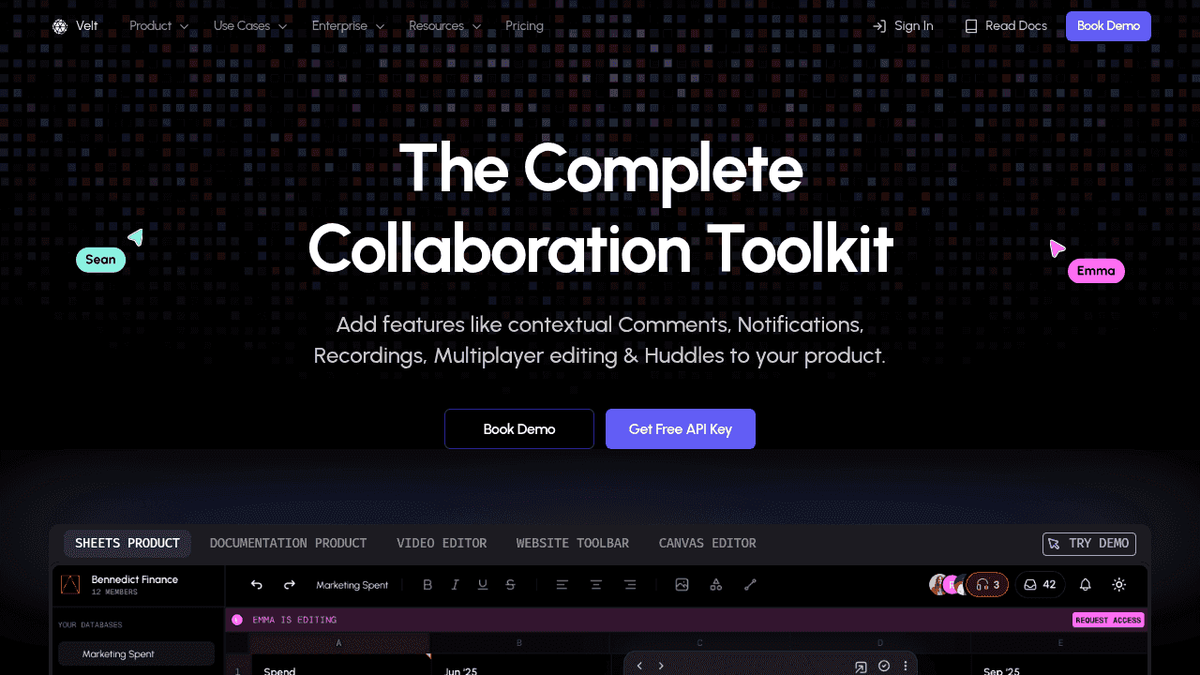
Most CRDT libraries provide data structures and sync algorithms, and stop there. Velt is review and approval infrastructure built on CRDT foundations (Yjs). It ships a production-ready layer on top: contextual comments, approval workflows, presence, notifications, audit trails, and recording, all out of the box.
Key Features
Velt includes a number of key features for collaborative applications:
- Ships UI layer, presence system, permissions, notifications, and communication features out of the box. No custom build required.
- Add live cursors, contextual comments, and real-time editing in days, not months
- Approval workflows and immutable audit trails included out of the box, ready for enterprise compliance requirements
- Scales to millions of monthly active users on fully managed infrastructure
- Enterprise options: end-to-end encryption, audit logs, data self-hosting, and SOC 2 / HIPAA compliance
The Downsides
Velt is online-first with limited offline support, making it a poor fit for local-first or peer-to-peer apps where infrastructure independence is a hard requirement. The SDK is JS/TS and React-first, with no native Rust, Swift, or Python bindings like lower-level libraries offer. Because Velt abstracts the CRDT layer by design, teams that need granular control over sync internals will find the opinionated architecture works against them. The real-time infrastructure runs on Velt's cloud by default; data self-hosting is available, but the connection layer itself is not self-hosted outside enterprise plans.
The Bottom Line
Velt works best for product teams building B2B SaaS apps that need to ship contextual comments, formal approval workflows, and audit trails without months of custom development. If your use case involves review and approval infrastructure over raw data sync, Velt gives you the full stack in days. Teams needing offline-first architecture, low-level CRDT control, or multi-language bindings are better served by Yjs or Automerge.
Yjs
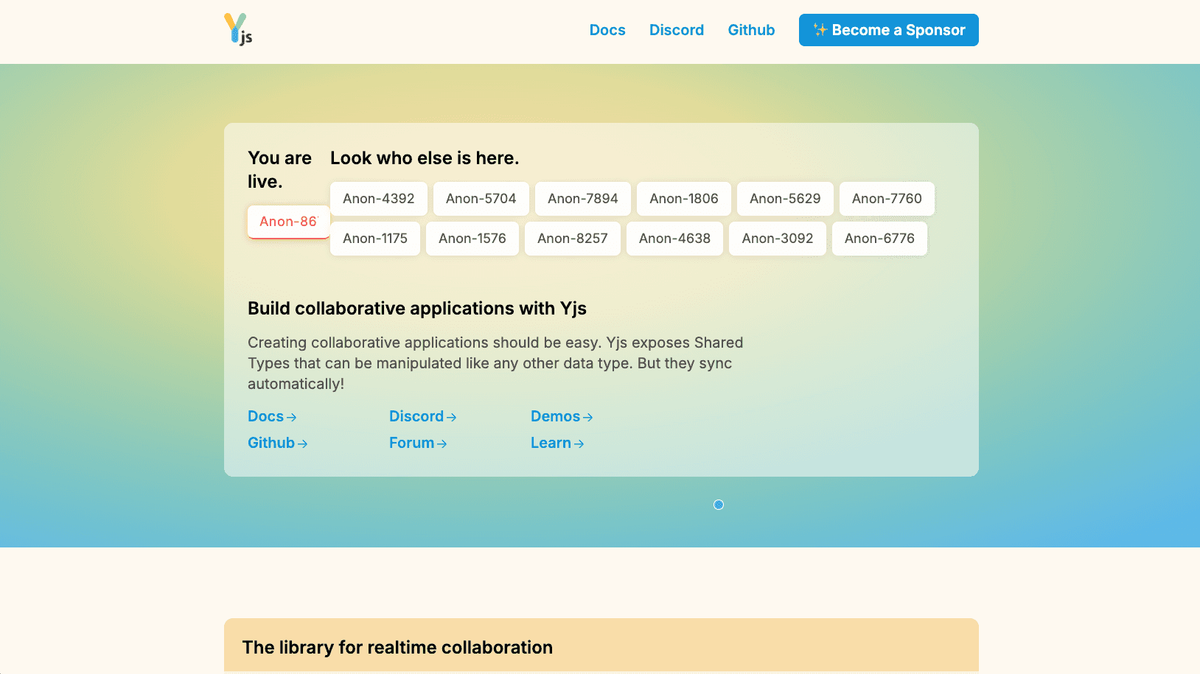
Yjs is a modular framework for building collaborative applications that exposes its internal data structure as shared types, with changes automatically distributed to other peers and merged without conflicts.
Key Features
Yjs includes a number of key features for collaborative applications:
- Support for offline editing, version snapshots, undo/redo and shared cursors with unlimited scalability
- Multiple modules for different editors, communication protocols, and databases
- Network-agnostic architecture supporting peer-to-peer connections
The Downsides
Yjs requires bundle size overhead through WebAssembly generation, making debugging more challenging and potentially impacting browser performance. It requires you to bring your own realtime infrastructure. You'll need to implement your own UI components, user presence indicators, and application-level features.
The Bottom Line
Yjs offers powerful CRDT capabilities for text collaboration but requires substantial development effort to create production-ready collaborative applications. It's good for teams building text editors or document collaboration who need granular control over synchronization protocols and don't mind handling infrastructure complexity.
Automerge
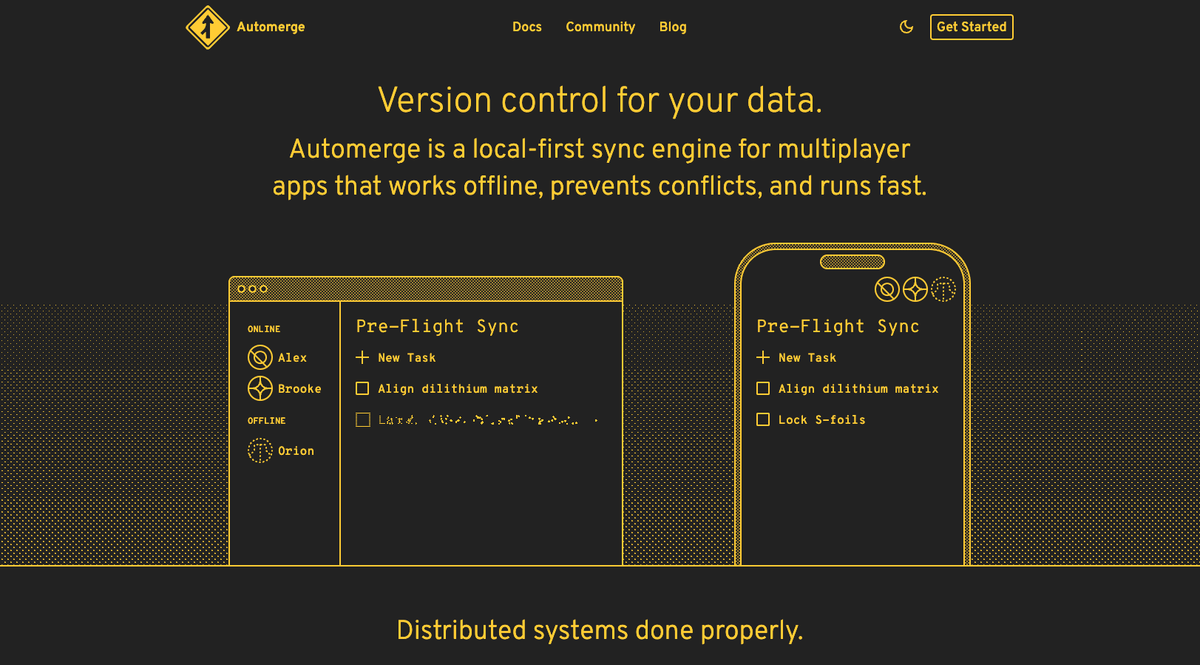
Automerge is a CRDT implementation with a JSON data model, built in Rust with JavaScript bindings through WebAssembly. Network communication happens via automerge-repo, a separate module that handles synchronization between peers.
Key Features
Automerge includes a number of key features for collaborative applications:
- RGA algorithm implementation designed for collaborative editing
- Multi-language support through Rust core with bindings for JavaScript, Python, and other languages
- JSON-like document structure for familiar data manipulation
The Downsides
Automerge historically suffered from performance issues, with some operations taking nearly 5 minutes compared to optimized implementations completing identical work in 56 milliseconds. Version 2.0 resolved many of those bottlenecks, and Automerge 3.0 (released 2025) cut memory usage by over 10x: a Moby Dick-sized document drops from 700 MB in v2 to 1.3 MB in v3. Even so, you still need to build collaboration UI, handle networking infrastructure, and manage application state separately.
The Bottom Line
Automerge provides capable CRDT functionality for JSON documents but demands development work to create complete collaborative applications. It requires you to bring your own realtime infrastructure. It's good for applications requiring JSON document collaboration where developers prefer working with familiar object structures. Teams building memory-sensitive apps (mobile, edge) will benefit most from the v3 upgrade.
Loro
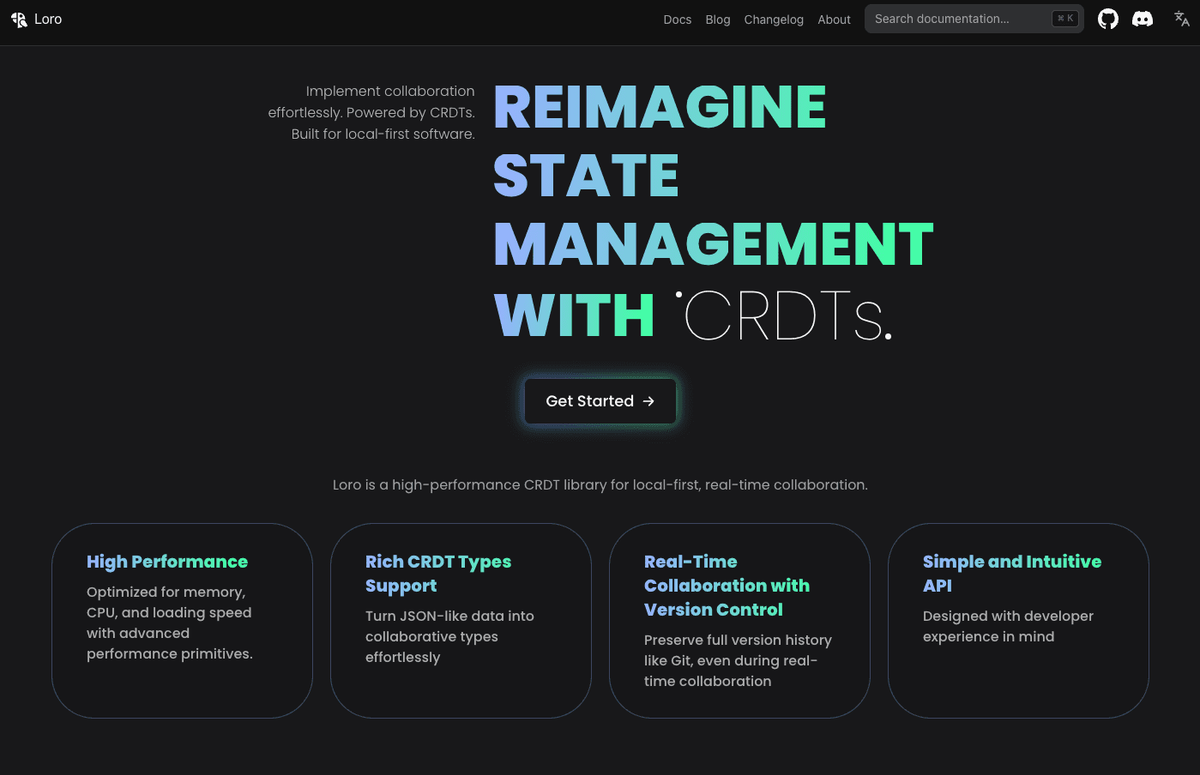
Loro is a high-performance CRDT library built with Rust that focuses on memory usage, CPU performance, and loading speed for local-first applications.
Key Features
Loro includes a number of key features for collaborative applications:
- Fugue CRDT algorithm that reduces text editing interleaving anomalies
- APIs for Rust, JavaScript, and Swift
- Data structures including text, lists, maps, trees, and counters
- Version history tracking similar to Git
The Downsides
Loro reached stable v1.x releases (currently v1.13.6) and is in active production use at companies including Latch.bio and Marimo.io. You still need to build your own UI, presence, and collaboration workflows. Teams should expect API evolution as the library matures, and the encoding schema is not guaranteed backward-compatible across all versions.
The Bottom Line
Loro delivers strong performance and has reached stable v1.x releases, making it a viable choice for teams that can invest in building their own collaboration layers. It's a good fit for performance-critical local-first apps where developers want fine-grained control over sync and history without relying on managed infrastructure.
Microsoft Fluid Framework
Microsoft Fluid Framework is a library for building distributed, real-time collaborative web applications using JavaScript or TypeScript.
Key Features
Fluid Framework includes a number of key features for collaborative applications:
- CRDT-inspired distributed data structures with client libraries for shared state
- Ordering service handling message sequencing and minimum sequence number tracking
- Microsoft ecosystem integration with enterprise support
- Hub-and-spoke architecture simplifying convergence through server-side processing
The Downsides
Fluid Framework requires server-side infrastructure for operation transformation, lacks distributed garbage collection, and forces translation between CRDT data structures and application data structures.
The Bottom Line
Fluid Framework offers Microsoft-backed collaboration capabilities but introduces server dependencies that limit flexibility. It's good for Microsoft-centric organizations building document collaboration tools who can use existing Azure infrastructure.
RxDB CRDT Plugin
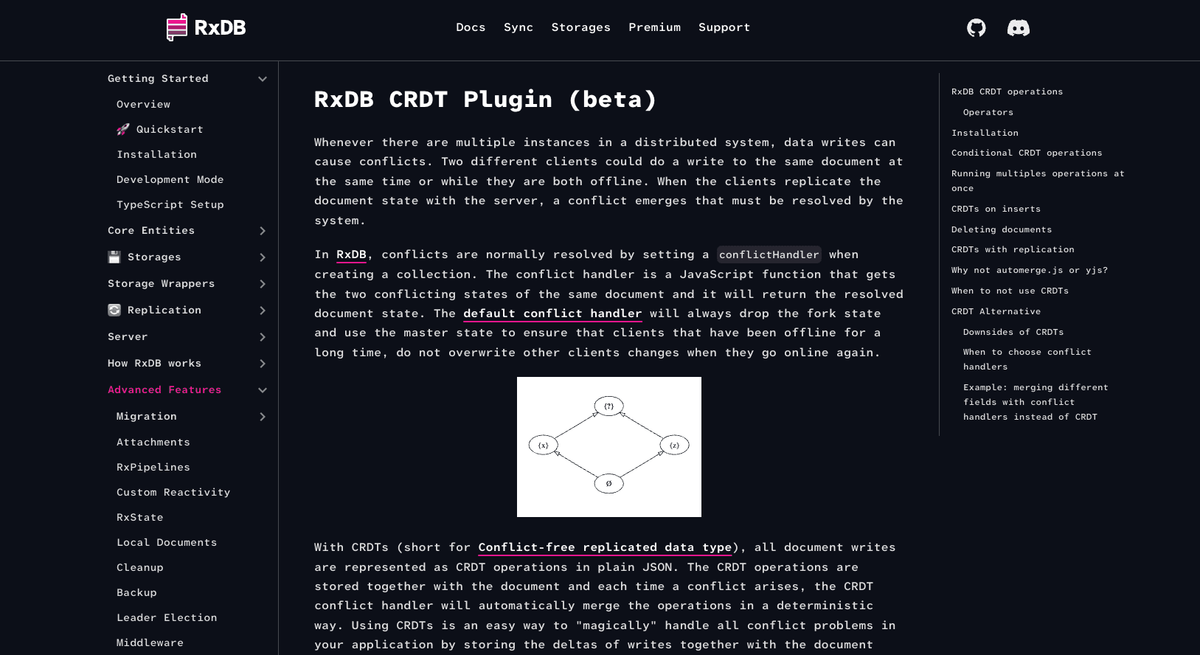
RxDB writes, stores and replicates CRDTs on NoSQL documents using MongoDB-style update operators processed through the mingo library.
Key Features
RxDB includes a number of key features for collaborative applications:
- Replication protocols for GraphQL, CouchDB, WebSocket, and cloud services
- Both CRDT and custom conflict resolution approaches with automatic merging or manual control
- Storage interface flexibility supporting LocalStorage, IndexedDB, SQLite, and other engines
The Downsides
RxDB's CRDT approach requires representing business logic through static JSON operators, which breaks down when complex user interaction is needed for resolution. Teams must separately implement collaborative UI, real-time presence, and user experience features.
The Bottom Line
This is good for applications needing database-centric CRDT integration where teams prefer NoSQL operations and already use RxDB for local data management.
Liveblocks
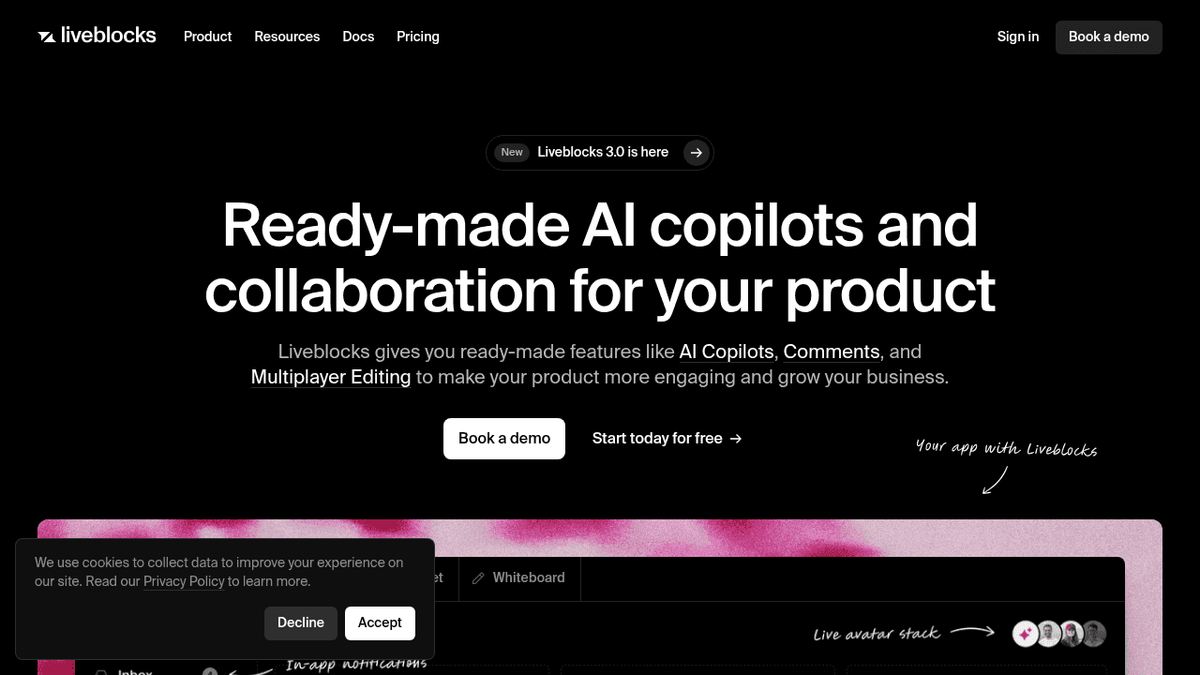
Liveblocks is a real-time collaboration library that keeps shared state synchronized across clients. It focuses on making multi-user experiences easy to implement in modern web applications, without requiring teams to build their own networking or state-sync infrastructure.
Key Features
Liveblocks includes a number of key features for collaborative applications:
- Uses CRDTs to automatically resolve conflicts between simultaneous edits
- Supports maps, lists, objects, and other shared data types
- Maintains eventual consistency without centralized locking
- Built-in user presence (who’s online, cursors, selections, status)
- Designed for low-latency UI feedback in collaborative apps
The Downsides
Liveblocks does not provide a rich-text editor or document model out of the box and you must integrate it with your own UI logic or a separate editor layer. Compared to libraries like Yjs or Automerge, Liveblocks offers fewer opportunities to customize internal CRDT behavior. Production self-hosting is not available: Liveblocks open-sourced its sync engine in February 2026 (AGPL v3) for local development and testing, but the company confirmed production self-hosting is not yet supported, making it a poor fit for enterprises with strict data residency requirements (HIPAA, SOC 2, jurisdictional compliance).
The Bottom Line
Liveblocks is best for teams that want collaboration, such as apps requiring real-time UI sync (dashboards, design tools, whiteboards, multiplayer workflows), but don't want to maintain real-time infrastructure.
Feature Comparison Table of CRDT Libraries
Here's how the libraries compare across critical features for real-time collaboration:
| Criterion | Velt | Yjs | Automerge | Loro | Fluid Framework | RxDB | Liveblocks |
|---|---|---|---|---|---|---|---|
| Real-time sync | Yes (SDK + infra) | Yes (CRDT shared types) | Yes (local-first + sync) | Yes (CRDT sync) | Yes (shared data objects) | Yes (replication/sync) | Yes (hosted realtime infra) |
| Conflict resolution | Yes (abstracted) | Yes (CRDT) | Yes (CRDT) | Yes (CRDT) | Yes (concurrent ops handled) | Yes (DB-level) | Yes (CRDT/managed store) |
| Pre-built UI comps | Yes (comments, cursors…) | No (bindings only) | No | No | Limited samples only | No | Yes (comments, presence, etc.) |
| Offline support | Limited (online-first) | Yes (offline + sync later) | Yes (local-first/offline) | Yes (local-first) | Partial (app-managed) | Yes (offline-first) | Partial (online-first, some caching) |
| Enterprise security | Yes (SOC2/HIPAA, etc.) | No (library only) | No | No | Yes (via Azure stack) | Partial (encryption only) | Yes (SOC2 Type II, HIPAA) |
| Self-hosting option | Yes (enterprise / hybrid) | Yes (OSS, self-host infra) | Yes | Yes | Limited (Azure preferred) | Yes (you host everything) | No (SaaS only) |
| Deployment complexity | Low to Med | Med to High | Medium | Med to High (Rust/WASM) | High (Azure + Fluid) | Medium | Low (managed + SDK) |
| Proven scale | Yes (SaaS/enterprise) | Yes (widely used in prod) | Rising (growing use) | Early (newer engine) | Yes (Microsoft ecosystem) | Yes (many JS apps) | Yes (SaaS, millions of users) |
| Language support | JS/TS (React-first) | JS/TS | Rust, JS/TS (via WASM) | Rust core + JS/Dart via WASM | TS/JS | JS/TS (browser, RN, etc.) | JS/TS (React, Next.js, etc.) |
| Production ready | Yes | Yes | Yes (v3 stable, active) | Yes (v1.x stable; API still maturing) | Yes | Yes | Yes |
| Custom encryption | Yes (custom encryption) | App-managed only | App-managed only | App-managed only | Platform-level (Azure) | Yes (field-level encryption) | Platform-level (TLS + at rest) |
| Managed hosting | Yes (supports self-hosted data) | No (3rd-party providers only) | No | No | Yes (Azure Fluid Relay) | No | Yes (fully managed platform) |
Why CRDT Libraries Matter in 2026
Three changes are making CRDT selection more consequential this year. First, the local-first movement has moved from research into mainstream product development: teams shipping mobile and desktop apps now expect offline editing and background sync as table stakes, not advanced features. Libraries like Loro and Automerge v3 are direct responses to that demand, cutting memory footprints and adding version-history APIs that make local-first architecture practical at production scale.
Second, AI-assisted editing is creating new conflict surfaces. When an AI agent and a human edit the same document simultaneously, deterministic merge rules matter more than ever. CRDT-backed sync gives both parties a consistent view without locking, which is why collaboration infrastructure providers are investing heavily in their underlying sync engines.
Third, enterprise compliance requirements around audit trails and approval workflows have expanded. Regulations and procurement checklists increasingly ask for immutable change history, role-based access, and formal sign-off flows. Low-level CRDT libraries provide the sync primitive but leave compliance infrastructure to the application team. Managed platforms that bundle audit trails and approval workflows on top of the CRDT layer are gaining traction with B2B SaaS teams that need to ship fast without building compliance tooling from scratch.
FAQ
What is a CRDT library and why would I need one?
A CRDT library provides data structures that automatically merge changes from multiple users without conflicts, using mathematical rules instead of central coordination. You need one if you're building real-time collaborative features like shared documents, multiplayer editing, or offline-first apps where users work simultaneously on the same data.
How do I choose between Yjs and Automerge for my project?
Yjs excels at text collaboration with modular architecture but requires custom UI development. Automerge offers familiar JSON document structures with multi-language support but historically had performance issues. Choose Yjs for text-heavy applications where you can handle infrastructure complexity, or Automerge if you prefer JSON data models and can accept slower operations.
Can I use CRDT libraries for offline-first applications?
Yes, most CRDT libraries support offline editing where users make changes locally, then sync automatically when connection returns. Yjs, Automerge, Loro, and RxDB all handle offline scenarios, though implementation complexity varies. You'll need to build sync logic, conflict UI, and data persistence yourself.
What's the difference between using a CRDT library versus a complete collaboration platform?
CRDT libraries provide low-level data structures and sync algorithms but require you to build UI components, presence systems, permissions, and notifications separately. Complete platforms include these features pre-built, reducing development time from months to days but with less granular control over synchronization protocols. They also include real-time infrastructure and managed hosting.
How long does it take to implement real-time collaboration with CRDT libraries?
Implementation time varies by approach: building from scratch with libraries like Yjs or Automerge typically takes months to handle data sync, UI, presence, and infrastructure. Pre-built collaboration platforms can be integrated in days, though you'll trade customization flexibility for faster deployment.
Final thoughts on CRDT libraries and real-time sync
The right conflict-free replicated data types library depends on what you're building. If you want low-level control and have time to build UI layers, Yjs or Automerge work well. If you need to ship review and approval infrastructure with enterprise security, Velt gives you the complete stack: contextual comments, formal approval workflows, and audit trails without months of custom development, so you can launch sooner, not later.