


Best WebSocket Libraries and Platforms for Node.js (Updated July 2026)
Comparing the best WebSocket libraries for Node.js updated in July 2026 (WS, Socket.IO, SockJS, µWebSockets, Primus, and Velt) on performance, features, and real-time scale.

You're building real-time collaboration features and suddenly realize that basic WebSocket connection management is just the tip of the iceberg. Most developers spend weeks wrestling with reconnection logic, user presence, and message broadcasting before they even touch the review and approval infrastructure users actually care about. This comparison of the best realtime WebSocket libraries and Node.js tools reveals how different solutions handle this complexity gap, and which ones go beyond the connection layer to ship the collaborative experiences your users can actually see. Let's dig into a detailed breakdown of six popular options and see which ones actually deliver production-ready real-time collaboration.
TLDR:
- Raw WebSocket libraries (WS, Socket.IO, uWebSockets) handle the connection layer only. You build all user-facing features yourself.
- Socket.IO adds reconnection and HTTP fallback, but still requires custom engineering for presence, comments, and sync.
- SockJS and Primus are not recommended for new projects in 2026. Both are effectively unmaintained.
- uWebSockets delivers the highest raw throughput via a C++ core, but requires compilation dependencies and ships no collaboration features.
- Velt provides review and approval infrastructure (comments, approval workflows, presence, notifications, audit trails, and recording) on top of WebSocket connections, with SDKs for React, Vue, Angular, and Svelte.
Here's a quick-reference breakdown before we get started:
| Tool | Category | Key Features | Framework Support | Self-Hosting | Best For |
|---|---|---|---|---|---|
| Velt | Managed Service | Presence, cursors, comments, notifications, huddles | React, Vue, Angular, Svelte | ✅ Data residency options | Full collaboration layer, fast shipping |
| WS | Library | Raw WebSocket protocol, binary support, ping/pong | Node.js only | ✅ Self-hosted by default | Custom low-level WebSocket protocols |
| Socket.IO | Library | Auto-reconnect, rooms, namespaces, fallback polling | All major frameworks | ✅ Self-hosted by default | Reliable connection management layer |
| SockJS | Library | WebSocket emulation, HTTP fallback, legacy browser support | All major frameworks | ✅ Self-hosted by default | Legacy browser / restricted network environments |
| uWebSockets | Library | C++ performance, low memory, high throughput | Node.js only | ✅ Self-hosted by default | Extreme throughput, high-scale systems |
| Primus | Library (Wrapper) | Unified API across WS, Socket.IO, SockJS | Node.js only | ✅ Self-hosted by default | Switching transports without rewrites (outdated) |
What WebSocket Technology Offers Node.js
WebSocket technology allows bidirectional, real-time communication between servers and clients through persistent connections. Unlike traditional HTTP request-response cycles that require clients to repeatedly poll servers for updates, WebSocket connections maintain open channels for instant data exchange in both directions.
This persistent connection model makes WebSocket connections valuable for apps requiring immediate data synchronization. Chat systems rely on WebSocket connections to deliver messages instantly without refresh delays. Live dashboards use them to stream real-time analytics and metrics updates. Collaborative tools depend on WebSocket connections to sync user actions, cursor movements, and document changes across multiple participants simultaneously.
Node.js apps particularly benefit from WebSocket integration because the event-driven architecture naturally handles multiple concurrent connections. Gaming apps use WebSocket connections for real-time player interactions and state updates. Financial trading tools require instant price feeds and order confirmations. Project management software needs live updates for task changes and team collaboration.
The key advantage lies in eliminating the latency and overhead of repeated HTTP requests. Instead of clients asking "anything new?" every few seconds, servers push updates immediately when events occur. This creates responsive user experiences that feel truly interactive, not periodically refreshed.
However, implementing WebSocket functionality involves more complexity than basic HTTP handling. Developers must manage connection states, handle reconnections when networks fail, and often need additional features like user presence indicators and message broadcasting to multiple clients.
1. Best Overall: Velt

Velt ships review and approval infrastructure on top of WebSocket connections, giving teams the application layer that raw libraries leave out. Instead of spending months building contextual comments, approval workflows, presence indicators, notifications, audit trails, and recording from scratch, developers drop in Velt's SDK and ship in days. Velt works across all major frameworks, including React, Vue, and Angular.
The complete feature set eliminates months of custom development typically required for review and approval workflows. Instead of building comment threading, approval state machines, presence systems, notifications, and audit trails from scratch, developers integrate Velt's SDK with just a few lines of code.
What Velt Offers:
- Review and approval infrastructure with 25+ pre-built features, including contextual comments, approval workflows, presence, notifications, audit trails, and recording
- Framework-agnostic SDK supporting React, Vue, Svelte, and Angular without vendor lock-in
- Self-hosting options for compliance-sensitive applications requiring data residency control
- Automatic reconnection and offline queuing built in to handle network interruptions gracefully
- Enterprise-grade scalability handling 200M comments and 2TB data transfers in base plans
Pros:
- Review and approval infrastructure ships in minutes, not months: comments, approval workflows, presence, notifications, audit trails, and recording are all included out of the box
- Official SDKs for React, Vue, Angular, and Svelte: no custom bindings required
- GDPR, SOC 2 certified, and HIPAA compliance with data-residency self-hosting options
- Enterprise-scale infrastructure: 200M comments and 2TB data in the base plan
Cons:
- Managed service means less control over the raw connection layer than a bare library
- Overkill if you only need a single low-level WebSocket channel with no collaboration UI
Bottom line:
Velt ships review and approval infrastructure as production-ready software, cutting months of custom WebSocket development while providing enterprise-grade reliability and compliance.
Unlike traditional WebSocket libraries that focus solely on connection management, Velt provides the review and approval infrastructure that users actually interact with. Contextual comments, approval workflows, presence indicators, notifications, and audit trails work immediately without custom implementation.
The API and webhook system integrates with existing backend systems while maintaining the flexibility to customize behavior and styling to match brand requirements.
2. WS
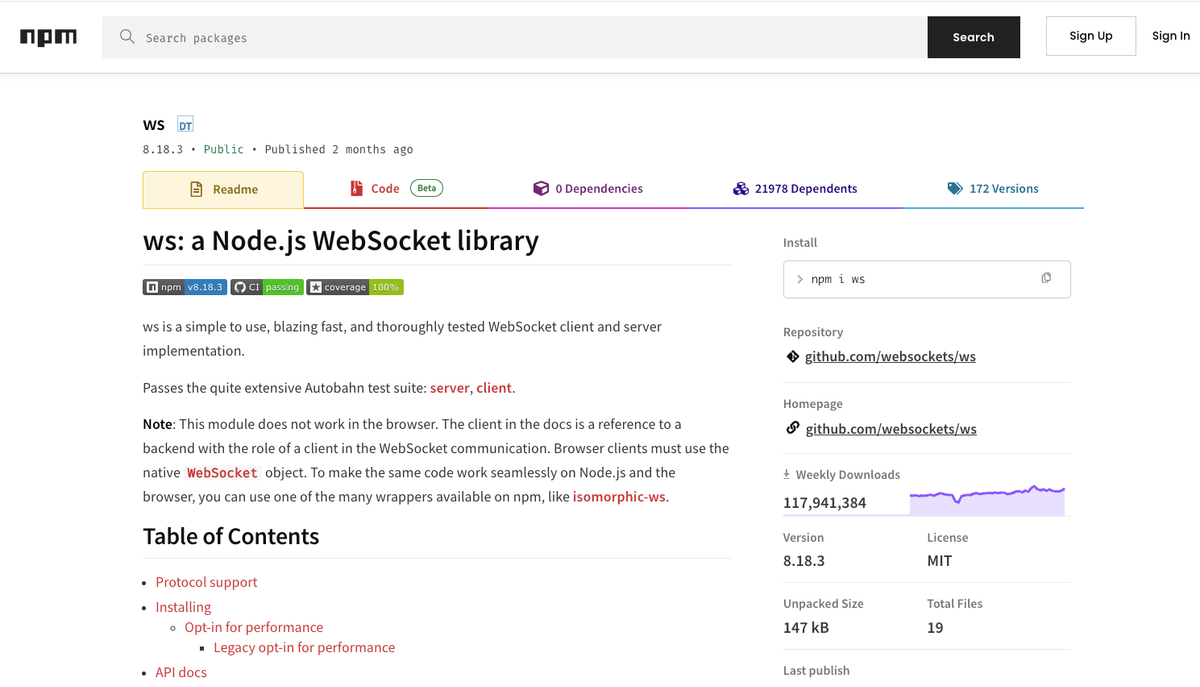
WS provides WebSocket client and server functionality for Node.js applications. It offers basic WebSocket protocol implementation with options for message compression and binary data handling. The library includes utilities for managing connections and sending messages between clients and servers.
This library focuses on standards compliance and minimal overhead, not high-level features. Developers get direct access to WebSocket protocol functionality without additional abstractions or proprietary extensions.
What WS offers:
- WebSocket server and client implementation following RFC 6455 specifications
- Binary and text message support with automatic frame handling
- Optional permessage-deflate compression to reduce bandwidth usage
- Basic connection event handling for open, close, and error states
- Ping/pong frame support for connection health monitoring
Pros:
- Strict RFC 6455 compliance with minimal overhead, predictable, debuggable behavior
- Full control over the raw WebSocket protocol for custom low-level implementations
- Optional permessage-deflate compression reduces bandwidth without extra abstractions
Community benchmarks suggest WS can handle over 100,000 concurrent connections on a single Node.js process with modest hardware, making it one of the most resource-efficient pure-JavaScript WebSocket options available.
Cons:
- No reconnection logic, room management, or fallback protocols, all must be hand-rolled
- Zero application-level features: presence, broadcasting, and comments require weeks of custom work
- Browser compatibility and network-failure handling are entirely the developer's responsibility
Bottom line:
Minimal WebSocket implementation that demands major custom development for production features.
3. Socket.IO
Socket.IO is a library that provides event-driven communication between web clients and servers. It includes automatic reconnection features and fallback protocols when WebSocket connections fail. The library supports broadcasting messages to multiple clients and organizing connections into rooms.
What socket.io offers:
- Automatic fallback to HTTP long polling when WebSocket connections fail
- Built-in reconnection with exponential backoff to handle network interruptions
- Room and namespace organization for grouping connections logically
- Cross-browser compatibility layer handling older browser limitations
- Event-based messaging system with JSON serialization
- Broadcasting features for sending messages to multiple clients simultaneously
Pros:
- Automatic reconnection with exponential backoff handles network interruptions without custom code
- HTTP long-polling fallback keeps connections alive in restrictive network environments
- Room and namespace support makes logical connection grouping straightforward
- Broad cross-browser compatibility layer out of the box
Socket.IO's protocol overhead, including its custom framing and HTTP long-polling handshake, adds latency compared to a bare WS connection under equivalent load, a trade-off worth considering for high-frequency message streams.
Cons:
- No application-level features, user presence, comments, and document sync must be built from scratch
- The fallback polling layer adds protocol overhead compared to pure WebSocket libraries
- Still requires extensive custom engineering to deliver complete, user-facing collaboration
Bottom line:
A powerful foundation for the networking layer, but not a shortcut to shipping the complete, user-facing collaborative experiences that modern apps require.
While Socket.IO solves connection management challenges, it doesn't provide application-level features like user presence, collaborative editing, or contextual comments that most real-time applications require. The comparison with modern solutions shows how much additional development remains necessary.
4. SockJS
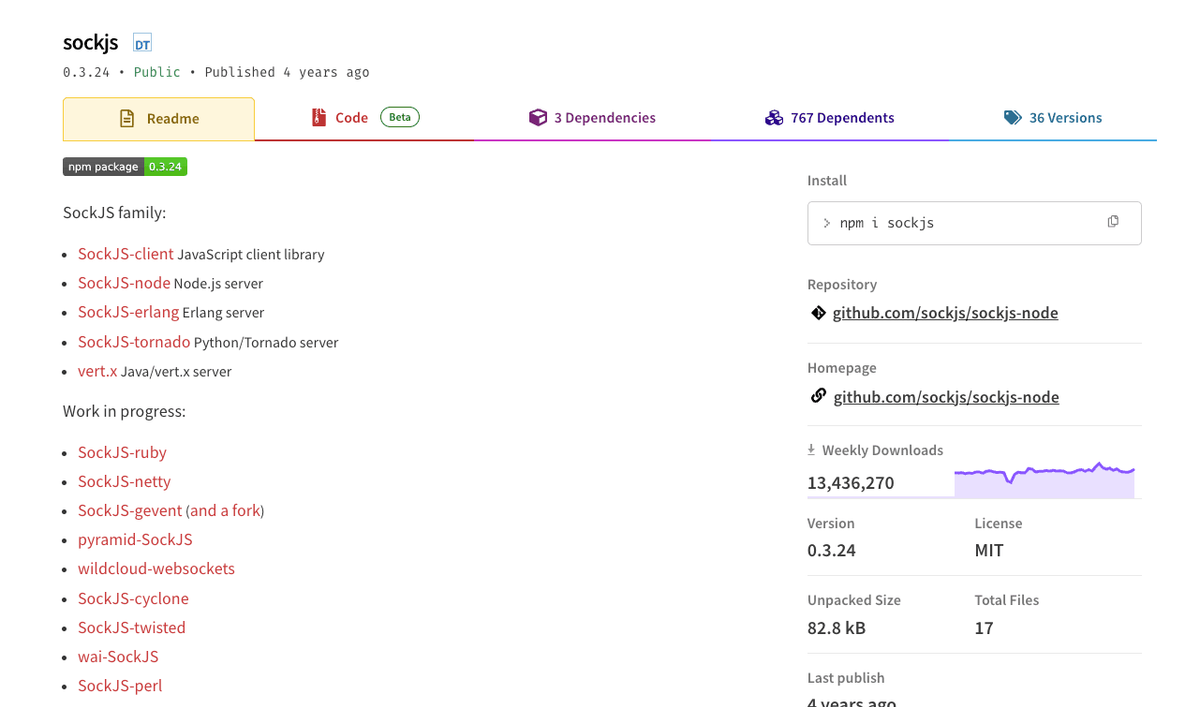
SockJS offers WebSocket-like functionality with automatic fallback to HTTP-based protocols. It provides browser compatibility for environments that block WebSocket connections. The library mimics the standard WebSocket API while supporting legacy browser versions.
The focus on compatibility made SockJS popular when WebSocket support was inconsistent across browsers and network infrastructure. It attempts to provide reliable real-time communication regardless of client features or network restrictions.
What sock.js offers:
- WebSocket API emulation maintaining familiar interface patterns
- HTTP long polling fallback for environments blocking WebSocket connections
- Legacy browser support extending back to Internet Explorer 6
- Cross-domain communication handling for complex deployment scenarios
- Transport protocol negotiation selecting optimal connection method automatically
Pros:
- Automatic transport negotiation picks the best available connection method without extra config
- Extends WebSocket reach to legacy environments and networks that block standard WebSocket connections
Cons:
- Development has effectively stalled, not recommended for new projects in 2026
- Limited to one connection per domain; no broadcasting or multiplexing support
- Solves browser-compatibility problems that are largely irrelevant in modern web development
Bottom line:
Outdated solution designed for problems that no longer exist in modern web development.
SockJS development has slowed down a lot as the problems it solved became less relevant. The modern examples show how current solutions provide better functionality with less complexity.
5. uWebSockets
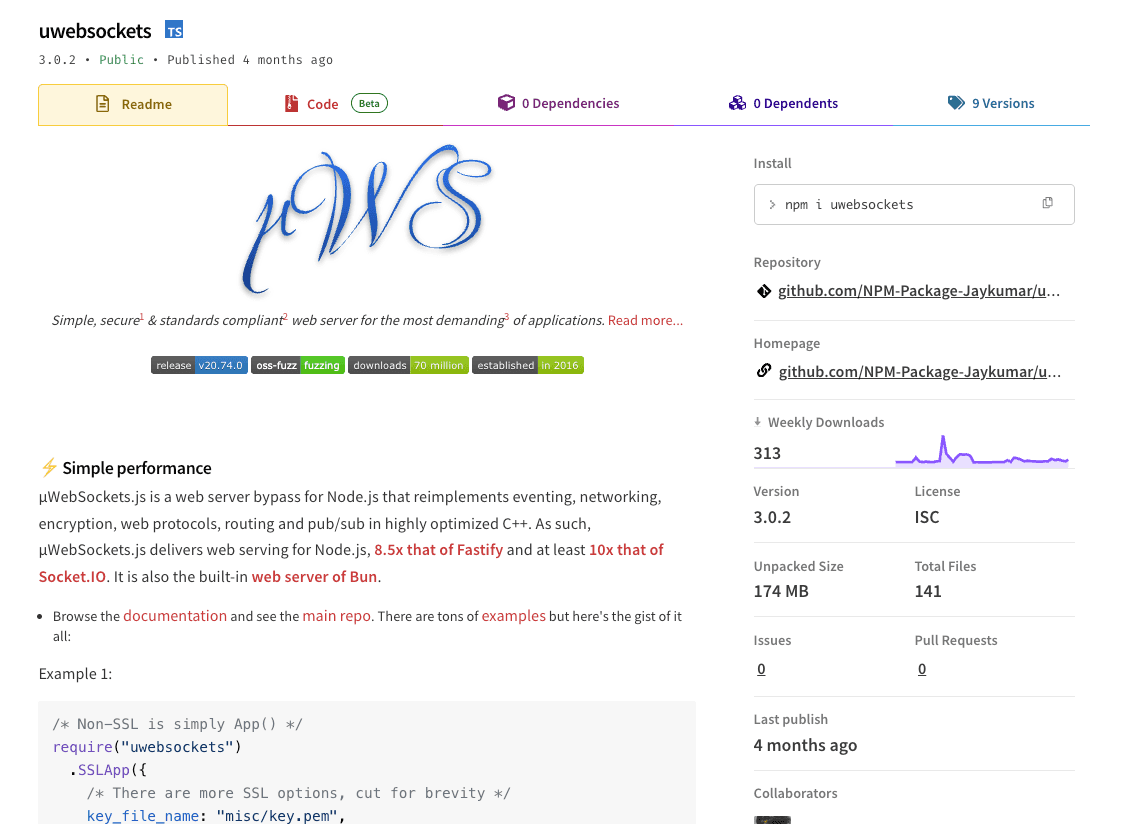
uWebSockets is a WebSocket server implementation focused on performance optimization. Written in C++ with Node.js bindings, it handles high-throughput message processing with minimal memory overhead. The library supports standard WebSocket protocols without additional abstractions.
The performance focus makes uWebSockets attractive for apps handling thousands of concurrent connections or processing high-frequency message streams. Benchmarks show major performance advantages over JavaScript-based implementations.
What uWebSockets offers:
- High-performance C++ implementation optimized for throughput and latency
- Minimal memory footprint reducing server resource requirements
- Standards-compliant WebSocket protocol without proprietary extensions
- Direct Node.js integration through native bindings
- HTTP server functionality integrated with WebSocket handling
Pros:
- C++ implementation delivers industry-leading throughput with minimal memory footprint
- Handles thousands of concurrent connections with low latency under heavy load
- Standards-compliant WebSocket protocol, no proprietary extensions to work around
Cons:
- Requires C++ compilation dependencies, complicating CI/CD and deployment pipelines
- No rooms, presence, or collaboration features, all application logic must be custom-built
- Custom development effort typically outweighs the performance gains for most production apps
Bottom line:
Performance-focused library that demands extensive custom development for application features.
6. Primus
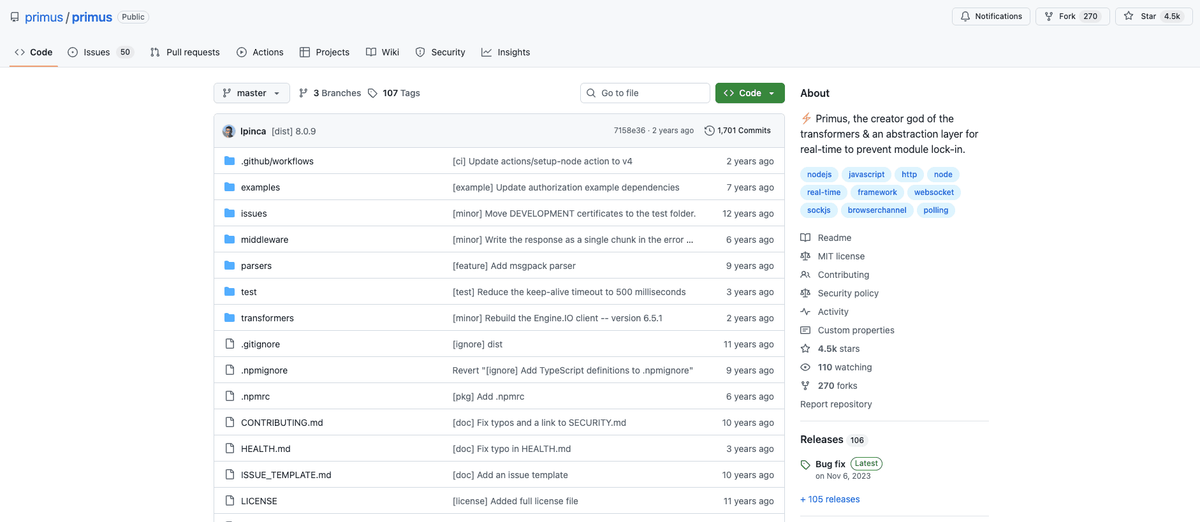
Primus functions as a wrapper library for other WebSocket implementations including WS, Socket.IO, and SockJS. It provides a unified API that allows switching between underlying transport methods. The library includes reconnection features and attempts to standardize different WebSocket library interfaces. However, the project has not been actively maintained for several years and is generally not recommended for new applications in 2026.
The abstraction approach aims to provide flexibility by allowing developers to change underlying WebSocket implementations without rewriting application code. This handles concerns about vendor lock-in or performance optimization needs.
What primus offers:
- Unified API across multiple libraries, reducing implementation-specific code
- Transport method switching that allows runtime optimization
- Built-in reconnection logic handling network interruption recovery
- Stream-compatible interface integrating with Node.js stream ecosystem
- Plugin system extending functionality through community modules
Pros:
- Unified API lets you swap underlying WebSocket transports (WS, Socket.IO, SockJS) without rewriting app code
- Built-in reconnection logic works across all supported transports
Cons:
- Not actively maintained, not recommended for new applications in 2026
- Adds an abstraction layer without fixing the feature gaps of the libraries it wraps
- Debugging is harder because issues can originate in Primus or the underlying transport, and docs cover both
Bottom line: An outdated abstraction layer that introduces debugging complexity and is no longer actively maintained or recommended for modern applications.
However, the meta-library approach introduces its own complexity without solving the fundamental limitations of the libraries it wraps. If the underlying library lacks broadcasting features, Primus doesn't add them. Performance characteristics depend entirely on the chosen transport.
Implementation: What the Code Actually Looks Like
Seeing the code side by side is the clearest way to understand what each approach costs in engineering time.
Raw WS, full control, full responsibility:
const WebSocket = require('ws');
const wss = new WebSocket.Server({ port: 8080 });

wss.on('connection', (ws) => {
  ws.on('message', (message) => {
    // Manual broadcast — no rooms, no filtering built in
    wss.clients.forEach((client) => {
      if (client !== ws && client.readyState === WebSocket.OPEN) {
        client.send(message.toString());
      }
    });
  });
  // No reconnection logic, no presence, no comments, no audit trail
});
Socket.IO, reconnection and rooms out of the box, no collaboration UI:
const { Server } = require('socket.io');
const io = new Server(3000);

io.on('connection', (socket) => {
  socket.join('team-room');
  socket.on('message', (msg) => {
    socket.to('team-room').emit('message', msg);
  });
  // Still no presence indicators, comments, or approval workflows
});
Velt, comments, presence, and approval workflows in a few lines:
import { VeltProvider, VeltComments, VeltPresence } from '@veltdev/react';

function App() {
  return (
    <VeltProvider apiKey="YOUR_API_KEY">
      <VeltPresence />
      <VeltComments />
      {/* Comments, presence, and approval workflows ship on day one */}
      <YourApp />
    </VeltProvider>
  );
}
The WS and Socket.IO examples cover the connection layer only. The Velt example ships contextual comments, live presence, and approval workflows as production-ready features your users can interact with on day one.
WebSocket Library Feature Comparison
| Feature | Velt | WS | Socket.IO | SockJS | WebSockets | Primus |
|---|---|---|---|---|---|---|
| Built-in Collaboration | ✅ | ❌ | ❌ | ❌ | ❌ | ❌ |
| Auto Reconnection | ✅ | ❌ | ✅ | Handled client-side | ❌ | ✅ |
| Fallback Protocols | ✅ | ❌ | ✅ | ✅ | ❌ | Via Transport |
| Framework Support | All Major | Node.js Only | All Major | All Major | Node.js Only | Node.js Only |
| Production Scale | All-in-One Managed ServiceCustom High-Throughput Systems | Feature-Rich Connection Management | Legacy Browser Support | Extreme Performance (Niche) | (Outdated Abstraction) |
This comparison shows how traditional WebSocket libraries require extensive custom development while Velt provides complete real-time collaboration functionality out of the box. Most alternatives focus solely on connection management, leaving developers to build application-level features themselves.
Enterprise scalability varies dramatically between solutions. Basic libraries handle simple use cases but struggle with the complexity of real-world collaborative applications. The developer tools and infrastructure requirements differ greatly between approaches.
Framework support limitations affect architectural flexibility. Libraries that only work with Node.js servers create constraints for teams using different technology stacks or planning future migrations.
Final thoughts on choosing WebSocket libraries for real-time applications
Building real-time applications shouldn't consume months of your development time fighting with connection management and reconnection logic. While basic libraries like WS and Socket.IO handle the networking layer, they leave you building every user-facing feature from scratch. Velt is review and approval infrastructure for SaaS products: it ships the comments, approval workflows, presence, notifications, audit trails, and recording that belong on top of those connections, so your team spends time on product logic instead of rebuilding infrastructure from scratch.
FAQs
What is the difference between a WebSocket library and a WebSocket service?
A WebSocket library (e.g., WS, Socket.IO) handles the connection layer: opening sockets, routing messages, and managing reconnects. A WebSocket solution like Velt builds on that foundation to deliver application-level features: presence, comments, notifications, and document sync. Libraries give you a pipe; full-stack solutions give you a working collaboration layer.
Is Socket.IO still relevant in 2026?
Yes, for connection management. Socket.IO's automatic reconnection, HTTP long-polling fallback, and room support remain useful for teams that need a reliable networking layer. It doesn't provide application-level collaboration features, so you'll still need to build presence, comments, and sync yourself.
When should I use a managed WebSocket service instead of a self-hosted library?
Use a managed service when your roadmap includes collaboration features (presence, comments, approvals) and you can't afford 3 to 6 months of custom engineering to build them. Self-hosted libraries make sense when you need full protocol control, have strict data-residency requirements, or are building a highly specialized low-level system.
Can I self-host a real-time collaboration solution?
Velt offers data-residency self-hosting options, giving compliance-sensitive teams control over where data lives without sacrificing the pre-built collaboration layer. Pure self-hosting, running the entire stack yourself, is possible with libraries like WS or Socket.IO, but requires building every application feature from scratch.
Which WebSocket solution scales to millions of connections?
For raw connection throughput, uWebSockets is the benchmark leader thanks to its C++ core, but it ships no application features, so scaling the connection layer is just the starting point.