Most collaborative text editing platforms make you choose between flexibility and speed. You can either get low-level APIs that require weeks of frontend development, or you can get pre-built solutions that only work with specific editors and content types.
TLDR:
Document collaboration platforms split into infrastructure-only (Liveblocks, Pusher) vs. full-stack solutions (Velt) that include both backend and pre-built UI components
Liveblocks supports specific text editors (Tiptap, BlockNote, Lexical) while Velt works across any content type including documents, designs, videos, and dashboards
Velt offers self-hosted deployment and SOC 2 Type II compliance for regulated industries, unlike cloud-only alternatives
Velt's SDK includes AI-powered features like automatic comment categorization, voice transcription, and contextual copilots that work across your entire application
What is Liveblocks?
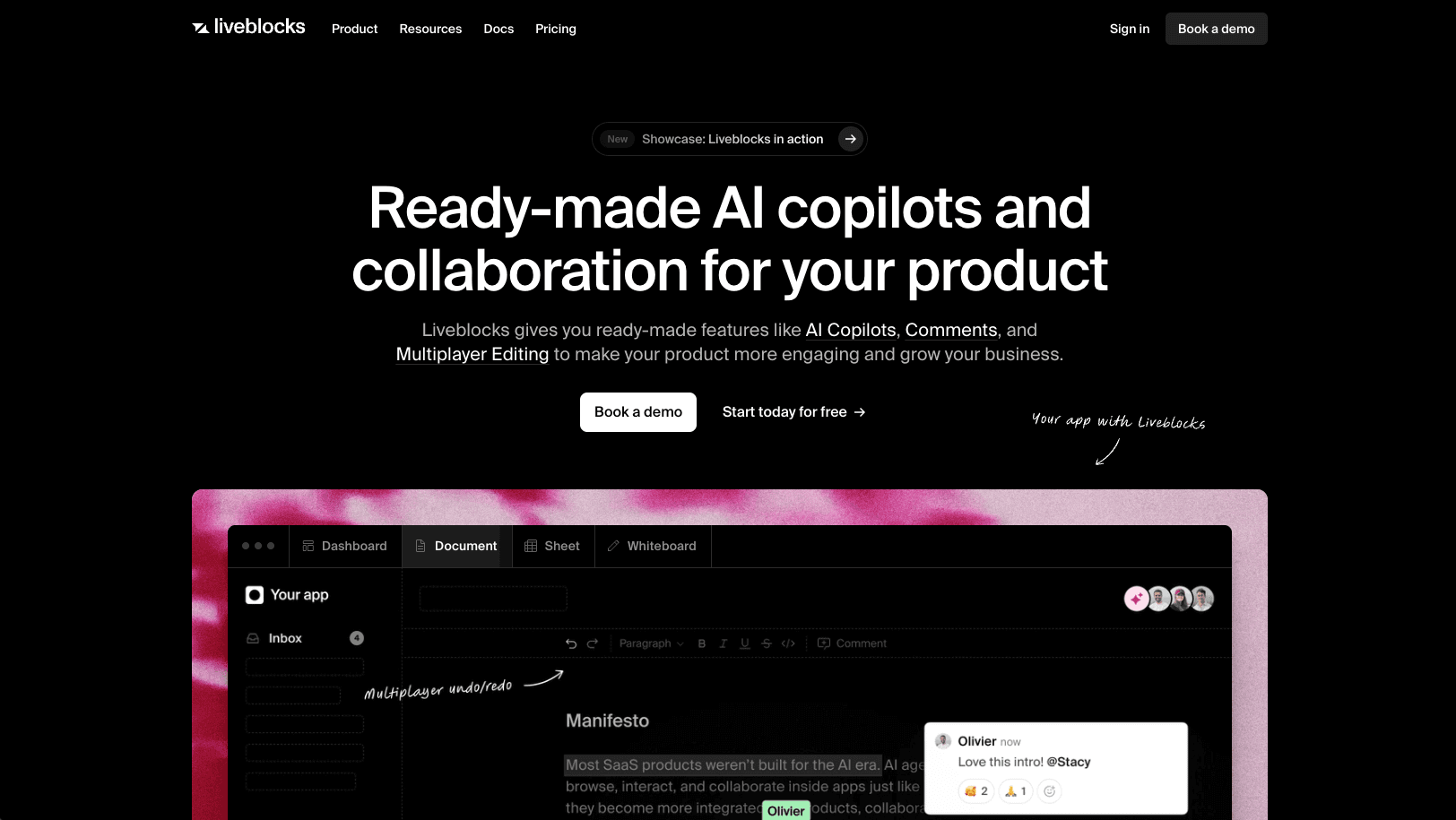
Liveblocks provides real-time collaboration infrastructure for developers building multiplayer web applications. The service handles backend infrastructure and offers frontend components for document collaboration and real-time sync.
Key Features
The Liveblocks offering includes a number of pre-built components you can customize:
AI Copilots for text assistance
Comments for contextual feedback
Multiplayer Editing for simultaneous document work
Presence indicators to show active users, and
Notifications for collaborative activity.
Focus
The service targets developers building collaborative text editing experiences and document-based applications. Liveblocks manages real-time data synchronization infrastructure, letting engineering teams focus on core product development instead of building collaboration features from scratch.
The Bottom Line
Their approach provides the foundational layer for collaborative features. You receive real-time infrastructure and some UI components, but you'll build substantial portions of the user interface and interaction logic to match your specific application requirements.
What is Velt?

Velt is a JavaScript SDK that adds collaborative features to web applications.
Key Features
The Velt SDK includes a number of pre-built components:
Contextual comments,
Real-time co-editing with live cursors,
Screen and voice recording with AI transcription,
In-app voice and video huddles, and
Notification systems with @mentions.
Focus
Velt handles both backend infrastructure and frontend UI components.
The Bottom Line
The components are customizable and work across document editors, design tools, analytics dashboards, and project management software.
The Criteria For Comparison
We looked at each solution in a number of key categories:
Real-time document editing and sync
Infrastructure and UI components
Comments and annotations
Presence and live cursors
Ai integration and automation
Enterprise security and compliance
Real-Time Document Editing and Sync
Liveblocks focuses on real-time data synchronization for specific text editors. The service integrates with Tiptap, BlockNote, and Lexical through Yjs, providing collaborative rich-text editing infrastructure with threads and comments. For text-heavy applications using these supported editors, Liveblocks handles backend persistence and sync without separate database infrastructure. The tradeoff appears when you need collaboration beyond these text editors. You'll build most UI components and interaction patterns yourself. Organizations wanting collaborative features across different content types write custom code for each use case.
Velt, though, supports any editor framework or content type. The SDK delivers synchronization capabilities alongside pre-built UI components, leveraging Yjs behind the scenes. You can add contextual commenting to text ranges in any rich text editor, pin annotations to design elements, mark up spreadsheet cells, or timestamp video feedback using the same API structure. This flexibility helps when your application includes multiple content types requiring collaboration. Instead of maintaining separate implementations for each context, Velt handles document collaboration across your entire application with consistent user experiences.
Infrastructure and UI Components
Liveblocks provides real-time data infrastructure and synchronization APIs. Developers get the backend foundation but handle all frontend development, including presence displays and edge case handling for offline states and conflict resolution. The system does provide lightweight components for comment interfaces and notification systems. Liveblocks works well for teams with frontend resources and specific design needs, but expect weeks of development creating UI components, styling interaction states, and testing collaborative scenarios.
Velt, on the other hand, includes both infrastructure and pre-built UI components for comments, notifications, presence indicators, and recording. These ship with default styling customizable through theming to match your design system. For deeper control, headless mode provides access to underlying APIs and data while you build custom interfaces.
Comments and Annotations
Liveblocks provides a Comments component that connects to their real-time infrastructure. You'll need to build your own notification delivery, resolution workflows, and filtering logic around the base component
Velt's commenting system, though, anchors feedback to specific locations in your application, including text selections, UI elements, or coordinates. The system includes threaded replies, @mentions, resolution states, and priority levels. AI automatically categorizes comments as bug reports, feature requests, or general feedback, while analytics track comment views and engagement.
Presence and Live Cursors
Liveblocks delivers presence awareness through its Presence API, displaying active user avatars and tracking cursor positions in real time. The service shows collaborator selections and cursor movements within supported text editors.
Contrasting, Velt's presence system works across your entire application beyond text editing surfaces. The SDK tracks active users, cursor positions, and selections on any content type or interface element. Users see who's viewing a dashboard, hovering over a design element, or moving through different sections of your application. The presence indicators connect with Velt's huddle feature for immediate voice or video conversations.
AI Integration and Automation
For high comment volumes, AI organization surfaces relevant feedback and groups related discussions automatically, helping teams identify patterns across user input. The two solutions approach this slightly differently.
Liveblocks includes AI Copilots that deliver text assistance within collaborative editing environments. Users report accurate suggestions that function during active team editing sessions.
Velt integrates AI capabilities throughout its SDK. Voice and video recordings receive automatic transcription and summaries, letting teams review feedback quickly. AI categorization analyzes comment content and applies tags like "bug report" or "feature request" without manual input. The contextual AI copilot accepts natural language prompts directly inside your application. Users can request text rewrites, edit suggestions, or intelligent modifications without switching tools.
Enterprise Security and Compliance
Security and compliance are critical characteristics for any document collaboration process. Both Liveblocks and Velt provide these features:
Liveblocks offers SOC 2 and HIPAA compliance with a 99.9% uptime guarantee for most business applications running standard cloud deployments. The service provides secure data transfer and storage through hosted infrastructure. The absence of self-hosted options creates constraints for organizations with strict data residency requirements. Companies in regulated industries that need control over where collaboration data resides cannot meet these requirements with Liveblocks' cloud-only approach.
Velt provides SOC 2 Type II compliance and HIPAA BAA signing for regulated industries. Velt provides 99.999% uptime guarantee to Enterprise customers. Self-hosted deployment options let you run collaboration infrastructure in your own cloud environment or specific regions. Fine-grained access controls determine who can view or comment on content, with full feature parity across cloud and on-premises deployments.
Why Velt is the Better Choice
The collaboration software market will reach $32.25 billion by 2030, driven by demand for tools that support teamwork inside applications. While workers lose 7.47 hours weekly to collaboration challenges and context-switching between tools, Velt solves these challenges by embedding collaboration directly into any application. The SDK integrates without requiring architectural changes or framework restrictions, letting teams of any size add collaborative features that scale with their needs.
Final thoughts on collaboration software for developers
Your application needs real-time document sync that works across every content type, not specific text editors. Velt gives you the full stack for collaboration without the weeks of custom UI development or the limitations of editor-specific solutions. You can add comments, live cursors, and voice feedback anywhere in your app and ship collaboration features your users actually want.
FAQ
How do I add collaborative editing to a custom document application?
Choose an SDK that supports your editor framework and content types. Velt works with any editor through its flexible API, while Liveblocks requires specific editors like Tiptap or Lexical with Yjs integration.
What's the difference between infrastructure-only and full-stack collaboration solutions?
Infrastructure-only solutions provide backend sync and APIs but require you to build all UI components yourself. Full-stack solutions like Velt include pre-built, customizable UI components for comments, presence, and notifications alongside the backend.
When should I consider self-hosted deployment for collaboration features?
If your organization operates in regulated industries (healthcare, finance) or has strict data residency requirements, Velt provides an option to store your collaboration data in your own cloud environment to maintain compliance.
Can I use the same collaboration SDK across different content types in my application?
Velt's SDK works across text editors, design canvases, analytics dashboards, and other content types with consistent APIs. Solutions focused on specific editors may require separate implementations for different collaboration contexts.
How long does it take to implement real-time collaboration features?
With pre-built UI components, implementation takes days to weeks depending on customization needs. Building from infrastructure-only solutions typically requires several weeks to months of frontend development for comments, notifications, and presence indicators.