

Best Multi-Framework Collaboration SDKs for React, Vue & Angular in December 2025
Compare the best multi-framework collaboration SDKs for React, Vue, and Angular in December 2025. See features, pricing, and why Velt leads with 25+ tools.
You need collaboration features in your app, but your team uses multiple frameworks. Building separate implementations for React, Vue, and Angular means triple the work and triple the bugs. A collaboration stack for B2B that supports all your frameworks lets you add comments, presence, and notifications once. Same features, same behavior, no matter which framework you're running.
TLDR:
- Multi-framework collaboration SDKs add real-time features like comments and presence across React, Vue, Angular, and vanilla JavaScript without months of custom development
- Most alternatives like Liveblocks and Ably provide backend APIs only, requiring you to build all frontend UI components from scratch
- Velt is a complete collaboration SDK with comments, presence, huddles, recordings, notifications, and AI features that work across all major JavaScript frameworks
What is a Multi-Framework Collaboration SDK?
A multi-framework collaboration SDK is a developer tool that adds real-time collaborative features to web apps across React, Vue, Angular, or vanilla JavaScript. These SDKs handle features like in-app comments, live presence indicators, multiplayer editing, and notifications. Building these features from scratch takes months of development work. You'd need to architect real-time infrastructure, handle conflict resolution, design UI components, and test across different user scenarios. These tools provide backend infrastructure and frontend UI components. You get WebSocket connections, data synchronization, and user management alongside ready-to-use comment boxes, presence avatars, and notification menus.
How We Ranked Multi-Framework Collaboration SDKs
We assessed each SDK against criteria that matter for production apps. The collaboration software market is growing rapidly, which makes choosing the right foundation critical for long-term success. Here's what we looked at:
- Feature breadth: Whether it covers comments, presence, cursors, notifications, and recordings, or just one piece of the puzzle.
- Framework support: Whether you can integrate it across React, Vue, Angular, and vanilla JavaScript with feature parity and consistent behavior, or if certain frameworks are treated as second-class citizens requiring workarounds or custom implementations.
- Infrastructure and UI: Whether it provides ready-to-use components or just backend APIs that require custom frontend work.
- Pricing model: Whether it's based on actual collaborators (MAC) or all users (MAU).
- Reliability: What uptime guarantees and SLAs are offered.
- Data control: Whether you can self-host data or bring your own cloud storage.
- Security compliance: Whether it meets SOC 2, HIPAA, or GDPR requirements.
- AI capabilities: Whether there are built-in AI features for tagging, summaries, or automation.
We based this comparison on public documentation, pricing pages, and technical specs from each provider.
Best Overall Multi-Framework Collaboration SDK: Velt
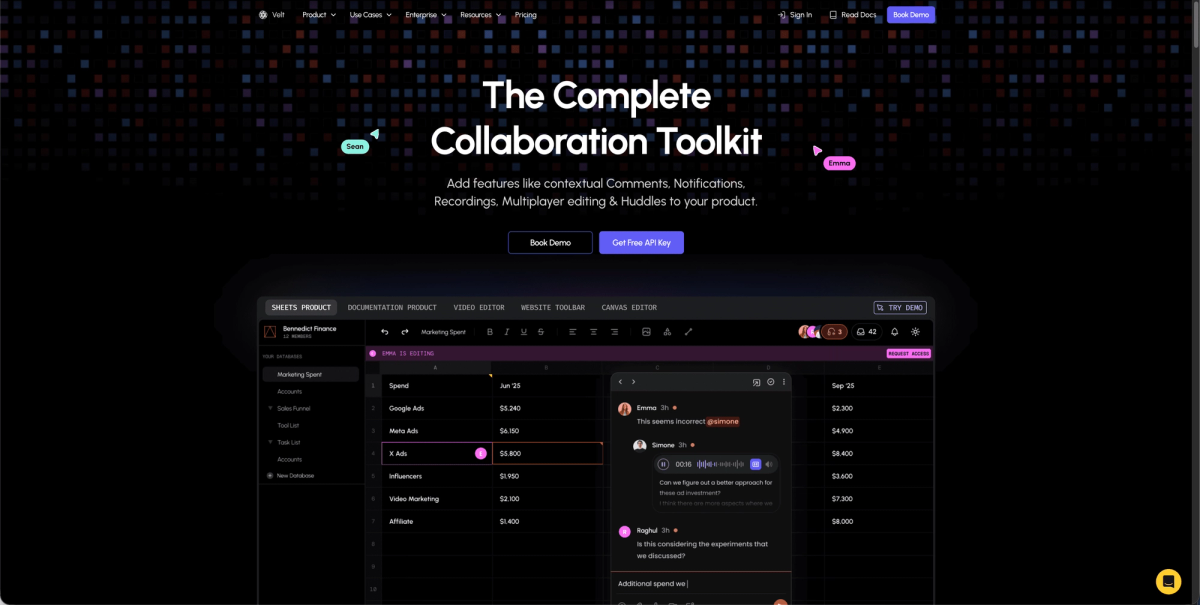
Velt provides over 25 collaboration features that work across React, Vue, Angular, and vanilla JavaScript. You get contextual comments, real-time presence, co-editing, voice/video huddles, screen recordings with AI transcription, in-app notifications, and an AI copilot. The SDK includes both backend infrastructure and frontend UI components. It handles WebSocket connections, conflict resolution through Yjs and CRDT tech, and Firebase-backed infrastructure while delivering customizable UI components.
The multi-framework architecture prevents compatibility issues as your tech stack changes. You can deploy using managed hosting, bring your own real-time infrastructure, or store collaboration data in your own cloud with self-hosting options for compliance-sensitive industries.
Velt includes 99.999% uptime guarantees and SOC 2 Type II and HIPAA certifications. The pricing model charges only for Monthly Active Collaborators who perform collaboration actions, not every user who connects. This MAC-based approach typically costs 80% less than MAU-based pricing since only about 20% of users actively collaborate in most apps.
Tiptap
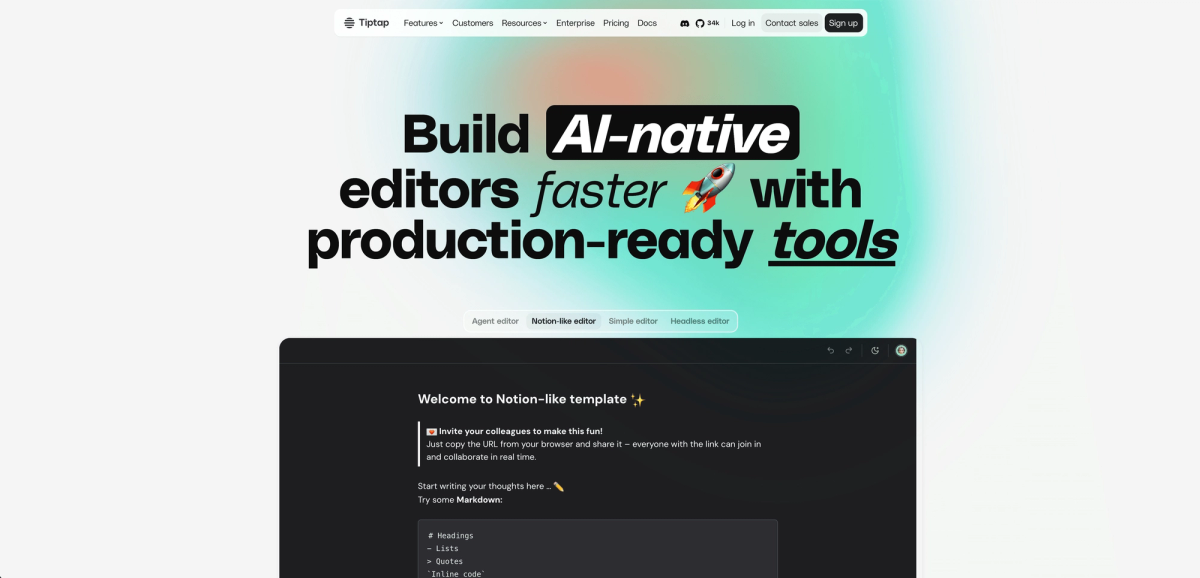
Tiptap is a headless rich text editor framework that includes collaboration features for text editing experiences. The platform provides consistent support across React, Vue, Angular, and vanilla JavaScript for its core editor, but collaboration capabilities are confined to the text editing environment rather than extending across your entire application.
Key Features
Tiptap provides a number of collaboration features:
- Real-time multiplayer text editing with Yjs integration for document sync across React, Vue, Angular, and vanilla JavaScript
- Basic commenting functionality within the editor environment
- Version history and snapshot comparison for document management
- Content AI features for text transformation and grammar assistance within the editor
Limitations
While Tiptap supports React, Vue, Angular, and vanilla JavaScript for its core editor, the collaboration features are limited to text editor experiences and don't extend to the rest of your app. You won't get features for notifications, presence indicators outside the editor, huddles, recordings, or collaboration primitives for non-text elements. The SDK charges per document instead of per collaborator and relies on standard WebSockets which can lead to dropped data. Tiptap doesn't support collaboration data self-hosting for enterprises with strict data residency requirements.
Best For
Development teams building document-centric apps like knowledge bases or content management systems where the primary collaboration happens inside a rich text editor, regardless of their JavaScript framework choice. For teams needing collaborative experiences that extend beyond document editing to include notifications, huddles, and AI features across all content types, Velt provides broader coverage.
Liveblocks
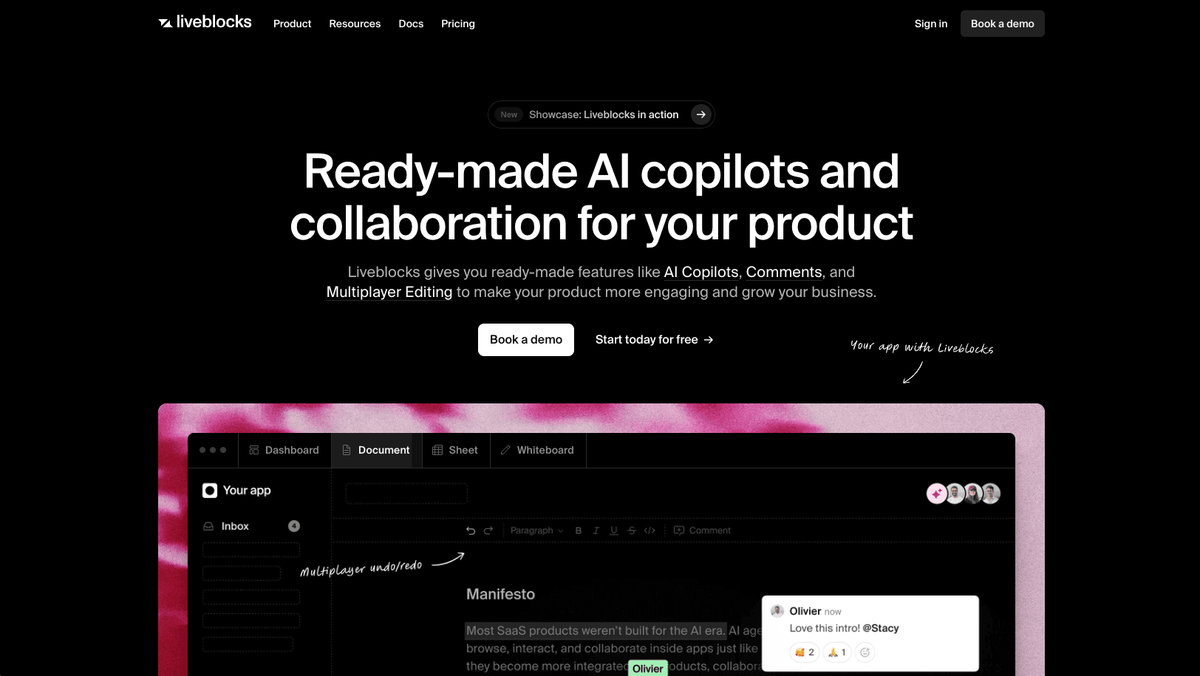
Liveblocks provides real-time collaboration infrastructure focused on backend services for building multiplayer features. The platform is built primarily for React, with limited support for other JavaScript frameworks, making it less suitable for teams using Vue, Angular, or vanilla JavaScript.
Key Features
Liveblocks provides a number of collaboration features:
- Backend infrastructure for real-time data synchronization using WebSockets
- Presence tracking and cursor positioning APIs for multiplayer experiences
- Lightweight components requiring frontend customization
- CRDT-based conflict resolution for concurrent editing
Limitations
Liveblocks provides backend infrastructure, requiring developers to build frontend UI components from scratch including comment threads, notification systems, and user avatars. The framework support is heavily React-focused, with minimal or experimental support for Vue, Angular, and vanilla JavaScript. This makes it challenging for teams working across multiple frameworks or planning to migrate their tech stack in the future. The pricing model charges per MAU with frequent pricing changes, creating unpredictability for enterprise customers planning long-term budgets. Dynamic anchoring and positioning for comments must be implemented manually. Liveblocks offers 99.9% uptime and doesn't support data self-hosting for compliance requirements.
Best For
React-focused engineering teams with frontend resources who want control over UI implementation and need flexible real-time infrastructure for custom collaborative experiences. Teams requiring robust support for Vue, Angular, or vanilla JavaScript, or those working across multiple frameworks, should consider alternatives with broader framework compatibility like Velt.
Ably
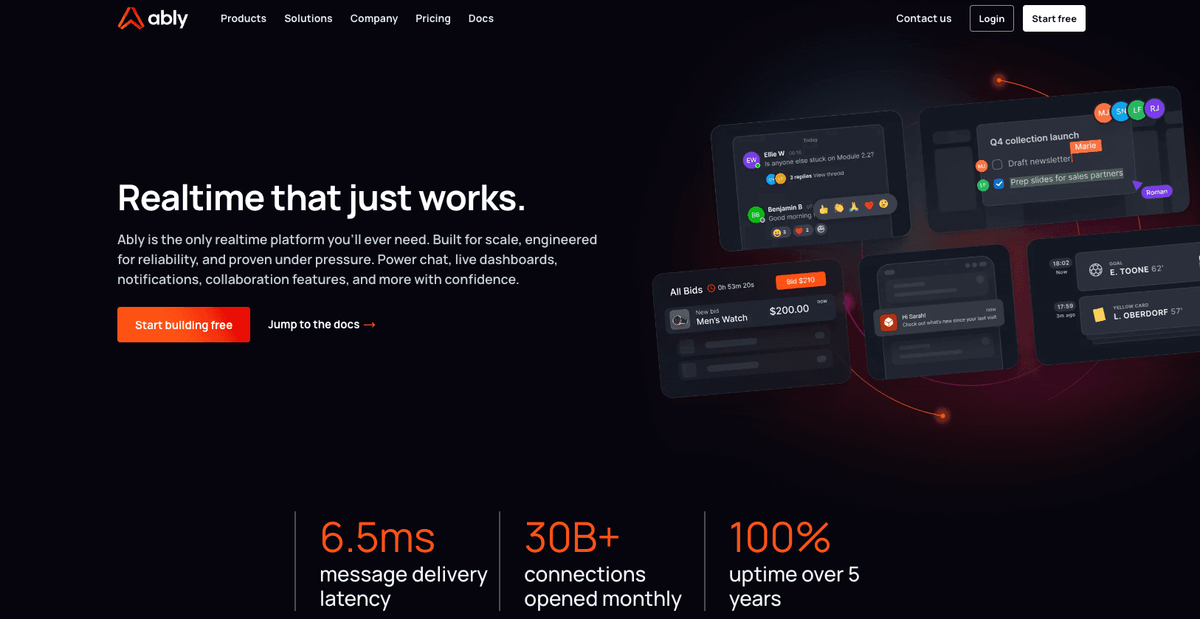
Ably is a real-time messaging infrastructure offering pub/sub capabilities and presence features across multiple protocols and programming languages. While Ably provides SDKs for React, Vue, Angular, and vanilla JavaScript, it operates at the infrastructure level without framework-specific UI components, requiring teams to build their own collaboration interfaces for each framework they support.What they offer
Ably provides a number of collaboration features:
- Real-time pub/sub messaging with WebSocket and MQTT support for bidirectional communication across clients
- Presence tracking and channel-based communication infrastructure that shows online/offline status
- Message history and persistence for asynchronous collaboration workflows
- Multi-language SDKs across JavaScript (including React, Vue, Angular, and vanilla JavaScript), Python, Ruby, Java, and Go
Limitations
While Ably supports all major JavaScript frameworks through its multi-language SDK approach, it provides infrastructure without collaboration UI components or higher-level features like comments, notifications, or document collaboration. Building a complete collaboration experience requires custom development of all user-facing features and coordination logic for each framework you support. The service doesn't include specialized collaboration primitives like conflict resolution for concurrent editing or document anchoring, meaning you'll need to implement these features separately for React, Vue, Angular, or vanilla JavaScript.
Best For
Backend-focused teams building custom real-time messaging systems or IoT apps requiring low-level control over message routing and protocol handling across multiple programming languages. Teams needing ready-to-use collaboration UI components that work consistently across JavaScript frameworks should consider Velt.
Feature Comparison Table of Multi-Framework Collaboration SDKs
Here's how the leading multi-framework collaboration SDKs compare across core capabilities:
| Feature | Velt | Tiptap | Liveblocks | Ably |
|---|---|---|---|---|
| Comments and Annotations | ✓ | In-editor comments | ✓ | Backend only (no built-in UI) |
| Real-Time Presence and Cursors | ✓ | ✓ (editor) | ✓ | ✓ |
| Multiplayer Editing (CRDT) | ✓ | ✓ | ✓ | Requires custom implementation |
| Notifications System | ✓ | Not available | ✓ | Via SDK |
| Audio/Video Huddles | ✓ | Not available | Not available | Not available |
| Screen Recording | ✓ | Not available | Not available | Not available |
| AI Features | ✓ | Content AI only | AI Agents | Not available |
| Pre-Built UI Components | ✓ | Editor only | ✓ (limited) | Not available |
| Framework Support | React, Vue, Angular, Vanilla JS | React, Vue, Angular, Vanilla JS | React, JavaScript (limited) | Multi-language |
| Data Self-Hosting | ✓ | ✓ | Not available | Not available |
| Enterprise Uptime SLA | 99.999% | Not disclosed | 99.9% | 99.999% |
| Pricing Model | MAC | Per document | Per document | MAU / usage-based |
Why Velt is the Best Multi-Framework Collaboration SDK
We built Velt as a complete collaboration stack because teams were either combining multiple tools or spending months building features internally. You get infrastructure and ready-to-use UI components alongside AI-powered features like auto-tagging and transcription. The multi-framework support keeps your collaboration layer intact through tech stack changes. Whether you're running React today and Vue tomorrow, the same SDK works without rebuilding features.
The multi-framework support isn't just about compatibility—it's about consistency. Whether your team uses React, Vue, Angular, or vanilla JavaScript, you get the same features, the same APIs, and the same behavior. You're not dealing with a primary framework that gets all the features and secondary frameworks that get experimental support. This matters when your frontend team uses different frameworks across products, or when you're migrating from one framework to another.
Deployment flexibility matters for enterprise buyers. You can use our managed hosting, bring your own real-time infrastructure, or store collaboration data in your own cloud. Combined with SOC 2 Type II and HIPAA compliance, this gives you the control regulated industries require.
The MAC pricing model charges only for users who actually collaborate, typically saving 80% compared to MAU-based alternatives. Most apps see around 20% of connected users performing collaboration actions, so you're not paying for passive viewers.
Final thoughts on multi-framework collaboration tools
A collaboration SDK that supports React, Vue, Angular, and vanilla JavaScript gives you flexibility as your tech stack changes over time. You skip months of building real-time infrastructure, conflict resolution, and UI components from scratch. The best options include both backend services and frontend components with deployment flexibility for compliance requirements. Focus on SDKs that charge for active collaborators instead of all users to keep costs reasonable as you scale.
FAQ
Which multi-framework collaboration SDK is best for teams with limited frontend resources?
Velt provides both backend infrastructure and pre-built UI components, making it the fastest option for teams without dedicated frontend developers. Liveblocks and Ably require building all UI components from scratch, while Tiptap's components only work within text editors.
How do I choose between MAC-based and MAU-based pricing for collaboration SDKs?
MAC (Monthly Active Collaborator) pricing charges only for users who perform collaboration actions like commenting or editing, while MAU (Monthly Active User) pricing charges for all connected users. Since only about 20% of users typically collaborate actively, MAC-based pricing usually costs 80% less for the same usage.
Can I self-host collaboration data for compliance requirements?
Velt supports storing collaboration data in your own cloud while using their managed infrastructure. Liveblocks, Ably, Tiptap, and Firebase don't offer data self-hosting options, which can be a blocker for regulated industries with strict data residency requirements.
What's the difference between collaboration infrastructure and a complete collaboration SDK?
Infrastructure tools like Ably and Firebase provide real-time messaging and data sync but require you to build all collaboration features (comments, notifications, presence indicators) and UI components yourself. Complete SDKs like Velt include ready-to-use collaboration features and UI components alongside the infrastructure.
Which collaboration SDK works best for apps beyond document editing?
Velt supports collaboration across your entire app including comments, huddles, recordings, and notifications for any content type. Tiptap focuses on text editor collaboration, while Liveblocks provides infrastructure that requires custom implementation for each feature you need.
What does "multi-framework support" really mean for collaboration SDKs?
True multi-framework support means the SDK provides the same features, APIs, and UI components across React, Vue, Angular, and vanilla JavaScript without treating any framework as secondary. Some providers offer "support" for multiple frameworks but only provide full-featured components for React, requiring custom implementation for other frameworks. Velt provides feature parity across all major JavaScript frameworks, so your collaboration experience remains consistent regardless of your tech stack.