

Tiptap Cloud vs Velt: Which Collaboration SDK Fits Your App in December 2025?
Compare Tiptap Cloud and Velt for collaboration features. Velt offers comments, multiplayer editing, and notifications across any DOM element vs Tiptap's editor-only approach.
You need collaboration features in your app, and you're stuck deciding between Tiptap Cloud and something more flexible. Velt approaches this differently: instead of tying collaboration to just the text editor, we built a multiplayer editing, commenting and notifications SDK that works across your entire app. Tiptap Cloud excels at document-based multiplayer editing, but if your app goes beyond text fields, you'll want to understand the tradeoffs.
TLDR:
- Tiptap Cloud limits collaboration to text editors, while Velt works across any DOM element in your app
- Velt charges only for active collaborators (MAC), typically 20% of MAUs, versus TipTap's connection-based pricing
- You can self-host collaboration data with Velt while keeping managed infrastructure for sync
- Velt includes pre-built UI components for comments, notifications, and presence out of the box
- Velt offers a JavaScript SDK that adds 25+ collaboration features to any web app with built-in commenting and notifications
What is Tiptap Cloud?
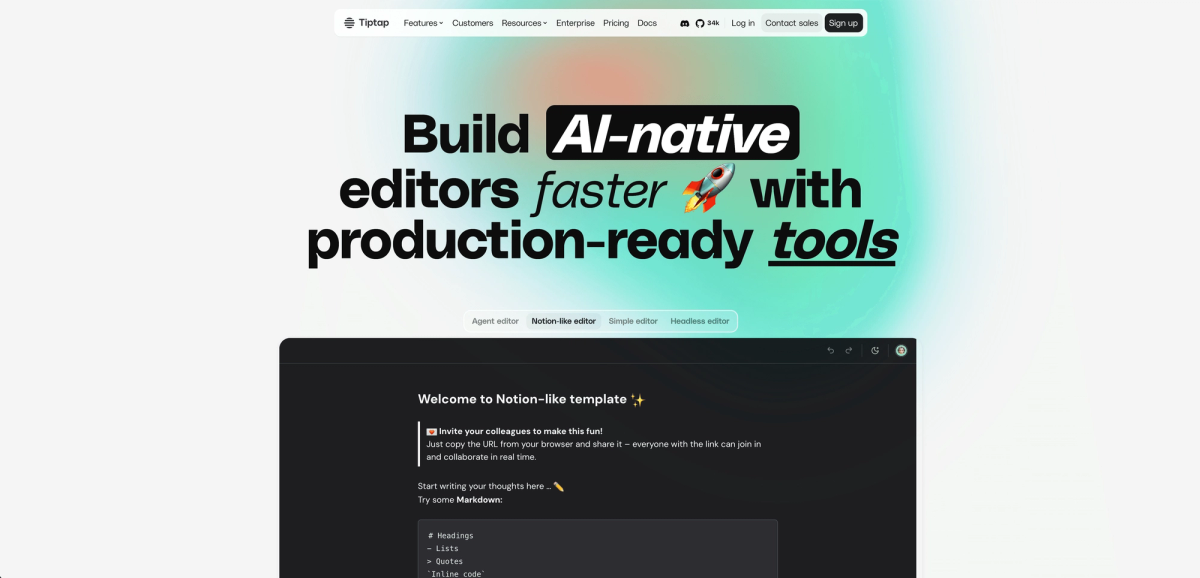
Tiptap acts as a headless wrapper for ProseMirror, letting devs build rich text editors with custom UIs. To add realtime capabilities, teams often integrate Tiptap Cloud. This managed service handles the backend infrastructure needed to sync document states instantly across users. The core collaboration tech depends on Yjs, a high-performance CRDT library. Tiptap Cloud manages WebSocket connections via their Hocuspocus server, supporting multiplayer editing where cursors and text changes render live. It turns a standard text field into a shared document experience.
This architecture targets editor frameworks, coupling collaboration tightly to the document. Using Tiptap Cloud requires storing document data within their ecosystem to manage sync. This fits document-heavy apps but creates a rigid dependency on their cloud storage model.
What is Velt?
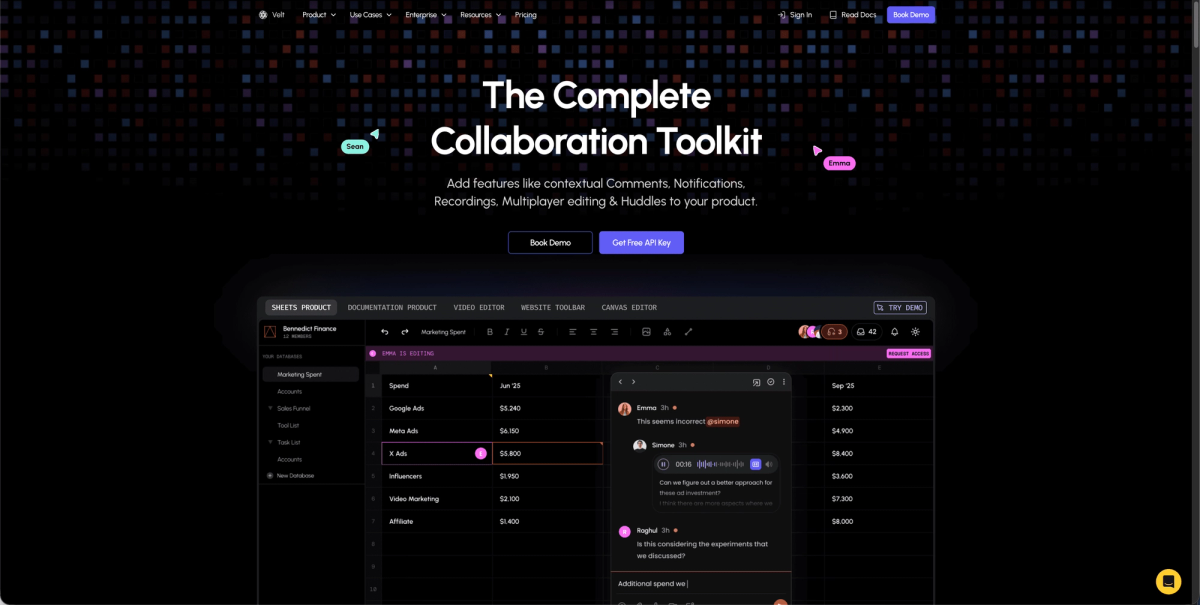
Velt operates as a JavaScript commenting SDK designed to layer collaboration features onto any web app, regardless of the framework. Unlike editor-specific wrappers, Velt functions as a complete collaboration stack, offering over 25 pre-built components that developers can drop directly into their builds. The SDK provides a complete collaborative experience:
- Multiplayer Editing: Ensures changes merge correctly without overwriting each other's work
- Contextual Commenting SDK: Pin annotations to specific DOM elements, including text, images, and video frames.
- Notifications SDK: Manage mentions and updates through a pre-built inbox system.
- Real-time Presence: Show active users via live cursors and avatars.
- Async Video & Audio: Integrated recording tools for feedback directly in the UI.
Velt supplies the interface layer immediately. Teams get customizable UI elements, such as comment bubbles and notification panels, paired with the backend infrastructure. This approach allows engineers to integrate sophisticated collaboration into dashboards or video editors without engineering frontend interactions from scratch. And Velt is built on proven and well-established technologies. The SDK uses CRDT (Conflict-free Replicated Data Types) technology through Yjs, which automatically resolves editing conflicts when multiple users work simultaneously.
Comparing Tiptap Cloud with Velt
To help you understand the differences between Tiptap Cloud and Velt, we assessed each according to the following criteria:
- Multiplayer editing and reliability
- Commenting SDK and notifications
- Collaboration across application types
- Data self-hosting and security
Multiplayer Editing and Reliability
At the core of collaboration SDKs and their cloud backend is how multiplayer activities are handled.
Tiptap Cloud ties multiplayer functionality directly to the document. Collaboration and history features generally require storing documents within their infrastructure, creating a strict dependency. Implementation involves a lot of overhead, forcing you to manage TipTap and Hocuspocus configuration, install Yjs dependencies, and configure JWT authentication to establish connections.
Velt, though, approaches synchronization with greater flexibility. Velt uses the same proven CRDT technology (Yjs) as Tiptap Cloud, but our WebSockets infrastructure is more resilient, faster and enterprise ready. Velt's engine operates across your entire app rather than being limited to text editors. You are not required to store content in specific proprietary formats. This allows you to add multiplayer interactions to any component, from canvas elements to video timelines, without backend constraints.
Of course, when you bake real-time collaboration into your application, reliability is critical. Both Tiptap Cloud and Velt provide managed infrastructure to support these real-time features. Reliability is critical for realtime features. Velt offers 99.999% uptime for enterprise plans vs Tiptap just offers 99.9%. Our infrastructure supports apps with millions of monthly active users, delivering scalable, conflict-free editing without the heavy configuration or document-centric restrictions found in Tiptap.
Commenting SDK and Notifications
When you consider a collaboration SDK for your app, you'll need to keep in mind four key considerations:
- Scope: where can collaboration features be exposed? Is it only in a text editor, for example, or anywhere you want?
- Notification system: how does the SDK handle notifications? Is this something that's part of the SDK framework or do you need to build it yourself?
- Context awareness: is the collaboration limited to a specific type of content (like documents) or can collaboration features, such as commenting, be used on other content types within the application?
- Integration effort: how hard is it to get the SDK integrated and the features exposed within the application?
Tiptap restricts its tiptap comments extension to the editor environment. While functional for text threads, it cannot support feedback on UI components like dashboard widgets or sidebars. The service also lacks a native notification system, forcing engineering teams to construct custom backend logic for mentions.
Velt, on the other hand, provides a commenting SDK compatible with any DOM element. Users can pin comments to video frames, data charts, or standard divs. Intelligent positioning keeps these annotations anchored during layout shifts.
And when it comes down to notifications, which are a critical part of any collaborative environment, Tiptap requires you to bring your own (i.e., another component you can install or one you build) while Velt includes a complete notifications SDK. We automatically route @mentions to email, Slack, and Microsoft Teams. This keeps stakeholders informed about collaboration events everywhere, preventing the fragmentation typical of editor-bound tools.
The table below summarizes how each provider tackles those four key considerations.
| Feature | TipTap Cloud | Velt |
|---|---|---|
| Scope | Text Editor Only | Any UI Element |
| Notification System | Build from scratch | Built-in (In-app, Email, Slack) |
| Context Awareness | Document text | Global DOM (Video, Images, Divs) |
| Integration Effort | High (Requires custom backend) | Low (Drop-in components) |
Collaboration Across Application Types
While you may have a specific use case in mind for your collaboration features, such as an editor in a specific app, there may be a time when you want to expose those collaboration features in different areas of the app, or in other apps all together. So as you decide between Tiptap Cloud and Velt, you need to consider flexibility: will your choice allow you to expose collaboration features where you want or will you need to rip-and-replace when you realize that your collaboration SDK has boxed you in?
Tiptap Cloud works best for rich text scenarios. If you build a Google Docs clone, it manages multiplayer editing well inside the editor instance. However, its utility ends at the text box. It offers no native mechanism to collaborate on surrounding app elements like settings panels, data visualizations, or navigation menus.
Velt, though, decouples collaboration from the editor to support any DOM element across your product. You can add a comments SDK to a sales CRM dashboard, a video editing timeline, or a complex design canvas. Velt integrates alongside any editor framework, including Tiptap, Lexical, and SlateJS, allowing you to maintain your preferred text stack while unifying the collaboration experience globally. Avoiding fragmented tools is critical when context switching costs organizations an estimated $450 billion annually in the US alone. This flexibility extends to presence and communication. Velt lets you deploy live cursors, huddles, and video recordings anywhere in the interface. The SDK lets users collaborate on the entire product instead of remaining confined to text fields.
Data Self-Hosting & Security
Let's face it: collaboration requires governance. Not only is it possible to share sensitive information during collaboration experiences, such as users working on a document that requires PII, but every comment and response becomes part of the data footprint. When that footprint spans regulatory industries, the data must be protected. The easiest way to solve this challenge is to allow collaboration SDK users to self-host the data.
TipTap allows self-hosting the editor interface, yet real-time collaboration features generally depend on Tiptap Cloud. Full control over storage and synchronization usually mandates a custom enterprise on-premise contract, complicating the stack for teams that simply require data ownership.
Velt, though, supports true collaboration data self-hosting. We separate the realtime tech from the storage layer. You keep all user-generated content in your own cloud environment while Velt manages the synchronization infrastructure. This architecture lets you retain data sovereignty without maintaining a heavy backend. Velt also maintains SOC 2 Type II compliance, can execute HIPAA BAAs, provide custom encryption keys, and isolated environments. You receive the maintenance benefits of a managed service while keeping your data under your own lock and key.
Why Velt is the Better Choice
Velt supports collaboration across your entire product. While Tiptap restricts focus to the editor, Velt provides a complete Commenting SDK and Notifications SDK that function on any DOM element. We include fully customizable UI components, saving engineering teams months of frontend work required to build these features manually. And, our pricing model favors scalability. Velt uses a Monthly Active Collaborator (MAC) system, charging strictly for users who actively edit or comment. This approach avoids billing for passive concurrent connections. You get enterprise-grade infrastructure without the limitations of single-editor solutions.
Final thoughts on multiplayer editing and collaboration tools
Multiplayer editing shouldn't force you to rebuild your stack around a single editor. Tiptap Cloud ties collaboration to their document infrastructure, which creates dependencies that limit where you can add features. Velt, though, works across your entire product, giving you the same real-time tech without the storage constraints. You get enterprise reliability and the freedom to collaborate on any UI element, not simply text. And, if the time comes when you want to expand collaboration features in your app beyond just traditional text editing, selecting Velt won't require you to rip-and-replace when you need more than just document collaboration. If you need collaboration beyond text editing, Velt is the better choice.
FAQ
How should I decide between Tiptap Cloud and Velt for my product?
Choose Tiptap Cloud if you're building a document editor where text collaboration is your only requirement. Pick Velt if you need collaboration features across your entire app, like commenting on dashboards, video timelines, or any UI element, while keeping your existing editor stack.
What's the main difference in how these tools handle multiplayer editing?
Tiptap Cloud locks multiplayer features to the document editor and requires storing content in their infrastructure. Velt decouples sync from storage, letting you add realtime editing to any component while keeping data in your own cloud.
Who is TipTap Cloud best suited for versus Velt?
Tiptap Cloud fits teams building rich text editors as their core product who can accept document-centric constraints. Velt works for SaaS platforms, design tools, analytics dashboards, and any app needing collaboration beyond text fields, especially when you want pre-built UI components instead of building from scratch.
Can I keep control of my collaboration data with either solution?
Tiptap Cloud typically requires their managed service for real-time features, with full control needing custom enterprise contracts. Velt offers collaboration data self hosting out of the box, letting you store all user content in your own cloud while we handle the sync infrastructure.
How does pricing differ between Monthly Active Users and Monthly Active Collaborators?
Tiptap Cloud charges based on connections and document operations. Velt uses Monthly Active Collaborators (MAC), billing only for users who actually comment or edit, typically 20% of your total users, which can reduce costs by 80% compared to connection-based pricing models.