

Why Approval Workflows Belong in Your Product (Not in a Separate Tool) (May 2026)
Learn why approval workflows inside your product beat separate tools. Context preservation and faster reviews explained. May 2026 guide.
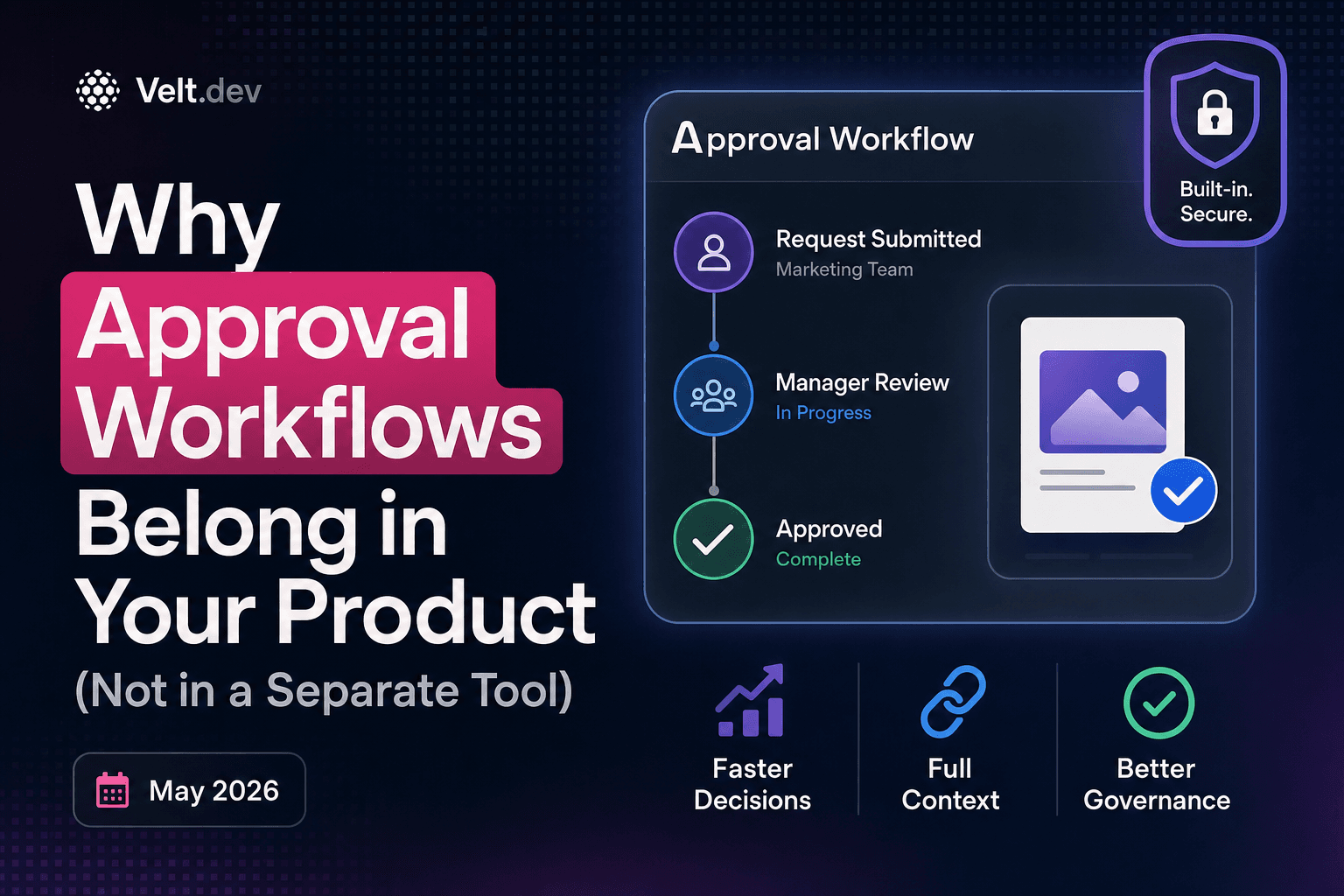
Most approval workflows fail because reviewers lose context the moment they leave your product. They're approving something in Jira or Asana without seeing the actual asset, the comment threads, or the version history. Building review infrastructure into your product keeps all of that in one place, so the reviewer sees exactly what they need to make a decision and the approval record stays tied to the work itself. For a 50-person team, that cost adds up to roughly $325,000 a year in lost productivity from approval-related context-switching alone.
TLDR:
- Embedded approval workflows keep reviews inside your product so approvals happen against actual work.
- A 50-person team loses $325,000 yearly chasing approvals across Slack, email, and task tools.
- Context-switching adds 23 minutes of lost focus per approval interruption, compounding delays.
- In-app approval needs five pieces: contextual anchoring, multi-stage routing, role permissions, audit trails, and notifications.
- Velt provides review and approval infrastructure with inline comments, approval states, and audit trails that integrate via SDK.
What Is an Embedded Approval Workflow?
An embedded approval workflow is review and approval infrastructure built directly into your product, not routed through a separate tool. When someone submits a document, a design, or a business plan for review, the entire approval process happens inside the same interface where the work lives.
"Embedded" is the operative word. It means approval state, reviewer assignment, feedback threads, and sign-off all exist on the work item itself. Not in a standalone workflow tool open in another tab. Not in an email chain. Not in a Jira ticket with a link back to the thing being reviewed.
The distinction from standalone approval tools comes down to context. Reviewers see exactly what they're approving. Approvals stay anchored to the specific asset, so there's no gap between the decision and the work it applies to. That gap is where approval cycles slow down, and where the audit trail goes to die.
The Hidden Cost of Scattered Approval Systems

Scattered approval systems have a price. It just gets distributed across small moments nobody tracks.
The productivity math: Consider a 50-person team averaging $50 an hour. If you conservatively estimate approval-related interruptions cost each person 30 minutes a day chasing status across Slack, email, and Asana, that's 25 lost hours daily. Run the math at 250 working days and you get roughly $325,000 a year in lost productivity. For a process most teams treat as overhead.
The focus cost: Context-switching makes it worse. Research from UC Irvine found it takes roughly 23 minutes to fully refocus after an interruption. An approval ping isn't a 30-second check. It's a 25-minute derailment, repeated across everyone waiting on or blocked by a decision.
The downstream cascade: A design held up three days for sign-off delays more than that asset. It delays the campaign, the launch, the sprint. Approval bottlenecks that live outside your product are invisible until they collide with a deadline, and by then the cost is already real.
Why Approval Bottlenecks Form Outside Your Product
Approvals end up bottlenecked for three identifiable reasons. They usually compound each other, which is why fixing just one rarely moves the needle.
- Context gets lost in transit. When a reviewer has to leave your product to approve something in a separate tool, they lose the surrounding context. They're approving an artifact they can't fully see, which slows judgment and increases the chance of a rejection loop.
- Accountability disappears. Standalone approval tools don't know who did what inside your product. Audit trails are incomplete by definition, because the tool only sees the slice of the workflow that happens inside it.
- Friction kills adoption. If reviewers have to log into a separate tool, accept an invite, and learn a new interface, most won't. Each extra step compounds the drop-off, and the ones who do log in are the exception. They fall back to email or Slack, and the approval record never gets captured at all.
How Embedded Workflows Change the Approval Experience

The mechanics shift in a specific way. When a reviewer approves a design mockup inside your product, they see the exact asset, active comment threads, and version history on one screen. No export. No link-sharing. The decision happens against the work as it actually exists.
Contract review in compliance and FP&A tools works the same way. The approver reads the draft, sees inline annotations from legal, and signs off without leaving the document view. Version history is right there if timeline context matters.
Data report sign-offs might be the clearest case. An approver who can view the underlying dataset while reading the summary makes a faster, more confident call than one reviewing an exported PDF with no way to drill down.
Every decision stays anchored to its artifact. That's the real shift an embedded approval workflow creates over a standalone tool.
Key Capabilities Required for In-App Approval Infrastructure
Building in-app approval infrastructure reliably requires five specific capabilities. Get them all right and the workflow holds. Leave one out and something predictable breaks.
- Contextual anchoring: Approval requests should bind to specific records, assets, or UI elements, not float as generic tasks detached from what's actually being reviewed.
- Multi-stage routing: Real approvals rarely happen in one step. The system needs sequential chains (legal reviews before finance signs off) and parallel tracks (multiple reviewers acting simultaneously).
- Role-based permissions: Who can approve what, enforced at the system level instead of managed manually per request.
- Audit trails: Immutable logs of every decision with timestamps and attribution, tied to the exact artifact version under review at the time of sign-off.
- In-product notifications: Reviewers get alerted inside the app or through connected channels like Slack or email, without needing to switch tools to find out what needs action.
When Standalone Approval Tools Still Make Sense
Embedded workflows aren't the right answer for every situation. Three scenarios genuinely favor standalone tools.
- Cross-application orchestration: If approvals need to route across five systems you don't own or control (ERP, HRIS, procurement, CRM), a dedicated orchestration tool like ServiceNow or Workato handles that job. Embedding into one product won't cover the full chain.
- RPA-heavy automation: When an approval triggers downstream actions across legacy enterprise systems, process automation tools have native connectors that a product-level SDK won't replicate.
- Legacy system constraints: If the software being reviewed can't accept a JavaScript SDK, embedding simply isn't feasible.
Standalone tools handle cross-system orchestration better. Embedded workflows handle context better. Know which problem you're solving before you pick the approach.
Implementation Considerations for Product Teams
When deciding whether to build approval workflows inside your product or rely on a separate tool, a few questions cut through the noise quickly.
- First, where does the work actually happen? If your users are already in your app reviewing content or signing off, pulling them into a different tool introduces friction that compounds over time. Approval steps that live close to the work they govern get completed faster.
- Second, who owns the audit trail? Embedded approval workflows keep decision records inside your data model, which matters for compliance, reporting, and debugging. External tools fragment that history.
- Third, how much of the approval logic is specific to your product? Generic standalone tools handle generic cases. The more your workflows reflect your own data, roles, and states, the harder they are to configure in an outside system.
The table below provides a high-level overview of different approaches to approval workflows, when they are best used, how long they take to integrate, and where audit trails are located.
| Approach | Best For | Context Preservation | Integration Time | Audit Trail Location |
|---|---|---|---|---|
| Velt (Embedded SDK) | Review and approval workflows on work that lives in your product (designs, contracts, reports, data assets) | Full context: reviewers see the exact artifact, comment threads, and version history in one view | Minutes via SDK integration with full UI customization | Inside your data model, tied to exact artifact versions |
| Liveblocks | Real-time multiplayer experiences like whiteboards, co-editing documents, or single-canvas collaboration | Full context within the collaborative canvas or document being edited | SDK integration with focus on presence and real-time sync primitives | Inside your application for collaborative state |
| Standalone Tools (Jira, Asana) | Task management and project tracking where approvals are one part of broader project workflows | Context lost: reviewers see a task with a link, not the actual work being approved | Hours to configure workflows and integrate via API or webhooks | In the external tool, disconnected from the actual work artifact |
| Process Automation (ServiceNow, Workato) | Cross-application orchestration spanning 5+ systems, or RPA-heavy automation with legacy enterprise systems | Minimal context: approval requests route through systems with metadata only | Days to weeks for workflow configuration and connector setup | Distributed across multiple systems with aggregated logs |
| Custom Build | Highly specialized approval logic that no existing tool can handle, with eng resources to spare | Full control over context presentation and data binding | 3-6 months for basic approval infrastructure, ongoing maintenance required | Wherever you build it, but you own the schema and compliance burden |
Velt: Review and Approval Infrastructure for SaaS Products
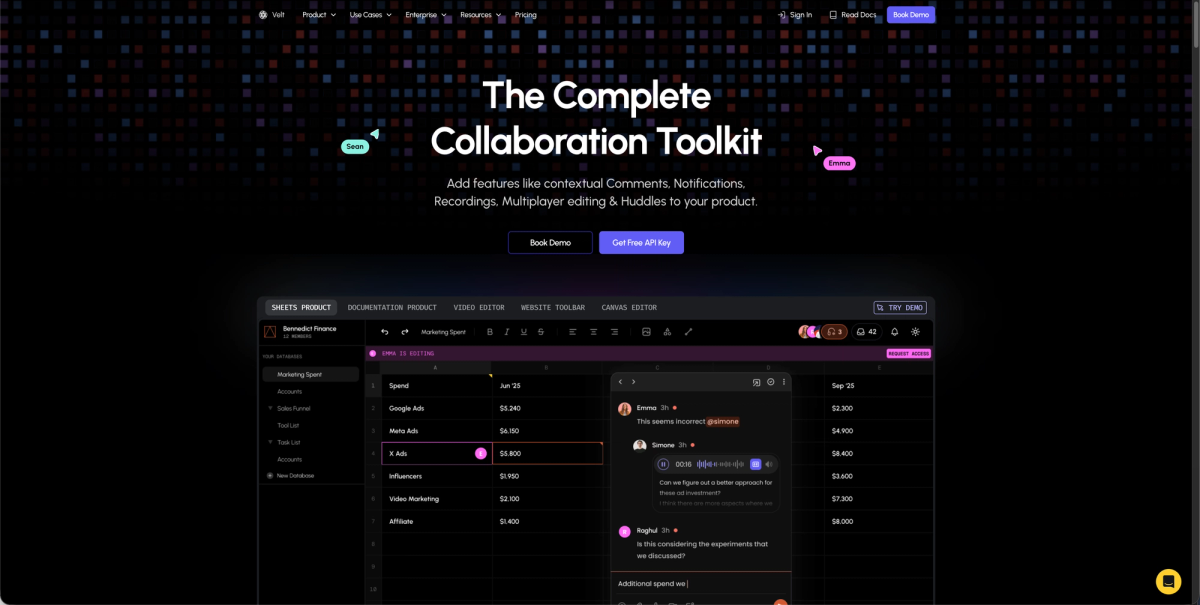
Velt is purpose-built review and approval infrastructure for SaaS products. If you're shipping a tool where multiple people create, review, or sign off on work, Velt gives you the building blocks to handle that entire workflow inside your app.
The core of what Velt provides:
- Inline commenting that binds to specific elements in your UI, so reviewers can flag exactly what they mean without writing "the thing in the top right corner"
- Approval workflows with status states, role-based permissions, and audit trails baked in
- Presence indicators, notifications, and recording so teams stay in sync without leaving your product
Velt integrates via SDK in minutes. You get full UI customization, so it looks like you built it. And Velt handles the hard parts: state management, real-time sync, permission logic, and the audit trail your compliance team will eventually ask for.
If Liveblocks is the better fit for your use case (say, a multiplayer whiteboard or co-editing doc), it probably is. Velt is the right call when your product needs review and approval infrastructure: structured sign-off, comment threads, status tracking, and a record of who approved what.
Final Thoughts on Where Approvals Should Actually Happen
Your users are already in your product making decisions. Pulling them into another tool to approve those decisions kills context and slows everything down. Embedded approval infrastructure collapses that gap, which is why teams with reviewers who need to see the work they're approving choose it over standalone tools. Building it takes longer than buying it, and the compliance record matters more than most teams realize upfront. Book a demo if you want to see what a pre-built version looks like.
FAQ
How do I choose between embedded approval workflows and standalone approval tools?
Embedded workflows are better if approvals happen on work that already lives in your product (designs, contracts, reports) and you need decisions anchored to specific artifacts with full context. Standalone tools make sense when you're routing approvals across five systems you don't control, or when legacy constraints prevent SDK integration.
Can I add approval workflows to my SaaS product without building from scratch?
Yes. Velt provides approval infrastructure as an SDK that integrates in minutes, giving you status states, role-based permissions, audit trails, and inline commenting without building from scratch. You get full UI customization so it looks native to your product.
How do in-app approval workflows reduce review cycle time?
Reviewers see exactly what they're approving without switching tools or losing context, which cuts judgment time and reduces rejection loops. The decision happens on the work itself, not on an exported copy discussed in email, so there's less back-and-forth before sign-off.
What does it cost to run approvals outside your product?
For a 50-person team at $50/hour, if approval-related context-switching costs each person 30 minutes daily chasing status across Slack and email, that's around $325,000 annually. Add the 23-minute refocus time after each interruption and the cost compounds across everyone blocked waiting on decisions.
When should I use Velt instead of Liveblocks for approval workflows?
Velt is built for review and approval infrastructure with structured sign-off, comment threads, status tracking, and audit trails. Liveblocks is better for single-canvas multiplayer experiences like whiteboards or co-editing documents where real-time presence is the primary need.