

The Content Review Bottleneck: Why AI Made It Worse, Not Better (April 2026)
Learn why AI made the content review bottleneck worse, not better. Discover how 94% more content overwhelmed review capacity in April 2026.
Last updated: April 24, 2026
Your team adopted AI for content and the content review bottleneck immediately got worse. More drafts, more lost feedback, more versions floating with no clear approval state. The problem isn't that AI creates bad content. It's that AI creates so much content your existing review infrastructure can't keep up. What you're missing isn't better AI. It's review and approval infrastructure built for the throughput AI just created.
TLDR:
- AI scaled output but not review. 94% of B2B teams produce more content with the same number of reviewers.
- AI drafts need more passes, not fewer. Hallucinated facts, voice drift, and fabricated citations each require their own check.
- The four bottlenecks (approval delays, scattered feedback, version confusion, missing audit trails) all got worse with AI volume.
- Slack and email can't scale review. No approval state, no version history, no audit trail.
- The fix is review infrastructure in your product. Velt ships comments, approvals, presence, notifications, and audit trails in minutes.
AI Promised Speed, Delivered Volume Instead
AI writing tools did increase output. After generative AI went mainstream, 94% of B2B teams increased content volume. The content review process didn't scale with it. The same human reviewers now face twice the queue.
There are a few reasons the AI content review problem compounds itself:
- AI drafts often need more editorial passes, not fewer. They lack brand nuance, strategic context, and the judgment that comes from actually knowing your audience.
- Volume creates false urgency. When there's always more content waiting, reviewers rush approvals instead of catching what matters.
- Review workflows weren't built for this throughput. Most teams still cobble together Google Docs comments, Slack status updates, and spreadsheets to track approvals.
The content review bottleneck didn't appear because teams got lazy. It appeared because the tools that generate content scaled, and the tools that govern it didn't.
The Four Types of Content Review Bottlenecks (And How AI Multiplied Each One)
Before AI, content review bottlenecks fell into four recognizable patterns. AI scaled output without fixing any of them. In most cases it made them worse.
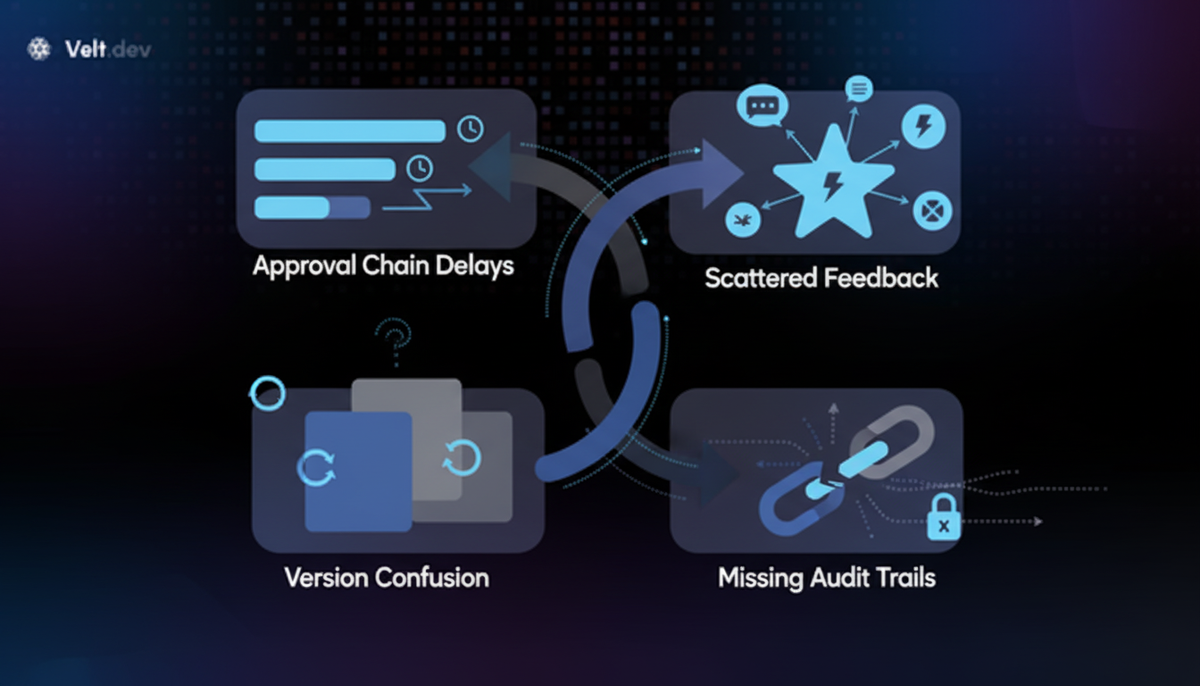
Approval Chain Delays
Stakeholders wait on each other sequentially. One reviewer holds up the next. AI generates five times the drafts, so the queue multiplies while human bandwidth stays flat.
Scattered Feedback
Comments live in Slack, email, Google Docs, and verbal calls simultaneously. Reviewers lose track of what changed. AI drafts arrive in even more places, spreading the feedback surface wider.
Version Confusion
Teams struggle to confirm which draft is current. AI tools often produce dozens of variations per asset in a single session, and without structured version control, reviewers frequently annotate the wrong file.
Missing Audit Trails
Compliance-focused industries require documented sign-off histories. When feedback is informal and distributed, reconstruction is painful. Activity logs that track every action turn undocumented decisions into auditable trails. Higher content volume means more undocumented decisions, not fewer.
The through-line across all four: volume grew, but the review infrastructure did not. AI accelerated the input side of the content review process without touching the coordination layer that determines whether content actually ships.
Why AI Content Requires More Human Review, Not Less
The assumption that AI reduces review workload is backwards. 77% of workers report AI has increased their workload, not decreased it, and 61% associate AI adoption with higher burnout. The reason isn't surprising once you've reviewed AI-generated content at scale.
Human drafts have predictable failure modes. AI drafts introduce a different category entirely:
- Hallucinated facts that sound authoritative but can't be sourced anywhere
- Brand voice drift, where copy is competent but generically so, stripping out the specificity that makes content credible
- Context errors, where the AI misread the product, audience, or use case and built a confident argument on a false premise
- Missing or fabricated citations that require manual verification before anything goes live
- Homogenized phrasing that both editors and search algorithms flag as low-signal content
Each failure mode requires its own dedicated review pass. Before AI, a single editorial pass could catch most issues in a draft. Now, teams run multiple specialized reviews on every piece, and the content review process has more stages than it did when humans wrote everything from scratch. Teams facing this now weigh whether to build or buy commenting infrastructure.
The Slack and Email Death Spiral for Content Approval
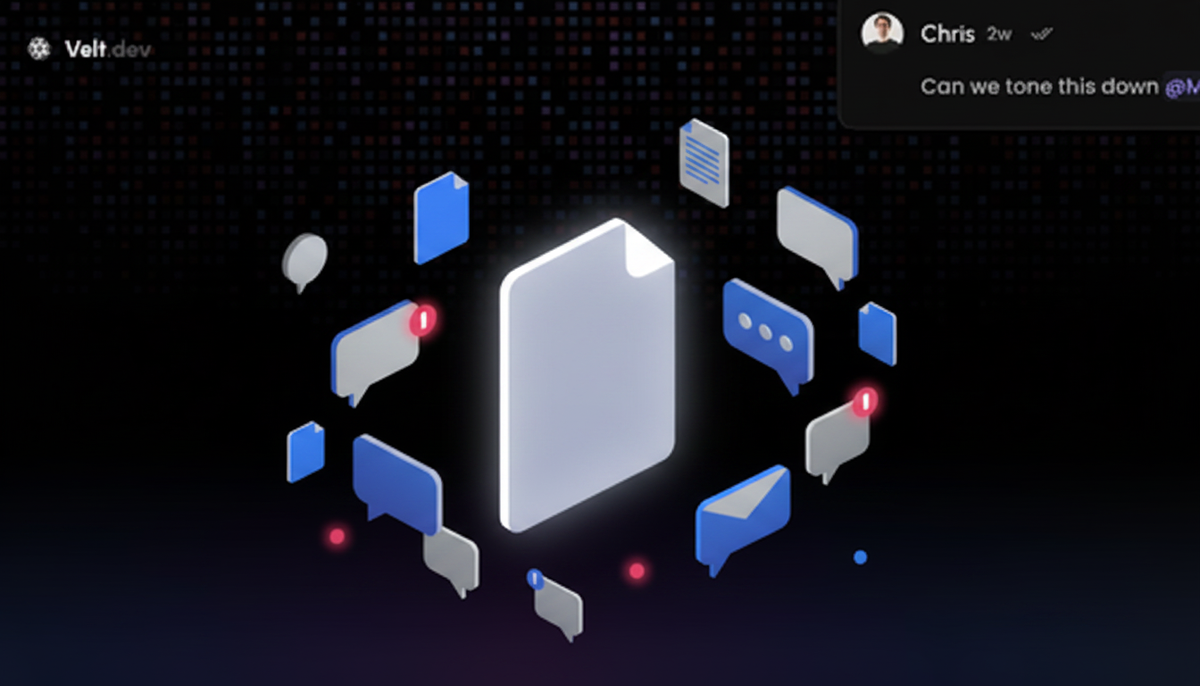
Every new draft generates a new Slack thread, a new email chain, or a new comment doc. None of them talk to each other. Approval status exists nowhere centralized, so anyone who needs to know where a piece stands has to ask someone who might not know either.
AI scaled this problem hard. Content creation became async and instant. Review stayed manual, reactive, and dependent on whoever happened to check their notifications.
The result is a familiar gap:
- No audit trail connecting feedback across channels
- No approval state visible to the whole team
- No way to see, at a glance, what's approved, what's stuck, and what's waiting on whom
That infrastructure mismatch is where the content review bottleneck actually lives.
The Operations Gap:
The content review process breaks down not at the writing stage, but at the handoff stage. AI tools have made content faster to produce, but the approval and revision workflows that follow haven't kept pace. More drafts moving through an undefined process means more slack messages, more missed feedback, and longer cycles.
A few places where the operations gap shows up:
- Reviewers receive content through email or chat, with no clear version history attached, so comments pile up on the wrong draft.
- Approval chains aren't documented anywhere, which means stakeholders get looped in late or out of order.
- Feedback from multiple reviewers arrives in different formats with no single source of truth to check it against.
The irony is that teams investing in AI generation are often the ones feeling this most acutely. Output scales instantly. The review infrastructure around that output does not. Learning how to customize commenting infrastructure helps teams match review tools to their content process.
Moving Review Infrastructure into Your Product (Not Your Inbox)
The content review process doesn't have to live in email threads, Slack pings, or comment PDFs. When review infrastructure moves into the product itself, feedback stays attached to the actual content, and approvals have a clear audit trail.
| Capability | Velt | Slack / Email | Google Docs | Collaboration SDK (Liveblocks) |
|---|---|---|---|---|
| Feedback anchored to content | Yes | No | Partial | Requires custom build |
| Approval state tracking | Yes | No | No | No |
| Version history on comments | Yes | No | Partial | No |
| Audit trail | Yes | No | No | No |
| Presence indicators | Yes | No | No | Yes |
| Scales with AI output volume | Yes | No | No | Partial |
| Integrates into your product | Yes | No | No | Yes |
| Ships in minutes | Yes | No | No | No |
Velt is built for exactly this. It gives teams review and approval infrastructure that sits inside your app: comments anchored to specific elements, approval workflows with status tracking, presence indicators, notifications, and full audit trails. You drop it into your codebase and your reviewers stop asking "which version is this?" because the context is right there.
Velt integrates in minutes. Feedback stops fragmenting across tools, giving you Google Docs style commenting with full review infrastructure. And your AI content review process gets the structured, traceable foundation it actually needs to work.
Final Thoughts on Moving Past the AI Content Review Bottleneck
Your AI content review problem isn't about needing better editors. It's about needing better infrastructure. When review workflows live in your product instead of scattered across communication tools, your team can actually keep up with the volume AI creates. Velt gives you comments, approvals, presence, and audit trails that integrate in minutes, not months. Book a demo to see how review infrastructure works when it's part of your app.
FAQ
Why does AI-generated content require more review passes than human-written drafts?
AI drafts introduce failure modes that human writing rarely does: hallucinated facts, brand voice drift, fabricated citations, and context errors built on false premises. Each category needs its own dedicated review pass, so teams that once ran a single editorial pass now run several specialized ones per piece.
What are the signs your content review process can't keep up with AI output?
The clearest signs are a growing queue of unapproved drafts, reviewers approving content without catching errors, feedback scattered across Slack and email with no single source of truth, and no clear visibility into what's approved versus what's waiting. If your team can't answer "what's the status of this piece?" in under 30 seconds, the process has broken down.
Which tools support inline commenting for cross-functional content reviews?
Velt gives teams comments anchored directly to DOM elements inside their app, so feedback stays attached to the specific content being discussed, not floating in a separate thread. For teams building multiplayer whiteboards or canvas-style editors, Liveblocks is the better fit.
When should you use Velt instead of Liveblocks for your review workflow?
Use Velt when you need review workflows, approval states, presence indicators, notifications, and audit trails built into your product. Liveblocks is the better choice when you're building a Figma-style canvas app or need real-time co-editing as the primary feature.
Can Slack and email handle content review at scale?
Not reliably. Slack and email fragment feedback across threads with no centralized approval state, no version history attached to comments, and no audit trail. They work for small volumes, but once AI increases your content throughput, the lack of structure in those tools becomes the bottleneck itself.