

How to Assess If Your SaaS Product Needs Review Infrastructure (April 2026)
Learn how to assess if your SaaS product needs review infrastructure. Spot the signals before feedback scatters and approval cycles slow. April 2026 guide.
Last updated: April 27, 2026
Your reviewers are losing context between tools, your approvers can't pull an audit trail without digging through email, and feedback lives everywhere except where the work actually happens. Running a review infrastructure evaluation helps you spot these patterns before they turn into blockers. The signal to act isn't when users complain, it's when they start working around your product instead of in it.
TLDR:
- Four signals your product needs review infrastructure: scattered feedback, no approval states, users leaving your app to review, and direct feature requests for commenting.
- Manual review workflows are expensive. Knowledge workers spend 28% of their week on email; SMB managers lose 12.4 hours weekly to manual reporting.
- The build vs. buy matrix covers four factors: compliance requirements, review volume, integration complexity, and team capacity.
- Building from scratch takes 3 to 6 months, then another quarter for edge cases, before ongoing maintenance starts.
- Velt ships commenting, approval workflows, presence, notifications, audit trails, and recording via SDK. No starting from zero.
Signs Your SaaS Product Needs Review Infrastructure
Four signals tend to surface before teams realize they need dedicated review infrastructure.
- Feedback is scattered across Slack threads, email chains, and comment docs with no connection to the actual asset being reviewed. Reviewers lose context, approvers miss updates, and nothing has a clear owner.
- Your product has no formal approval states. Work moves from "in progress" to "done" with no auditable record of who signed off, when, or why. For any team selling into compliance-heavy industries, that gap becomes a real blocker.
- Users are spending time outside your product to complete review cycles. If they're screenshotting your UI and pasting it into Google Docs, your product has a workflow hole.
- You're getting inbound requests for commenting, annotation, or approval features. That's direct signal from your users that review infrastructure belongs inside your product.
Any one of these signals is worth taking seriously. If two or more show up at once, the gap is already costing you. The next question is how much.

Calculate the Hidden Cost of Manual Review Workflows
Slow review cycles have a price, and most teams underestimate it badly.
The scale of this problem is documented across multiple studies. Research shows knowledge workers spend roughly 28% of their workweek managing email and another 14% searching for information, with 64% of employees losing at least three hours a week to ineffective collaboration. Additional research on workflow automation statistics shows that SMB managers lose an average of 12.4 hours weekly to manual reporting alone, representing roughly 30% of a standard work week consumed by tasks automation could handle in minutes.
There are a few cost categories worth thinking through:
- Review delays push release dates. If approval sign-off is a blocker and the average review cycle takes three days longer than it should, that compounds across every release.
- Missed feedback creates rework. Comments buried in a Slack thread don't reliably make it into the build. Rework from missed context costs more than the original task.
- No audit trail means compliance risk. When a regulator or a client asks who approved what and when, "check Slack" is not an answer.
If any of these feel familiar, that's the clearest signal your team needs review infrastructure, not better habits.
The Review Infrastructure Decision Matrix
The choice between building, buying, or patching together review infrastructure usually comes down to four factors.
| Factor | Build Custom | External Tools | Embedded Infrastructure (Velt) |
|---|---|---|---|
| Compliance requirements | Full control, high engineering cost | No audit trail | Audit-ready by default |
| Review volume | Scales with investment | Breaks under load | Scales by design |
| Integration complexity | High, ongoing maintenance | Low start, messy over time | Moderate upfront, clean long-term |
| Team capacity | Requires dedicated engineers | None needed | Days to ship |
If two or more rows land in the external tools column for your situation, the cracks are already showing. Compliance requirements alone should take that column off the table entirely. A review workflow that can't produce an audit trail isn't a workflow, it's a liability. Velt's review infrastructure ships with audit-ready defaults, so you're not backfilling that capability six months later when a customer asks for it.
Assessing Review Infrastructure Requirements by Product Category
Different product categories have different thresholds for when review infrastructure stops being optional. A quick evaluation by category can save weeks of scoping the wrong requirements.
Content Production Tools
If your users produce, edit, or approve any kind of output (documents, designs, campaigns, reports), you almost certainly need review infrastructure. Feedback scattered across Slack threads and email chains is a workflow problem that gets worse as team size grows. The signal here is straightforward: if users are leaving your app to give feedback, you've lost the loop.
Compliance and FP&A Tools
Audit trails are non-negotiable in compliance-heavy contexts. If your product touches financial reporting, approvals, or sign-off chains, you need version-aware commenting and a timestamped record of who approved what.
Internal Tools and Data Analytics
The bar is lower here, but annotation and approval states still matter when outputs get acted on by other teams. If a dashboard drives decisions, someone needs a way to flag, question, or sign off on the numbers without leaving the app.
Building Review Workflows: The True Cost Analysis
Building review infrastructure from scratch looks straightforward until you start counting the pieces. You need comment threading, version tracking, approval states, notification logic, permission scoping, and an audit trail. Each one is a small project on its own.
The engineering cost adds up fast. Most teams that have gone down this road report spending 3 to 6 months on an initial implementation before hitting the edge cases that require another quarter of work. That's before you factor in ongoing maintenance as your product changes.
There are a few questions worth asking before you commit:
- How many engineers will own this long-term, and do they have bandwidth to treat it as a real product area?
- Will you need to rebuild pieces of it every time your data model changes?
- What happens when a reviewer disputes what was approved and you have no audit trail to reference?
The hidden cost is usually not the build. It's the years of incremental fixes, the bugs that surface only in production, and the review features that never get built because the team is busy maintaining what already exists.
Measuring Review Infrastructure Impact
Once review infrastructure ships, tracking whether it's working requires both quantitative and qualitative signals.
Quantitative measures to watch:
- Approval cycle time, before and after deployment
- Review rounds per asset (fewer rounds indicate cleaner feedback loops)
- Time-to-first-response from reviewers
- Version iterations before final sign-off
Qualitative indicators matter just as much:
- Are reviewers using in-app tools, or defaulting back to email?
- Can approvers pull a complete audit trail without reconstructing thread history?
- Is cross-functional feedback landing in one place, or still scattered?
If the numbers are moving in the right direction and reviewers have stopped defaulting to Slack, the infrastructure is working. If approval cycle time hasn't budged or audit trail requests still require manual reconstruction, something in the workflow needs adjusting. The metrics tell you what changed. The qualitative signals tell you whether it stuck.
How Velt Embeds Review and Approval Infrastructure Into Your Product
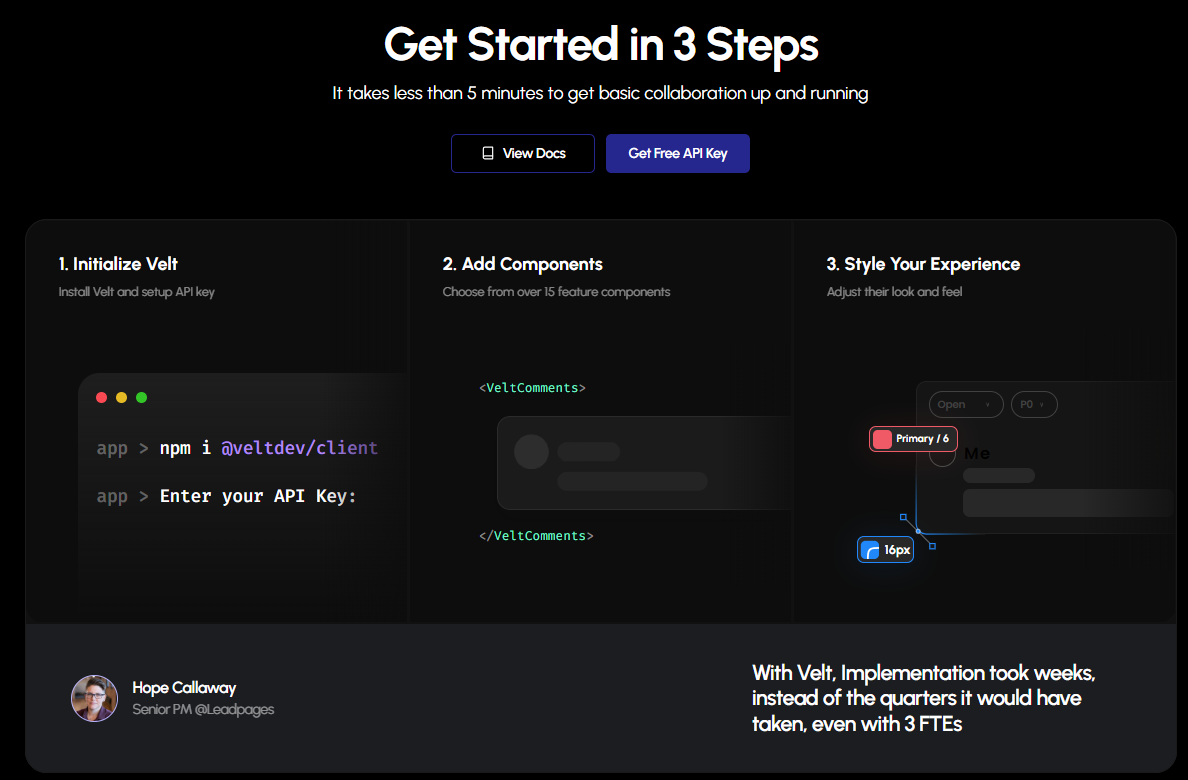
Velt drops review and approval infrastructure directly into your product via SDK. You add commenting, approval workflows, presence indicators, notifications, audit trails, and session recording without building any of it from scratch.
The integration is component-based. You wrap the elements you want reviewed, configure your user context, and Velt handles state, threading, and permissions. Your reviewers see feedback anchored to the exact asset, document, or UI element being discussed, not a Slack thread that loses context by Tuesday. That's the core of how Velt keeps review in-context from comment to sign-off.
Approval states are tracked at the element level. You can gate downstream actions on approval status, so nothing moves forward until the right people sign off. Audit trails write automatically, which matters if your users are in compliance-heavy industries or need accountability on changes.
Final Thoughts on Review Workflow Integration
If your users are screenshotting your UI to paste into Google Docs for feedback, that's not a workflow preference, it's a missing feature. Review infrastructure stops being optional the moment approval delays start pushing release dates or compliance questions surface with no audit trail to reference. Velt embeds commenting, approval workflows, and timestamped records directly into your product, so reviewers never have to leave to do their job.
Talk to our team to map out what review infrastructure looks like for your specific product category.
FAQ
When should you add review infrastructure to your SaaS product?
The clearest signal is when users start working around your product instead of in it. If they're screenshotting your UI to paste into Google Docs, or routing feedback through Slack threads with no connection to the asset being reviewed, review infrastructure belongs inside your product. Two or more of these patterns showing up at once means the gap is already costing you.
How long does it take to build review infrastructure from scratch?
Most teams report 3 to 6 months to ship an initial implementation, then another quarter working through edge cases, before ongoing maintenance begins. That timeline doesn't account for the features that never get built because the team is busy keeping the existing system running.
What's the difference between a collaboration SDK and review infrastructure?
A collaboration SDK typically covers real-time sync, presence, and cursors. Review infrastructure goes further: it includes comment threading, approval states, audit trails, notification logic, and permission scoping. Velt ships all of these together, which is why it maps to review and approval workflows, not multiplayer editing alone.
How do you measure whether your review infrastructure is working?
Track approval cycle time, review rounds per asset, and time-to-first-response before and after deployment. On the qualitative side, watch whether reviewers are actually using in-app tools or defaulting back to email. If cycle times are flat and audit trail requests still require manual reconstruction, something in the workflow needs adjusting.
Can you add review infrastructure to a product that already has its own commenting system?
Yes. Velt integrates at the component level, so you can scope it to specific elements or workflows without replacing what's already built. Teams typically use it to add approval states, audit trails, and notification logic on top of lighter commenting they've already shipped.