


Human in the Loop AI: Why Every AI System Needs a Review Layer (May 2026)
Learn why human in the loop AI review layers catch errors, improve accuracy, and meet compliance requirements. Guide for building HITL workflows in May 2026.
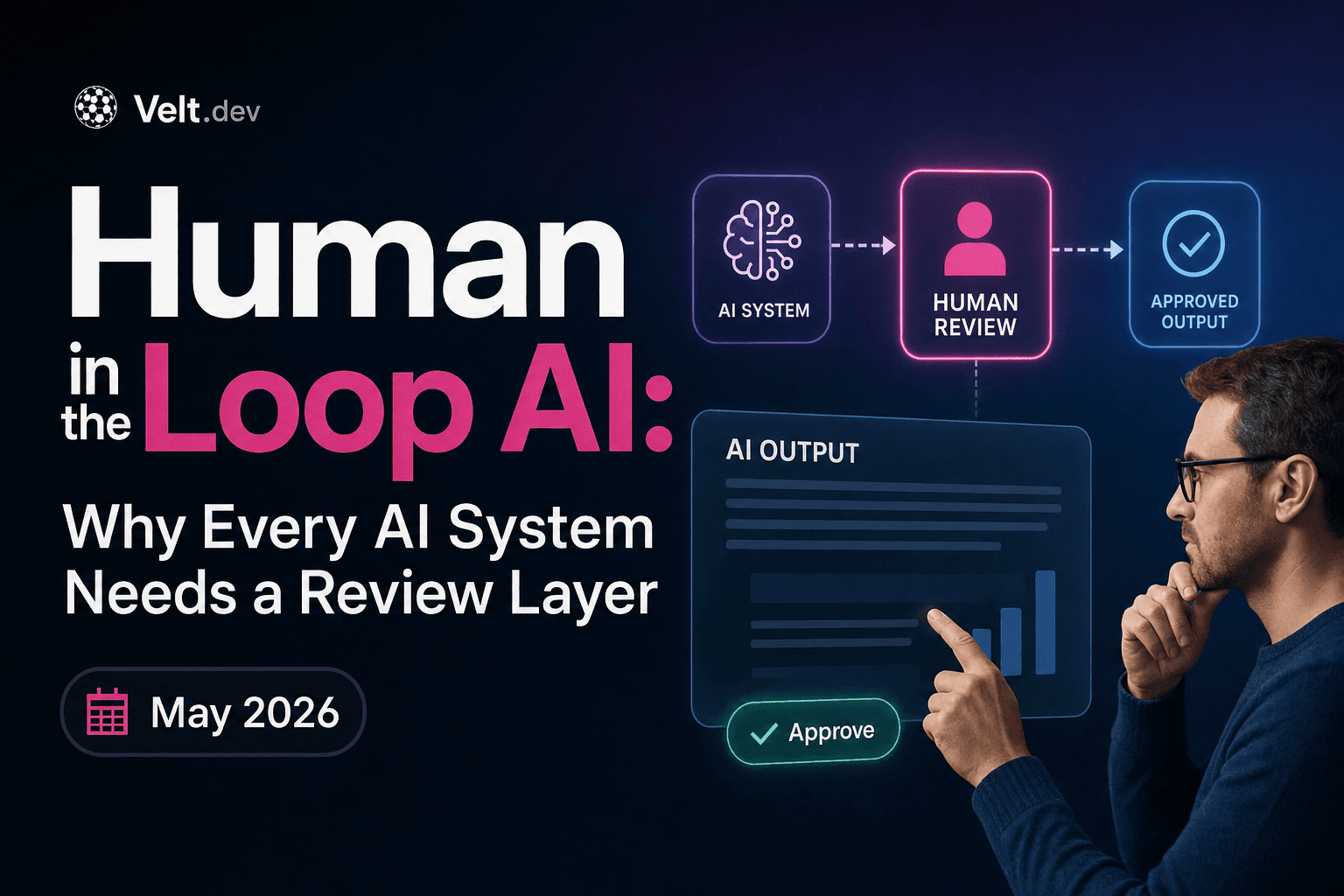
We're in May 2026, and most AI systems still operate with no checkpoints between the model output and the user seeing it. Human review AI changes that by flagging low-confidence decisions and routing them to someone who can actually assess context the model missed. You get speed from automation on the easy cases and accuracy from human judgment on everything else. Building this review and approval infrastructure requires approval workflows, audit trails, and structured feedback loops. The review layer isn't slowing you down, it's the only reason you can trust the system at scale.
TLDR:
- Human in the loop AI routes uncertain outputs to human reviewers based on confidence scores, catching errors before they cause damage while keeping routine decisions automated.
- Human-AI collaboration outperforms either humans or AI working alone: MIT research found human-AI teams achieve 90% accuracy vs. 73% for AI alone and creates a feedback loop that improves model accuracy over time.
- The EU AI Act requires human oversight for high-risk AI systems, with fines up to €30M for non-compliance.
- Tiered review workflows scale human oversight by routing only low-confidence or high-stakes AI outputs for manual approval.
- Velt provides review and approval infrastructure with inline comments, approval states, and audit trails that anchor feedback to specific AI outputs.
What Is Human in the Loop AI?
Human-in-the-loop (HITL) is an AI design pattern where humans stay actively involved in an AI system's decision-making process. At key points in a workflow, a person reviews, corrects, or approves the AI's output before anything moves forward.
Fully automated systems process inputs and produce outputs without checkpoints. HITL inserts a review layer at moments where the cost of an error is high enough to warrant human judgment. The AI handles volume and speed. Human judgment fills the gaps where model confidence alone isn't enough.
How Human in the Loop AI Works
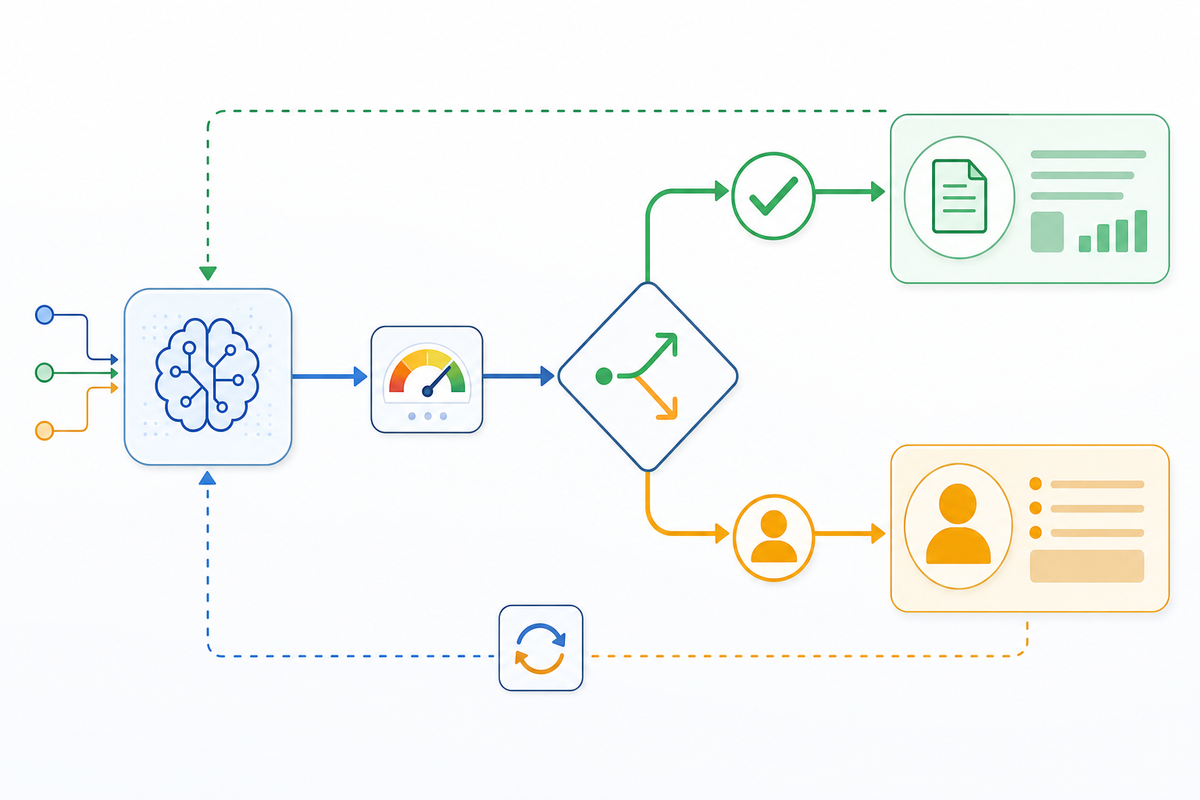
The core mechanism is straightforward. An AI model processes incoming tasks and assigns each output a confidence score. When that score clears a defined threshold, the output moves forward automatically. When it falls short, the system routes the item to a human reviewer for a judgment call.
That threshold is the key design decision. Set it too high and humans end up reviewing everything, which defeats the purpose of automation. Too low and errors slip through unchecked. Most HITL systems calibrate the threshold so only genuinely uncertain or high-stakes outputs get escalated, while routine decisions run on their own.
The feedback loop is where HITL compounds in value. Human corrections and overrides get fed back as labeled training data. Over time, the model learns from those failure cases, and the volume of flagged items shrinks. The review layer catches errors now and reduces how often they occur later.
Types of Human Oversight in AI Systems
Not every workflow needs the same level of oversight. Three models define the list, and choosing between them depends on how much risk you're willing to accept when AI makes decisions without waiting for a human.
Human in the Loop
A human reviews and approves each AI output before it takes effect. Every decision passes through a human checkpoint. This fits high-stakes contexts like medical coding, legal document review, or financial approvals, where individual errors carry a lot of downstream cost.
Human on the Loop
The AI operates autonomously while a human monitors outputs and steps in on exceptions. Routine decisions run without sign-off; flagged or anomalous cases get escalated. Common in fraud detection or content moderation at scale, where speed matters but someone needs to stay watchful.
Human in Command
The AI generates recommendations, but a human retains final authority before any action is taken. The model never acts unilaterally. Clinical diagnostics and autonomous systems often sit here, where an unchecked error is simply not acceptable.
Why Human Review Improves AI Accuracy and Reliability
MIT Sloan research found that human review catches errors AI systems miss on their own. The same study showed that human-AI collaboration can outperform either humans or AI working alone when each contributes complementary strengths. In one image-classification study, human-AI teams achieved 90% accuracy compared with 81% for humans alone and 73% for AI alone.
There are a few reasons why this holds across industries:
- AI models are trained on historical data, which means they can confidently produce outputs that are outdated, contextually wrong, or subtly biased in ways that aren't obvious from the output itself. A human reviewer brings current knowledge and situational awareness that no training set can fully replicate.
- Hallucinations are a known failure mode in LLMs. Without a review layer, those fabricated facts ship to end users. Human reviewers intercept them before they cause real damage.
- Accountability gaps close when a person signs off. In compliance-heavy industries, an AI output alone rarely satisfies audit requirements. Human approval creates the paper trail that compliance teams actually need.
The Compounding Effect of Review Over Time
Human review improves AI accuracy over time, not simply in the moment. When reviewers flag errors, correct outputs, or reject low-confidence results, that feedback can be routed back into model fine-tuning or used to tighten prompts. The review layer becomes a feedback loop that makes the underlying AI better with each cycle.
This is why HITL AI tends to get more reliable as it matures. The humans aren't simply catching mistakes; they're teaching the system where its edges are.
The Role of Human Oversight in Bias Detection and Ethical AI
AI systems learn from historical data, and that data often contains embedded biases. Without human review, those biases get amplified at scale instead of caught and corrected.
This is one of the clearest arguments for HITL AI in practice. A model trained on skewed datasets might consistently underserve certain demographic groups in lending, hiring, or healthcare recommendations. Human reviewers with domain knowledge can spot these patterns before they cause real harm.
Where Human Reviewers Catch What Models Miss
Bias in AI outputs rarely announces itself. It shows up in subtler ways: a resume screening tool that consistently ranks candidates from certain universities lower, or a content moderation system that flags dialect-specific language at higher rates. These aren't obvious errors. They require humans who understand context, culture, and the downstream consequences of a decision.
Human oversight also matters for ethical edge cases that fall outside a model's training distribution. When an AI system encounters a genuinely novel situation, it doesn't know what it doesn't know. A human reviewer can recognize when a decision warrants escalation, a second opinion, or a policy exception.
There are a few specific areas where this oversight proves its worth:
- Reviewing outputs across demographic segments to identify whether error rates or confidence scores differ in ways that align with protected characteristics, catching disparate impact before it compounds.
- Flagging decisions that technically satisfy a model's objective function but violate the spirit of what the system was designed to do, catching Goodhart's Law problems before they scale.
- Providing feedback loops that surface recurring edge cases back to the training pipeline, so the model improves over time instead of repeating the same mistakes.
Getting this right extends beyond fairness in the abstract. Regulators in the EU and US are actively building audit requirements around AI decision-making in high-stakes domains, especially for enterprise deployments. A documented human review layer is increasingly what separates a defensible AI system from a liability, especially when building enterprise-ready collaboration into AI workflows.
Regulatory Compliance and Human Oversight Requirements
Regulators are paying close attention to how AI gets deployed, and the expectations around human oversight are getting stricter by the year. The EU AI Act, which took full effect in 2026, requires human oversight for high-risk AI systems across sectors like healthcare, finance, and hiring. Non-compliance carries fines up to €30 million or 6% of global annual revenue.
For teams building in compliance-heavy industries, HITL AI isn't optional. It's what keeps you on the right side of the law.
Active Learning: How Humans Train AI Through Feedback
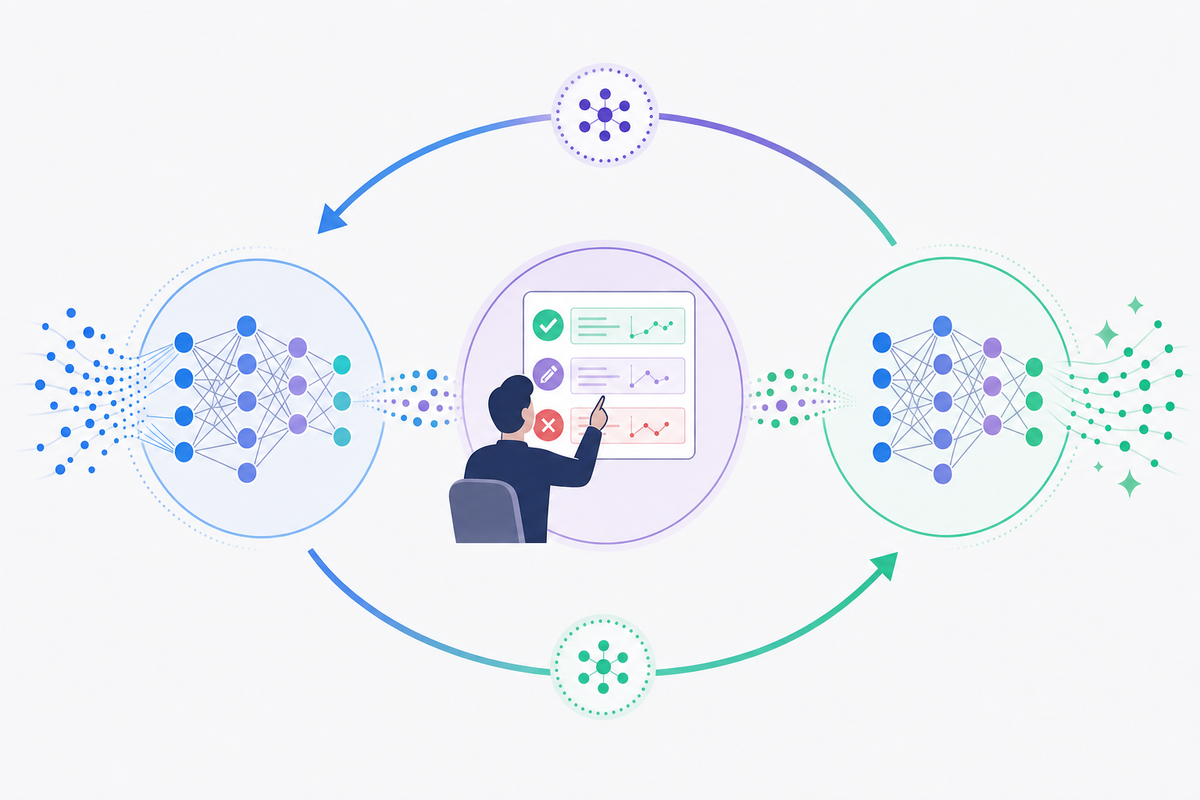
Active learning sits at the core of how AI systems actually get better over time. When a human reviewer flags an incorrect output, confirms a correct one, or edits a result, that signal feeds back into the model's understanding of what "good" looks like in a given context.
This feedback loop separates HITL AI systems that improve from those that plateau. Without it, a model trained on static data keeps making the same category of mistakes indefinitely.
How the Feedback Cycle Works
The mechanics are straightforward. A model generates an output. A human reviews it and either approves, rejects, or corrects it. That judgment gets logged and used to refine future model behavior through retraining, fine-tuning, or reinforcement learning from human feedback (RLHF).
Each of those review actions carries different weight:
- Corrections are the richest signal because they show the model both what was wrong and what the right answer looks like, giving it two data points in a single interaction.
- Rejections tell the model what to avoid but leave the correct path implicit, so they're useful in volume but less informative than direct edits.
- Approvals confirm the model is on track and help prevent over-correction during retraining, which matters when a model is already performing well in certain domains.
Over time, patterns in human feedback reveal where a model's blind spots are clustered, which helps teams decide where to focus retraining effort instead of treating the whole model as equally uncertain.
Real-World Use Cases Across Industries
Across industries, the pattern repeats: AI handles volume, humans handle the decisions that carry real consequences.
| Industry | What AI Does | What Humans Review |
|---|---|---|
| Healthcare diagnostics | Screens imaging scans and flags anomalies for attention | Radiologist validates findings before any diagnosis is recorded or treatment ordered |
| Financial fraud detection | Scores transactions and surfaces high-risk alerts in real time | Analyst confirms before freezing accounts or blocking payments |
| Content moderation | Auto-flags potential policy violations across millions of posts | Reviewer adjudicates borderline cases and processes user appeals |
| Autonomous vehicles | Classifies edge-case sensor inputs during operation | Safety engineer reviews failure logs and updates the underlying decision logic |
The specifics vary, but what each of these shares is a clear handoff point: the AI gets you to a decision, and a human takes responsibility for it.
Challenges of Implementing HITL
Implementing HITL AI sounds straightforward in principle, but the practical reality is messier. A few recurring challenges trip up most teams.
Where things tend to break down
- Reviewer bottlenecks are the most common failure point. When AI output volume exceeds reviewer capacity, queues pile up and latency benefits evaporate, particularly in content moderation or medical triage, where review can't be batched indefinitely.
- Feedback loop degradation happens when reviewer decisions aren't fed back into model training. If that signal dies in a spreadsheet, the model keeps making the same mistakes.
- Inconsistent review standards across reviewers introduce noise. Two humans reviewing the same output may reach different conclusions, making aggregate feedback less useful for retraining.
- Scope creep is real. Teams start with targeted checks on high-stakes outputs, then gradually route more through review until the human layer becomes a catch-all that bogs down the entire workflow.
Getting this right requires review infrastructure that routes outputs intelligently, captures structured reviewer decisions, and keeps audit trails intact so feedback is actually usable. Without that layer, HITL AI stays a concept instead of a functioning system.
How to Build Effective Human Review Workflows
Building a review workflow that actually holds up means thinking through a few core design decisions before you write a single line of code.
Define Clear Escalation Paths
Not every AI output needs the same level of scrutiny. A tiered approach works best: low-risk outputs get spot-checked, medium-risk outputs require a single reviewer sign-off, and high-stakes decisions go through a structured approval chain. Map these tiers before you build anything.
Match Review Tools to Reviewer Context
Reviewers need feedback tools that live where the work lives. Pulling someone into a separate review app breaks context and slows decisions. Inline commenting, approval states, and audit trails anchored directly to the AI output reduce the friction that causes reviewers to rubber-stamp instead of actually check.
Track What Gets Overridden
Every human correction is a labeled training signal. Capture which AI outputs were accepted, modified, or rejected, and why through activity logs. Teams that track override rates systematically can retrain models on real disagreements instead of guessing where the model is weakest.
Set Review SLAs
Human review only works if it happens on time. Define expected turnaround windows per output tier, assign clear ownership, and surface overdue reviews automatically through notifications. Without SLA enforcement, queues back up and the review layer becomes a bottleneck instead of a safeguard.
Human Oversight at Scale: When AI Volumes Grow
As AI systems take on more decisions, the question isn't whether humans should stay in the loop. It's how to keep them there without creating a bottleneck that slows everything down.
The answer lies in tiered review. Not every AI output carries the same risk, so not every output needs the same level of scrutiny. Low-stakes, high-confidence outputs can move automatically. Borderline cases get flagged for human review. High-stakes decisions require sign-off before anything happens. This kind of structure keeps humans where they matter most without requiring them to touch everything.
Building a Review Layer That Scales
Three approaches tend to work well in practice:
- Confidence-based routing sends outputs to human reviewers only when the model's confidence score falls below a defined threshold, so reviewers spend their time on genuinely uncertain cases instead of rubber-stamping easy ones.
- Asynchronous review queues let reviewers work through flagged items at their own pace, decoupling the human review step from real-time AI output so neither side blocks the other.
- Sampling and spot-checking applies human review to a random subset of auto-approved outputs, which catches drift and keeps the model accountable without requiring full coverage.
The goal across all three is the same: human judgment stays active in the system, but it's applied where it actually changes outcomes.
Building Review and Approval Infrastructure for AI Workflows
When AI makes a decision that affects real users, someone needs to be able to review it, flag it, and route it for correction. That review layer is infrastructure. It needs commenting, approval states, audit trails, and notifications baked in from the start.
Velt is built for exactly this. Velt provides review and approval infrastructure, with comments, approval workflows, presence, notifications, audit trails, and recording, designed to sit on top of AI-generated output and give human reviewers the tools to act.
What This Looks Like in Practice
The pattern is consistent across AI workflows. Here's how you wire it up using Velt's Approval Engine API: define the workflow, dispatch a run when AI produces output, then record the reviewer's decision:
// Step 1: Define the workflow (run once per workflow type)
// POST https://api.velt.dev/v2/workflow/definitions/create
const definition = await fetch('https://api.velt.dev/v2/workflow/definitions/create', {
  method: 'POST',
  headers: {
    'x-velt-api-key': process.env.VELT_API_KEY,
    'x-velt-auth-token': process.env.VELT_AUTH_TOKEN,
    'Content-Type': 'application/json',
  },
  body: JSON.stringify({
    data: {
      definitionId: 'ai-content-review',
      name: 'AI Content Review',
      nodes: [
        // AI generates the draft
        { nodeId: 'ai-draft', type: 'agent', config: { agentId: 'content-agent-v1' } },
        // Human reviewer approves or rejects
        { nodeId: 'human-review', type: 'human', config: { reviewers: [{ userId: 'u_editor_01', mandatory: true }] } },
        // AI publishes once approved
        { nodeId: 'ai-publish', type: 'agent', config: { agentId: 'publish-agent-v1' } },
      ],
      edges: [
        { from: 'ai-draft', to: 'human-review' },
        { from: 'human-review', to: 'ai-publish', when: 'output.decision == "approved"' },
      ],
    },
  }),
});

// Step 2: Dispatch an execution when an AI output is ready for review
// POST https://api.velt.dev/v2/workflow/executions/dispatch
const execution = await fetch('https://api.velt.dev/v2/workflow/executions/dispatch', {
  method: 'POST',
  headers: {
    'x-velt-api-key': process.env.VELT_API_KEY,
    'x-velt-auth-token': process.env.VELT_AUTH_TOKEN,
    'Content-Type': 'application/json',
  },
  body: JSON.stringify({
    data: {
      definitionId: 'ai-content-review',
      idempotencyKey: `review-${contentId}-${Date.now()}`,
      webhookUrl: 'https://your-app.com/webhooks/velt',
      webhookSecret: process.env.VELT_WEBHOOK_SECRET,
    },
  }),
});
// Returns: { executionId: 'exec_...', status: 'running' }
// Webhook fires: step.awaiting-approval → notify reviewer

// Step 3: Record the reviewer's decision
// POST https://api.velt.dev/v2/workflow/steps/record-reviewer-decision
const decision = await fetch('https://api.velt.dev/v2/workflow/steps/record-reviewer-decision', {
  method: 'POST',
  headers: {
    'x-velt-api-key': process.env.VELT_API_KEY,
    'x-velt-auth-token': process.env.VELT_AUTH_TOKEN,
    'Content-Type': 'application/json',
  },
  body: JSON.stringify({
    data: {
      executionId: execution.executionId,
      nodeId: 'human-review',
      reviewerId: 'u_editor_01',
      decision: 'approved',  // or 'rejected'
      note: 'Reviewed for accuracy and brand compliance.',
    },
  }),
});
// Webhook fires: step.completed → ai-publish step runs → execution.completed
// Full decision log is stored automatically in Velt's audit trail
The pattern is consistent across AI workflows:
- Reviewers need to leave inline comments on specific AI outputs, not fire off a Slack message and hope the right person sees it. Velt anchors feedback to the exact element being questioned with fully customizable collaboration experiences.
- Approval states need to be tracked explicitly so teams know what's been cleared, what's pending, and what got flagged. Velt handles that state without custom engineering.
- Every review action needs a record. Audit trails matter for compliance and for training future AI iterations. Velt logs it automatically.
Shipping this from scratch takes months. Velt integrates in days.
Final Thoughts on Human in the Loop AI
AI handles volume. Humans handle the decisions that carry real consequences. The systems that work are the ones where that handoff is deliberate, where review happens on genuinely uncertain outputs, and where every correction feeds back into making the model better. If you're building review workflows on top of AI-generated output, book a demo to see how Velt handles comments, approvals, and audit trails without building from scratch.
FAQ
What's the main difference between human in the loop and human on the loop AI?
Human in the loop AI requires explicit approval before any action takes effect, while human on the loop AI operates autonomously and only escalates exceptions. Choose human in the loop for high-stakes decisions like medical coding or financial approvals where individual errors carry a lot of cost, and human on the loop for high-volume workflows like fraud detection where speed matters but oversight is still needed.
Can AI systems actually improve from human review feedback?
Yes. When human reviewers flag errors, correct outputs, or reject low-confidence results, that feedback feeds back into model training through active learning. Corrections are particularly valuable because they show both what was wrong and what the right answer looks like, giving the model two data points per review action.
How do you prevent human review from becoming a bottleneck as AI volume scales?
Use tiered review based on risk and confidence scores. Low-stakes, high-confidence outputs move automatically, borderline cases get flagged for review, and high-stakes decisions require sign-off. This keeps humans focused where they actually change outcomes instead of rubber-stamping every AI output.
Human in the loop AI for compliance vs automation?
HITL AI satisfies both. The AI handles volume and speed while human review creates the audit trail and accountability that regulators require. Under the EU AI Act, high-risk AI systems in healthcare, finance, and hiring must include human oversight, making HITL the only legally compliant approach for these sectors.
What review infrastructure do you need for HITL AI workflows?
You need inline commenting anchored to specific AI outputs, approval state tracking, audit trails that log every review decision, and notifications to route flagged items to the right reviewers. Building this from scratch takes months, which is why review infrastructure tools like Velt ship these features as ready-to-integrate SDKs that go live in days.