


Manual Review vs Automated Review: Building a Risk-Based Workflow That Scales (May 2026)
Learn when manual review beats automation and when AI QA delivers better ROI. Complete guide to building risk-based review workflows in May 2026.
When your team was smaller, manual review vs automated review wasn't really a question. Everything got a human look. Now you're processing enough volume that manual review on everything creates a bottleneck, but automating the wrong checks just moves low-quality work downstream faster. The answer isn't picking one or the other. It's building review and approval infrastructure, the kind Velt provides, that routes low-stakes changes through automated checks and flags high-stakes ones for human judgment, without making you swap tools at each stage.
TLDR:
- Manual review catches context and judgment calls; automated review handles volume and consistency.
- Risk-based routing sends high-stakes changes to humans and low-stakes to automation.
- AI narrows the gap between automated checks and substantive review by reasoning about intent.
- Velt provides review and approval infrastructure that scales from manual commenting to automated QA.
What Manual Review and Automated Review Actually Mean
Manual review means a human reads, assesses, and responds to content or work output before it moves forward. In a software context, that looks like a pull request where someone leaves inline comments, requests changes, and eventually approves or rejects. In a content or design context, it's a stakeholder dropping feedback in a doc or a shared file.
Automated review means software checks the work instead. Linters, type checkers, test runners, and accessibility scanners fall here. They catch what they're programmed to catch, fast and consistently.
The gap between these two has been shrinking. AI can flag issues, summarize changes, and surface risks that previously required a senior engineer's eye.
The Core Differences Between Manual and Automated Review
Manual review catches the things automated tools miss: tone, contextual judgment, edge cases that require domain knowledge. Automated review catches the things humans miss: consistency errors, scale violations, anything that requires checking hundreds of items without fatigue. Neither is strictly better. Here's where each breaks down:
- Manual review slows to a crawl under volume. A team that handles 50 assets per week starts missing things at 500.
- Automated review fails on ambiguity. Rules-based checks can't read intent.
The smarter question isn't which one wins. It's where each one belongs in the same workflow. The table below breaks down six factors: speed per review, edge case accuracy, cost per decision, best use cases, primary limitations, and scaling behavior.
| Factor | Manual Review | Automated Review |
|---|---|---|
| Speed per review | Minutes to hours depending on complexity and reviewer availability | Seconds to minutes, runs on every save or commit |
| Accuracy on edge cases | Catches contextual issues, brand voice problems, and judgment calls that require domain knowledge | Misses ambiguity and novel situations outside predefined rules |
| Cost per decision | High labor cost but low false positive rate. Reviewer time scales linearly with volume. | Low marginal cost after setup. High initial investment in rule definition and tool configuration. |
| Best use cases | Architectural decisions, regulatory edge cases, client-facing brand content, cross-functional impact assessment | Compliance flag checking, formatting validation, broken link detection, accessibility scanning, high-volume repetitive checks |
| Primary limitation | Bottlenecks under volume. A team handling 50 reviews per week starts missing issues at 500. | Fails on intent and context. Can't assess whether logic holds under novel assumptions. |
| Scaling behavior | Requires adding more reviewers. Quality degrades with reviewer fatigue at high volume. | Scales horizontally with infrastructure. Consistency improves as volume increases and rules get refined. |
When Manual Review Still Wins
Some decisions carry stakes that rules can't measure. When a financial model changes how a business forecasts headcount, the review is assessing whether the logic holds under assumptions an automated scanner has never encountered.
A few places where human review stays necessary:
- Brand voice on client-facing content. Automated tools check grammar. They can't tell you whether a sales deck sounds like the brand or sounds like a template.
- Regulatory edge cases in compliance workflows. When a document sits near an exception, reviewers need judgment about intent, beyond pattern matching.
- Architectural decisions with cross-functional impact. A change to a data schema touches five teams. Automated checks test syntax. Humans assess the blast radius.
- Content that carries legal or reputational exposure. A marketing campaign crossing into a new market, or a contract clause with novel language, needs a person, not a rule.
Manual review here isn't legacy. It's the judgment layer for what rules can't anticipate.
When Automation Delivers Higher ROI
Automation pays off fastest when the review process is repetitive, high-volume, and rule-driven. Checking whether a contract contains required disclosure language, confirming a data report matches its source figures, or flagging accessibility violations in a UI all follow consistent logic that doesn't require human judgment on every pass. Research from McKinsey estimates that knowledge workers spend roughly 25% of their time on review and approval tasks. Automating even a fraction of that recaptures hours per person per week.
Automation ROI is strongest when:
- The criteria for a passing review can be written down as rules, because AI checks rules faster and more consistently than people do.
- Volume is high enough that manual review creates a bottleneck, slowing releases or approvals downstream.
- The cost of a false negative (missing a real issue) is lower than the cost of the delay manual review introduces.
Human review still wins when judgment, context, or accountability can't be codified into a ruleset.
The Hybrid Model: Routing Review Based on Risk
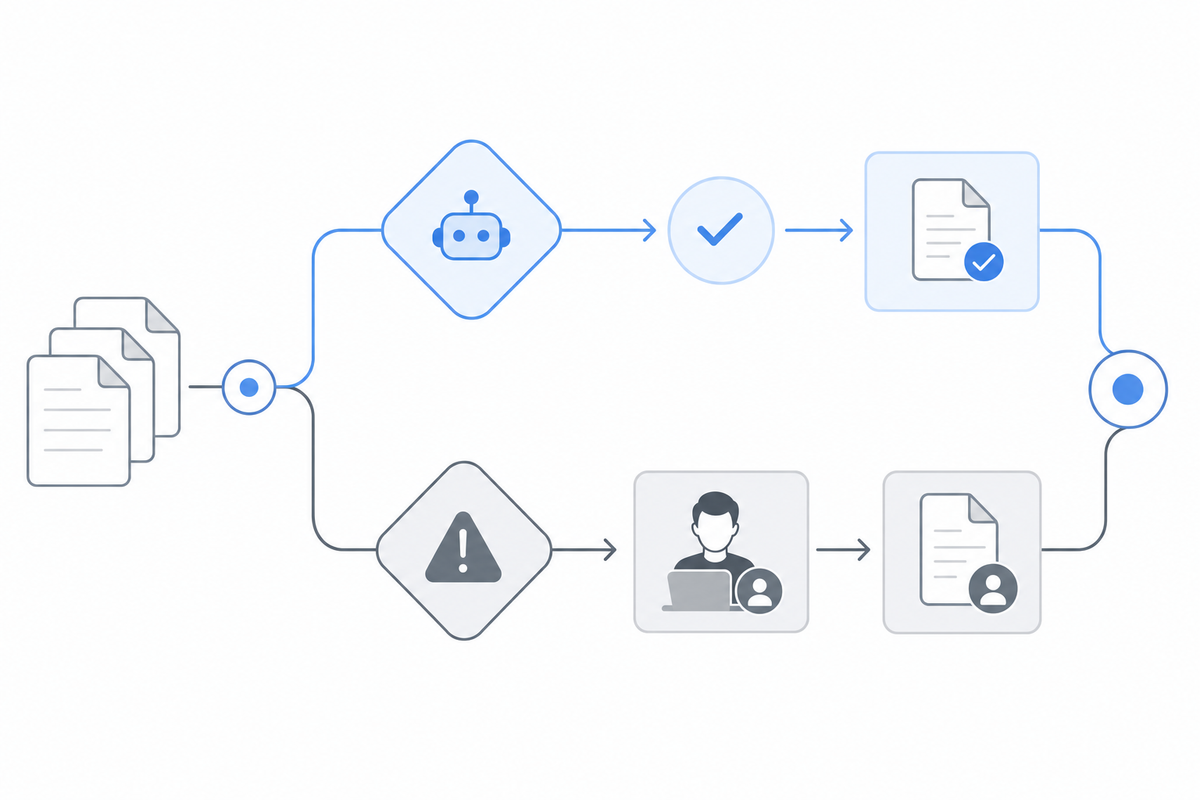
Risk-based routing is how mature review workflows actually operate. Low-stakes changes go straight through automated checks. High-stakes changes get routed to human reviewers. The split isn't arbitrary; it follows a logic tied to consequence.
Think about what makes a change risky: regulatory exposure, revenue impact, brand visibility, or customer-facing scope. A pricing update on a checkout page carries more consequence than fixing a typo in internal docs. Treating both with the same review depth wastes time on one and underprotects the other.
Routing Criteria That Work in Practice
A few signals that reliably predict where human judgment adds value:
- Content touching compliance-sensitive data fields or compliance language warrants human sign-off, since automated checks can catch formatting errors but miss contextual misuse.
- Changes affecting high-traffic pages or monetized surfaces carry revenue risk that automation alone shouldn't clear.
- Any update that modifies access controls, permissions logic, or security configurations should go to a human reviewer regardless of how clean the automated scan looks.
Automated checks still run on everything. The question is whether human review gets layered on top.
How AI Changes the Review Automation Range

AI pushes the review automation range further than rule-based tooling ever could. Static scripts check for known patterns. AI reasons about intent, context, and quality in ways that don't require you to pre-define every possible failure mode. A few concrete changes worth knowing:
- AI can flag issues it was never explicitly trained to catch. A model reviewing a sales deck doesn't need a rule that says "don't make unverified revenue claims": it understands what a claim is and why unverified ones create risk. That's a different category than a linter catching a missing field.
- It reduces false positives that frustrate reviewers and erode trust in automated feedback over time. A rules-based accessibility scanner flags every image missing an alt attribute. An AI-assisted scanner can distinguish decorative images from informational ones and skip the false alarm.
- It learns from reviewer behavior, so the gap between automated suggestions and human judgment narrows with use. If your team consistently overrides a certain flag as irrelevant, the AI adjusts. A static rule doesn't.
The result is that the line between "automated pre-check" and "substantive review" gets blurry. That changes how you should think about where humans stay in the loop.
The Economics of Review: Cost Per Decision
Every review cycle carries a cost most teams don't fully account for. There's the obvious part: reviewer time. But the less visible costs add up faster. Waiting on feedback delays downstream work. Miscommunication between reviewers and authors triggers rework cycles. Missed issues slip into production and generate support tickets or compliance findings. Automated review, though, catches the predictable failures early, before a human ever looks. That changes the math. Human reviewers spend time on judgment calls, not formatting errors or missing fields. The cost per decision drops when each decision actually requires a decision.
Building a Review Workflow That Scales
The review workflow that works for a 5-person team usually breaks somewhere around 20. A Slack thread that held feedback fine at small scale becomes a liability when 8 reviewers are commenting simultaneously and nobody can tell which version they're looking at. Scaling review means picking the right method for each stage of your pipeline. Some content genuinely needs a human eye. Other checks, formatting rules, broken links, compliance flags, can run automatically on every save.
The teams that get this right treat review as infrastructure, not process. They define which checks are automated, which require human sign-off, and what the handoff between them looks like before anything goes to production.
Velt: Review and Approval Infrastructure for the Full Range
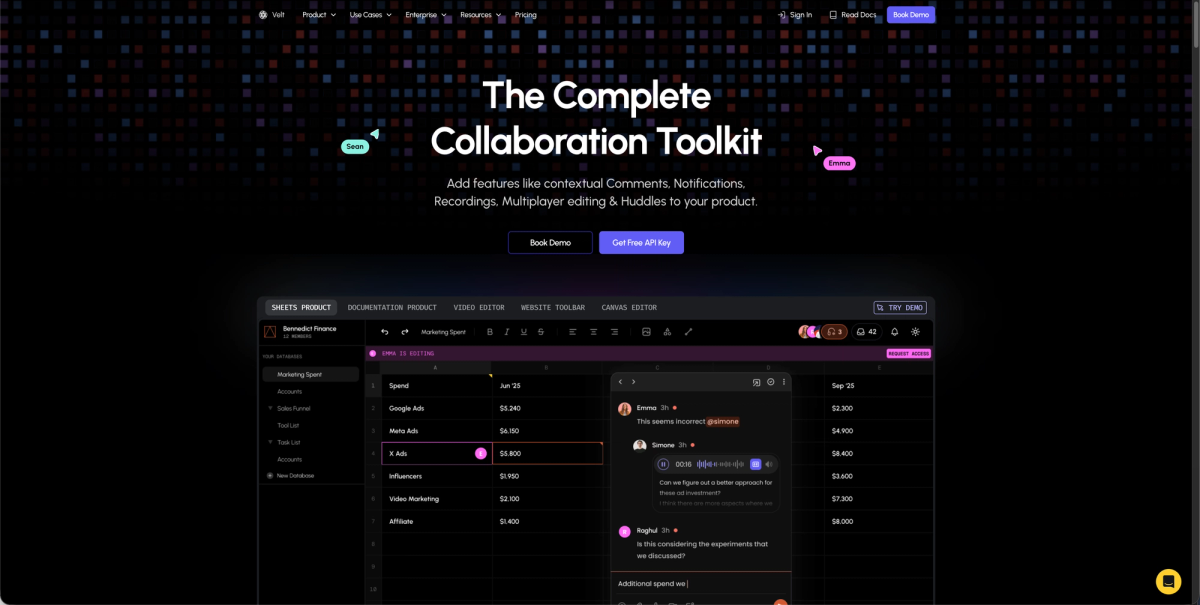
Velt is review and approval infrastructure that covers the full range described in this article. On the manual end, contextual comments bind to specific elements in your app, not to Slack threads or email chains. Approval workflows track formal sign-off with configurable assignees and resolution states. Audit trails log every decision, timestamped and attributed, so nothing gets lost.
On the automated end, Velt's AI layer can flag issues before a human ever opens the file. Rules-based checks run on submission. AI suggestions surface inline, in the same thread where human reviewers respond.
The result is a single review infrastructure that scales from a one-person manual check to a fully automated QA pipeline, without swapping tools at each stage.
Final Thoughts on Manual vs Automated Review
Review automation isn't replacing manual review.
It's redefining what manual review should spend time on. The workflows that scale are the ones that route decisions by consequence, not by habit, so your team reviews what matters instead of everything. AI now handles the prechecks that used to need a senior engineer, and according to recent research, 47% of developers say reviewing and validating AI-generated output is now their most critical skill for 2026. But judgment on brand, compliance edge cases, and cross-team impact still belongs to humans.
Velt covers both ends without forcing you to swap tools when your volume or complexity changes. See how it routes review in a 20-minute walkthrough and you'll understand why teams stop treating review as a bottleneck.
FAQ
Manual review vs automated review: which one is faster?
Automated review is faster for repetitive, high-volume checks like catching broken links or compliance flags. Manual review is slower but catches contextual judgment calls like brand voice or cross-functional impact that automation can't assess. Speed alone doesn't determine which method fits your workflow.
What's the best way to decide between manual and automated review?
Route based on risk, not blanket policies. Low-stakes changes like internal doc typos should go through automated checks only. High-stakes changes like pricing updates on checkout pages or regulatory content need human sign-off. The split follows consequence: revenue impact, regulatory exposure, brand visibility, or customer-facing scope.
Can AI review tools replace human reviewers completely?
No. AI can flag issues it was never explicitly trained to catch and reduce false positives, but it breaks down on decisions that require domain knowledge or judgment about intent. Financial model assumptions, brand voice on client-facing content, and architectural decisions with cross-functional impact still need a person.
How do you build a review workflow that scales past 20 people?
Treat review as infrastructure, not process. Define which checks run automatically (formatting, broken links, compliance flags), which require human sign-off, and what the handoff between them looks like. The workflows that break at scale are ones where feedback lives in Slack threads or email chains with no version control or audit trail.
Which software tools support inline commenting for cross-functional reviews?
Velt provides contextual comments that bind to specific elements in your app, with approval workflows and audit trails built in. The comments stay attached to the element being discussed, so feedback doesn't get lost when layouts change or when multiple reviewers comment at once.