The Velt vs Knock decision comes down to architecture. Knock works as middleware between your app and messaging providers like SendGrid and Twilio, requiring you to coordinate multiple vendor accounts and build your own notification UI. Velt bundles notifications with collaboration features like contextual comments and real-time presence in one SDK, handling both delivery and interface. But that's not every way they are different. In this post, we'll dig into the details of how the differences between Velt and Knock look like in practice.
TLDR:
Knock routes notifications through third-party providers you manage separately; Velt bundles notifications with collaboration features in one SDK
Velt includes pre-built UI components for notifications, comments, and presence; Knock requires you to build frontend interfaces yourself
Velt offers 99.999% uptime SLA and data residency across 45+ regions versus Knock's standard 99.99% reliability
Velt is a collaboration SDK with built-in notifications that link directly to document context where events occur
What is Knock?
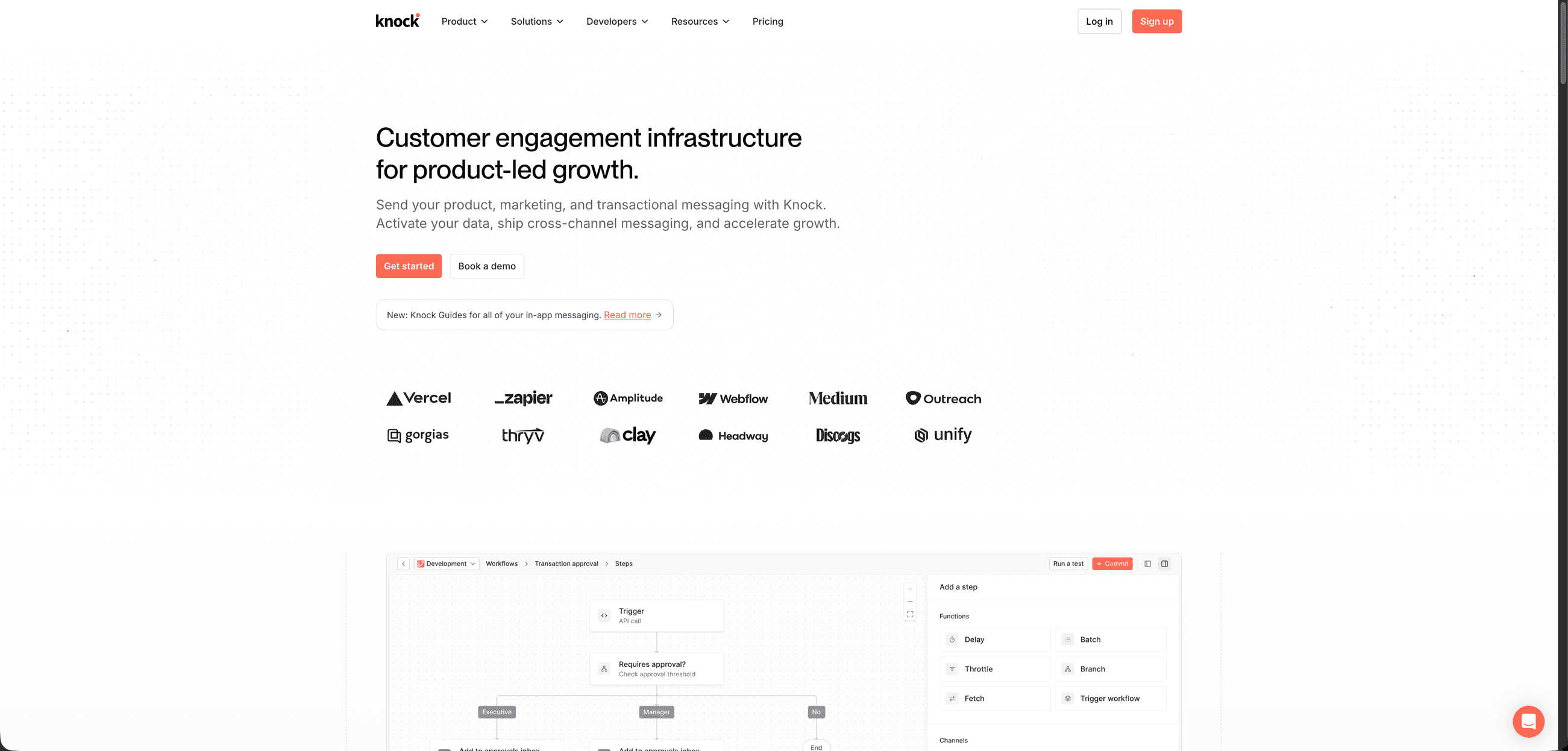
Knock is a notification infrastructure API that manages transactional alerts across multiple channels. It works as middleware between your app and providers like SendGrid, Twilio, Firebase Cloud Messaging, and Slack. The service handles notification orchestration. You trigger events from your backend, and Knock routes messages to appropriate channels based on your workflow configuration. A visual workflow builder lets you define notification logic, set delivery preferences, and configure channel fallbacks.
Knock helps engineering teams separate notification logic from application code. instead of hardcoding email templates and SMS triggers in your codebase, you manage notifications through Knock's dashboard and trigger them via a single API call.
What is Velt?
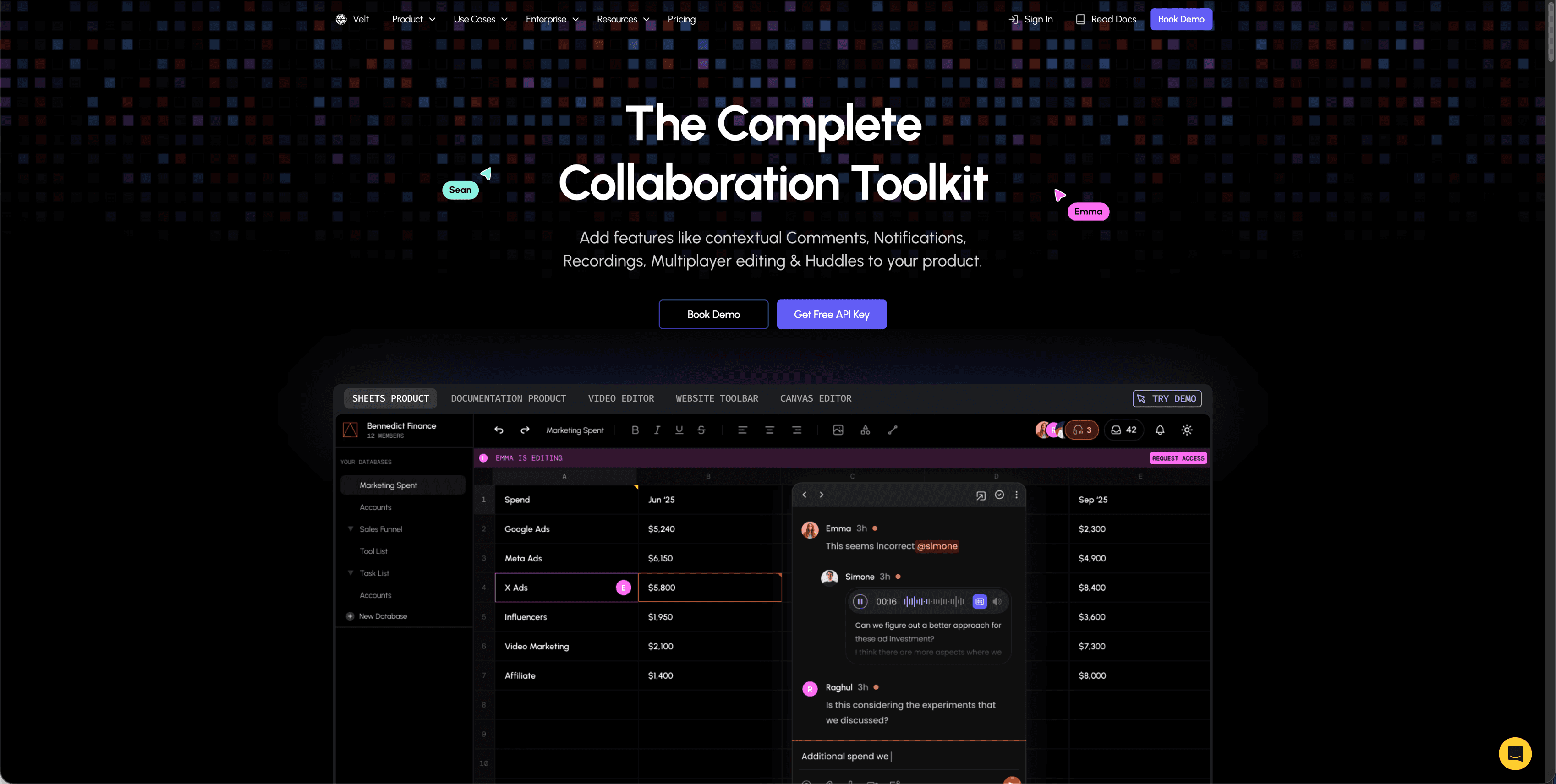
Velt is a collaboration SDK that bundles over 25 features into one integration, including contextual comments, real-time presence, notifications, screen recordings, live huddles, AI assistance, and activity tracking. Unlike notification-only services, Velt provides full collaboration infrastructure. When users comment on a document or join a video huddle, the notification system automatically captures and routes those activities. The SDK handles both UI components and backend logic, eliminating the need to build comment threads, presence indicators, or notification inboxes separately. Velt integrates into web apps and handles realtime synchronization, permissions, and data storage required for multi-user collaboration.
What To Consider When Assessing Notification SDKs
Whether you are looking at Velt, Knock, or another alternative, any evaluation of a notification SDK should consider a number of critieria:
Notification architecture and approach
Workflow management and message control
Channel support and delivery infrastructure
Developer experience and integration time
Enterprise requirements and compliance
Notification Architecture and Approach
How a notification SDK is architected can have a big impact on performance and user experience:
Knock routes notifications to third-party providers like SendGrid, Twilio, Firebase Cloud Messaging, and Slack. This requires that you maintain separate vendor accounts while Knock coordinates delivery through workflow configurations in their dashboard. These workflows define channel selection, batching rules, delays, and fallback logic when providers fail.
Velt, on the other hand, bundles delivery into the SDK with pre-built UI components for in-app notifications and a unified inbox. When users comment or @mention collaborators, notifications generate automatically and link to the exact document location. Email digests are optional, but the core experience happens in-app where users already work.
Workflow Management and Message Control
Managing notification volume matters when users generate dozens of events daily. Both Knock and Velt handle this differently:
Knock uses a workflow engine with triggers, batching rules, throttling limits, and channel preferences. You can batch notifications into hourly or daily summaries instead of individual alerts. Throttling caps how many notifications users receive in a given time window. Users control notification frequency per channel, though Knock lacks account-level limits to cap total message volume.
Velt handles notification control through collaboration context. When users comment, mention teammates, or reply to threads, notifications generate automatically. The system understands your app's hierarchy, so users without document access won't receive notifications about it. Activity aggregates into a unified inbox spanning the entire organization.
Channel Support and Delivery Infrastructure
Channel support is critical. If the notification SDK you have, or are looking at, doesn't support delivery in the channels your users spend the most time in (like Slack), it can require additional engineering work to build and support. Both Knock and Velt support email, SMS, push, and in-app messaging, but their implementation approach differs:
Knock routes messages through your third-party provider accounts like SendGrid, Twilio, and Firebase. Each provider requires separate billing and API management. It doesn't provide in-app notification feeds or inbox UI components, so you build the interface yourself. Slack and Teams integrations aren't included in standard plans, and features like batching require higher tiers.
Velt delivers notifications through built-in infrastructure. The SDK includes pre-built notification feeds and inbox UI. Email delivery runs through Velt's servers without requiring SendGrid accounts. Slack and Teams integrations work through webhooks for collaboration events.
Developer Experience and Integration Time
Any consideration of third-party SDKs should include an evaluation of the developer experience. What is it like to integrate it? Is the documentation clear? Are there code examples to use? And, of course, how hard is it to bake into your software? Both Knock and Velt handle this in their own way:
Knock provides isolated testing environments and versioning workflows that connect with CI/CD pipelines. Developers deploy notification configurations programmatically and test changes before production. The tradeoff appears during maintenance when coordinating multiple provider relationships, each with separate API keys, billing cycles, and failure modes.
Velt offers SDKs for React, Angular, Vue, and Svelte with pre-built UI components. Notifications use the same integration that powers comments, presence, and other collaboration features. There's no provider coordination because delivery infrastructure is bundled into the SDK.
Enterprise Requirements and Compliance
In today's business world, privacy and compliance are high priority considerations. If data is mishandled or if governmental requirements aren't met, it could mean fines or other penalties. Because of that, it's critical that you include an evaluation of how any SDK meets enterprise requirements like compliance.
For Velt and Knock, both services hold SOC 2 Type II and HIPAA certifications. Knock delivers enterprise-grade reliability for high-volume notification delivery with GDPR compliance for user data handling.
Velt takes it a step further, though, by adding infrastructure flexibility with data residency across 45+ geographic regions, letting you choose where collaboration data is stored. This helps teams operating under EU or Canadian data sovereignty rules. In addition, Velt's customer-managed reverse proxy support routes SDK traffic through your own infrastructure instead of directly to Velt's domains. Data self-hosting covers persistent collaboration content like comments and notifications, while realtime CRDT operations use managed cloud services. Finally, Velt offers a 99.999% uptime SLA for enterprise accounts versus the 99.99% industry standard, plus GDPR-specific APIs for data subject access requests and deletion.
Side-by-Side Comparison
Feature | Knock | Velt |
|---|---|---|
Architecture | Middleware that routes notifications through third-party providers like SendGrid, Twilio, and Firebase. Requires managing separate vendor accounts and API keys for each provider. | Bundled delivery infrastructure within the SDK. Includes pre-built UI components for notifications, comments, presence, and collaboration features in one integration. |
Workflow Management | Visual workflow builder with triggers, batching rules, throttling limits, and channel preferences. Configure notification logic through dashboard and trigger via API calls. | Notifications generate automatically from collaboration events like comments, mentions, and replies. Activity aggregates into unified inbox spanning entire organization. |
Channel Support | Routes through your provider accounts (SendGrid, Twilio, Firebase). Slack and Teams integrations not included in standard plans. No built-in UI components for notification feeds or inboxes. | Email, push, and in-app messaging through built-in infrastructure. Includes pre-built notification feeds and inbox UI. Slack and Teams integrations via webhooks for collaboration events. |
Developer Experience | Isolated testing environments and versioning workflows for CI/CD. Requires coordinating multiple provider relationships with separate API keys and billing cycles. | SDKs for React, Angular, Vue, and Svelte with pre-built UI components. Single integration powers notifications, comments, presence, and other collaboration features. |
Enterprise Features | SOC 2 Type II and HIPAA certifications. GDPR compliance. 99.99% uptime reliability for notification delivery. | SOC 2 Type II, HIPAA, and GDPR compliance. Data residency across 45+ regions. Customer-managed reverse proxy support. Data self-hosting for persistent content. 99.999% uptime SLA for enterprise accounts. |
Best For | Teams needing standalone notification delivery middleware who want to manage third-party provider relationships and need batching and throttling for transactional messaging. | Teams building collaborative apps where notifications work with contextual comments, real-time presence, recordings, and engagement features without managing separate providers. |
Why Velt is the Better Choice
Knock works well for teams needing standalone notification delivery middleware and managing third-party provider relationships themselves. Teams focused on transactional messaging may benefit from Knock's batching and throttling capabilities.
But, Velt is better for most teams building collaborative apps because notifications work with contextual comments, real-time presence, recordings, and engagement features in one SDK. When users receive a notification about a comment, they can reply, @mention teammates, and continue discussions without leaving your app. You integrate one SDK instead of coordinating SendGrid for email, Twilio for SMS, and Firebase for push, reducing integration complexity and maintenance overhead.
Final Thoughts on Notification API Solutions
When assessing a notification API like Knock or Velt's collaboration SDK, consider how notifications fit into your broader app architecture. Knock works as middleware between your code and providers like SendGrid or Twilio. Velt treats notifications as part of collaboration where comments, mentions, and activity automatically generate contextual alerts. You can integrate once and get both collaboration features and notifications without managing separate provider relationships.
FAQ
How should I decide between Knock and Velt for my app?
Choose Knock if you need standalone notification delivery middleware and already have collaboration features built separately. Choose Velt if you want notifications bundled with comments, presence, recordings, and other collaboration features in a single SDK. This reduces integration complexity and keeping users engaged within your app.
What's the main difference between Knock's workflow approach and Velt's notification system?
Knock routes notifications through third-party providers (SendGrid, Twilio) using a workflow builder you configure separately from your app logic. Velt generates notifications automatically from collaboration events (comments, mentions, replies) and delivers them through built-in infrastructure with pre-built UI components.
Who is Knock best suited for versus Velt?
Knock fits teams building transactional notification systems who want granular control over batching, throttling, and multi-channel routing through their own provider accounts. Velt fits teams building collaborative apps where notifications serve as one part of a larger real-time interaction system including comments, presence, and activity tracking.
What should I consider about provider management when assessing these tools?
Knock requires managing relationships with multiple third-party providers (SendGrid for email, Twilio for SMS, Firebase for push). When you use Knock you need separate API keys, billing, and failure modes for each provider. Velt bundles delivery infrastructure into the SDK, so you don't coordinate provider accounts or handle separate maintenance for each channel.
Can Velt handle enterprise data residency requirements?
Yes. Velt supports data residency across 45+ geographic regions and offers customer-managed reverse proxy support to route SDK traffic through your own infrastructure. Data self-hosting covers persistent collaboration content like comments and notifications, helping teams meet EU or Canadian data sovereignty requirements.