

What Is Review Infrastructure? Complete Guide (April 2026)
Learn what review infrastructure is and how it embeds feedback, approvals, and audit trails in your product. Complete guide for April 2026.
When AI outputs 40 drafts before your reviewer opens their laptop, you need somewhere for that sign-off to happen. Review infrastructure is the system you embed in your product to handle contextual comments, approval states, and audit trails right where the work lives. Not a separate tool. Not a workflow that routes through email. Infrastructure built into the app itself so review can keep pace with AI-generated output.
TLDR:
- Review infrastructure embeds feedback, approvals, and audit trails directly in your product instead of Slack or email.
- AI scaled content creation 10x, but review capacity stayed flat. Review is now the bottleneck in most workflows.
- Scattered review processes cost organizations 20-30% of annual revenue in lost approvals and duplicated effort.
- Building review infrastructure from scratch requires comment threading, presence, notifications, permissions, and audit logs: typically 6 months of engineering.
- Velt provides drop-in review and approval infrastructure that ships contextual comments, approval workflows, presence, notifications, and audit trails in days.
Last updated: April 17, 2026
What Review Infrastructure Means in Software Development
Review infrastructure, in software development, refers to the embedded systems that let teams give contextual feedback, track approvals, and maintain audit trails directly inside the products where work happens. Not a separate tool. Not a Slack thread. Infrastructure that lives in the app itself. This is worth separating from how "infrastructure review" gets used elsewhere. IT infrastructure reviews, highway project assessments, fund performance audits: those are about assessing external systems. Review infrastructure in software development is the opposite angle. It's what you build into your software so that review can happen at all.
The category is new because the need is new. AI tools now generate content, code, and business data faster than teams can sign off on it. Creation is no longer the bottleneck. Review is. And most SaaS products ship zero tooling to handle it.
Why Review Became the Bottleneck in 2026

AI flipped the ratio between creation and review. A content team with generative tools can produce 50 email variants before lunch. A dev with Cursor can scaffold a full feature in an afternoon. Supply chains running AI forecasting generate hundreds of production decisions per shift that humans still need to sign off on. Output scaled 10x. Review capacity didn't move. The result is a specific kind of backlog that's easy to miss. It doesn't look like a bug queue or a sprint board. It looks like a Slack thread asking "did anyone check this?" Or an email chain with six people CC'd and no clear decision. Or a document that went live because no one wanted to hold things up.
Review didn't get slower. The volume of things requiring review just outpaced every system built to handle it.
The pattern repeats across categories: in content production, AI drafts get published before brand or legal review; in compliance software, financial documents circulate without a clear sign-off trail; in internal tools, infrastructure changes get made without attribution. Creation scaled. The review layer never got rebuilt to match.
The Hidden Cost of Scattered Review Processes
Scattered review processes don't feel expensive until you add them up. IDC research puts the figure at 20 to 30% of annual revenue lost to re-keying, duplicated effort, and lost approvals across organizations. That's not an abstract number. It's what happens when approvals live in inboxes, feedback lives in Slack, and no one can reconstruct who signed off on what. Three costs compound fast:
- Context switching when reviewers have to locate the thing being reviewed, find the feedback thread, and get their bearings each time
- No audit trail when sign-off happens in a DM or a meeting, leaving compliance teams with nothing to show auditors
- Unclear approval states where "I think someone approved this" becomes the default, especially under deadline pressure
For teams in content production or compliance, that last one is particularly damaging. A document that goes out without a clear approval state creates downstream liability that a Slack message can't fix.
Core Components of Review Infrastructure
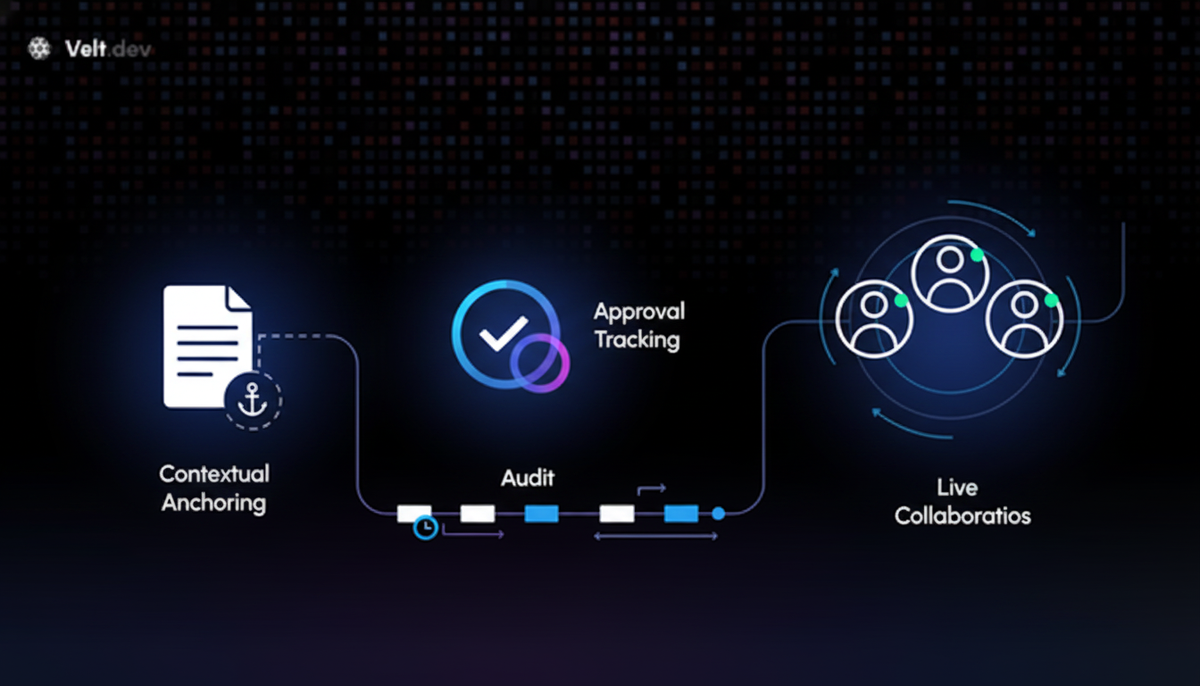
Review infrastructure is built from a set of foundational primitives that every SaaS product eventually needs, but few teams budget time to build properly. Think of how teams treat auth. Nobody builds OAuth from scratch anymore. You pick Clerk or Auth0 and move on. The same logic applies here. Let's look at the four components:
- Contextual anchoring
- Approval state tracking
- Real-time presence and notifications
- Audit trail generation
Contextual Anchoring
Feedback is useless without context. Pixel-based comment anchoring breaks when layouts reflow. Element-bound anchoring ties a comment thread to a data ID like slide-id or widget-id, keeping feedback attached to the thing being reviewed regardless of UI changes. Velt uses DOM-aware anchoring for exactly this reason.
Approval State Tracking
A comment thread is not an approval. Review infrastructure tracks discrete states: assigned, under review, approved, rejected. Without this layer, teams default to "I think someone approved it," which is how compliance incidents happen.
Real-Time Presence and Notifications
Reviewers need to know who else is looking and when something needs their attention. Presence signals prevent duplicated effort. In-app notifications with @mentions replace the Slack thread that would otherwise hold the conversation.
Audit Trail Generation
Every approval, comment edit, and state change should produce an immutable log, beyond a "recently updated" timestamp. A full record of who did what and when makes post-mortems possible and keeps compliance-heavy industries on track.
Review Infrastructure vs Approval Workflow Software
People use these terms interchangeably, but they solve different problems. Approval workflow software routes tasks. It tells the right person that something needs their attention, tracks whether they clicked approve or reject, and moves the item to the next step. Tools like Jira approvals, DocuSign, or ServiceNow workflows do this well. What they don't do is keep the conversation attached to the artifact. You click approve inside the workflow tool, but the actual feedback happened in a separate thread, a marked-up PDF, or a meeting no one recorded. The routing worked. The context got lost.
That gap is exactly what review infrastructure fills. The approval workflow software market is valued at $1.5 billion in 2024 and projected to reach $3.5 billion by 2033, growing at 9.8% annually. The growth makes sense: teams know they need formal sign-off. What the category hasn't solved is the feedback layer that precedes the approval.
Review infrastructure and approval workflow software aren't competing. They're sequential. Contextual comments, presence, and anchored feedback come first. Formal approval state and audit trail come second. Velt handles both in one layer, embedded directly in the product where the work lives. If you're weighing Velt against Liveblocks, our Velt vs Liveblocks comparison breaks down where each fit. The table below provides a high-level overview of the review components we looked at earlier and how they are tackled by review infrastructure (like Velt) and approval workflow approaches.
| Category | Review Infrastructure (Velt) | Approval Workflow Software (Jira, DocuSign, ServiceNow) |
|---|---|---|
| Primary Function | Embeds contextual feedback, comments, and presence directly in the product where work happens | Routes tasks between people and tracks formal sign-off states across systems |
| Where Feedback Lives | Anchored to specific DOM elements by data ID, keeping comments attached to the exact artifact being reviewed | Separate from the artifact: feedback happens in external threads, PDFs, or meetings that get referenced but not preserved |
| Audit Trail | Automatic immutable log of every comment, edit, approval state change, with timestamps and attribution built into the workflow | Tracks approval status and routing history, but not the contextual discussion that led to the decision |
| Integration Approach | Drop-in SDK that embeds review layer directly in your app's UI, ships in days | Standalone tools that require custom integrations and manual context transfer between systems |
| Use Case Fit | AI-generated content review, real-time collaboration on documents/designs, compliance workflows requiring contextual sign-off | Multi-step approval chains, contract signing, IT service requests, project phase gates |
| Market Size | New category built for AI-scaled content bottlenecks | $1.5B market (2024) projected to reach $3.5B by 2033 at 9.8% CAGR |
How Review Infrastructure Supports AI-Augmented Workflows
AI creates instantly. Verifying what it creates still takes a human. That gap is where review infrastructure earns its place.
In content operations, a generative tool can draft 40 campaign emails before a reviewer opens their laptop. Without anchored feedback and approval states embedded in the product, those drafts route through Slack, get commented on in a Google Doc, and go live before legal or brand signs off. The volume outpaces the process. Velt fits into this as the human oversight layer. AI agents produce output; review infrastructure gives human reviewers a structured place to respond, approve, or reject, with every decision logged. The audit trail isn't manual. It's a byproduct of the workflow itself. In compliance and FP&A software, the stakes are higher. An AI-generated financial summary still needs a CFO's eyes before it reaches a board. Velt tracks that sign-off formally, with timestamps and attribution, not a "LGTM" buried in a thread.
The same logic applies to data-rich analytics. When AI surfaces an insight in a dashboard, teams need to discuss it in context and reach a decision before acting. Velt keeps that conversation on the chart, not scattered across five different tools.
Building Review Infrastructure: The Build vs Buy Decision
Building review infrastructure from scratch sounds doable until you start listing what it actually requires. If you want to weigh the full tradeoffs, see our build vs buy guide for review infrastructure.
Comment threading alone touches auth, state management, WebSockets, and database schema. Add presence and you're writing conflict resolution logic. Add notifications and you're building aggregation across documents, @mention parsing, and email/Slack routing. Add permissions and you're implementing cascading rules across org, folder, and document levels. None of these are hard in isolation. Together, they're six months of engineering before a single user leaves a comment. This is the glue code tax. Primitive tools like raw WebSocket libraries hand you the socket. Everything else is your problem. The folder tree, the notification inbox, the permission inheritance, the audit log schema. Each piece seems small. The integration cost between them is where sprints disappear.
Velt ships all of it as drop-in infrastructure.
Review Infrastructure for Velt: Shipping Review and Approval in Days
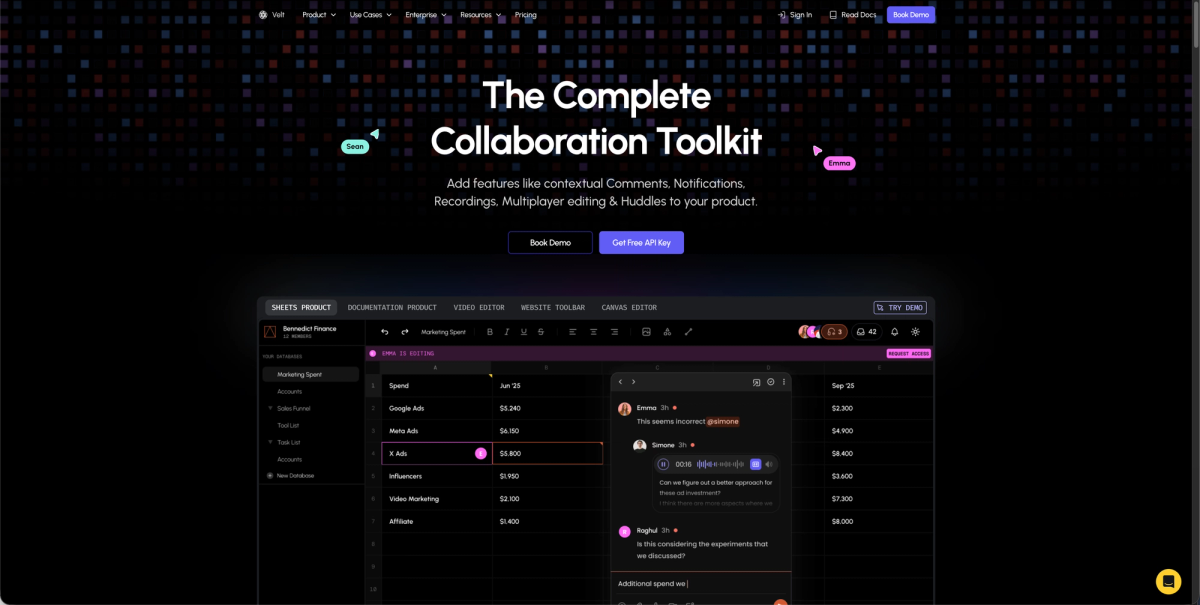
Velt is review infrastructure you drop into a web app instead of building yourself. Comments bind to DOM elements by data ID, not pixel coordinates. Approval states are discrete and trackable. Every change produces an immutable audit log automatically. The integration covers the full stack: contextual comments, approval workflows, real-time presence, in-app notifications, and recording. Stensul cut email review cycles from 8 days to 3 after deploying Velt. trumpet saw roughly a 10% lift in user engagement.
Leadpages reported the integration took days, not the 6+ months an internal build would require.
, the audit trail is the headline. Over 90% of organizations report that automating approval workflows reduces errors and speeds up decisions. Velt makes that audit trail a byproduct of the workflow, with timestamps, attribution, and approval states logged without any extra instrumentation.
The case for Velt is straightforward: if review is the bottleneck, and AI-generated content keeps raising the volume of what needs sign-off, the answer is infrastructure that scales with it. Not more Slack threads.
Final Thoughts on Review Infrastructure for AI Workflows
AI output scales faster than human review capacity, and most products ship zero tooling to close that gap. Review infrastructure keeps approval workflows attached to the artifact instead of scattered across Slack and email. You can build it yourself or integrate Velt and ship comments, approvals, and audit trails this week. Book a demo if you want to see how it fits your product.
FAQ
What is review infrastructure?
Review infrastructure is the embedded system that lets teams give contextual feedback, track approvals, and maintain audit trails directly inside the products where work happens. It includes contextual comment anchoring, approval state tracking, real-time presence, in-app notifications, and automatic audit trail generation built into the app itself, not scattered across Slack or email.
Review infrastructure vs approval workflow software.
Approval workflow software routes tasks and tracks formal signoffs (like Jira approvals or DocuSign) but doesn't keep feedback attached to the artifact being reviewed. Review infrastructure handles the contextual feedback layer first (anchored comments, presence, discussions), then tracks the formal approval state and audit trail in one unified system.
Can you build review workflows without losing context in Slack threads?
Yes. Velt binds comment threads to DOM elements by data ID (like slide-id or widget-id), keeping feedback attached to the exact thing being reviewed even when layouts change. Every approval, comment edit, and state change produces an immutable audit log automatically, with timestamps and attribution built in.
When should I use review infrastructure instead of building it myself?
If building contextual comments, approval tracking, notifications, presence, and audit logs would take your team more than a few weeks, review infrastructure makes sense. Velt ships all of this as drop-in infrastructure: teams like Stensul cut email review cycles from 8 days to 3, and Leadpages reported the integration took days, not the 6+ months an internal build would require.
How does review infrastructure support AI-generated content workflows?
AI creates content 10x faster than humans, but verification still requires human review. Review infrastructure provides the formal oversight layer: contextual feedback on AI-generated drafts, discrete approval states tracked before publication, and automatic audit trails logging every decision with timestamps and attribution, not buried in Slack threads.