


Build vs Buy Collaboration Software: Complete Decision Guide (April 2026)
Build vs buy collaboration software: compare costs, timelines, and ROI for real-time collaboration decisions in June 2026.
Your users expect real-time collaboration inside your app now, not eventually. The build vs buy collaboration software question comes down to whether your team has three to six months to architect WebSocket infrastructure and permission systems from scratch, or whether you need something to ship in weeks. Speed matters because every delayed month is a month competitors with better tooling can pull users away, but the real gap shows up in year two when you're still maintaining sync logic while bought solutions are handling that infrastructure for you.
TLDR:
- Building real-time collaboration costs 60% more in maintenance than initial development
- SDK integration cuts time-to-market from 3-6 months down to days or weeks
- Most teams choose hybrid: buy infrastructure (WebSockets, CRDT), build custom UI
- Enterprise compliance (SOC 2, HIPAA, data residency) takes 12-18 months to build yourself
- Velt offers 115+ primitive components so you control the experience without rebuilding sync logic
Understanding Build vs Buy Collaboration Software
Every B2B product eventually hits the same wall: users want to collaborate inside your app, not around it. Comments, live cursors, notifications, co-editing: these features have shifted from differentiators to expectations. The question is never really whether to add them. It's whether your team builds them from scratch or buys an SDK that already handles that stack.

"Build" means your engineers own the real-time infrastructure, UI components, permission logic, and notification systems. "Buy" means integrating a pre-built solution. Both paths carry real tradeoffs across cost, speed, and long-term ownership, and getting it wrong directly affects user retention.
The True Cost of Building Collaboration In-House
Most teams anchor on upfront dev cost when they consider a build. That's a mistake. The initial sprint to ship real-time comments or live presence is rarely the expensive part; maintaining it is. Industry benchmarks put software maintenance at roughly 60% of total lifecycle costs. For collaboration infrastructure, that burden is unusually high. WebSocket connections degrade, conflict resolution bugs surface at scale, and permission edge cases multiply as your data model grows. Every engineer hour spent on sync bugs is an hour not spent on your core product. At the end of the day, running persistent WebSocket servers, managing CRDT state, and scaling presence across concurrent users adds real infrastructure cost on top of all that.
Time to Market: Development Timelines vs Integration Speed
Building real-time collaboration from scratch takes months. You're architecting WebSocket infrastructure, designing permission models, handling conflict resolution, and building UI components users actually trust. Realistically, a small team is looking at three to six months before anything ships. An SDK, though, can cut that to days or weeks. That gap matters because every month your collaboration features are delayed is a month competitors with better tooling can pull users away. And doin't forget that speed compounds. Shipping faster means earlier user feedback, faster iteration, and quicker paths to the retention lift that collaboration features reliably produce.
When Building Makes Strategic Sense
While it may seem like buying is the way to go, building definitely has real merit in specific scenarios.
- The collaboration logic is your core product. If you're building the next Figma or Linear, real-time interaction is your competitive moat. Buying someone else's infrastructure means that moat is rented.
- Your workflows are genuinely novel. If no SDK maps to your data model or interaction patterns, you'll spend more time fighting the abstraction than building from scratch.
- You have strict proprietary constraints. Some industries with compliance requirements need collaboration data to never touch a third-party server, even with self-hosting options.
- You have the engineering depth to maintain it. Ownership has real value when the problem is core enough to be worth the long-term commitment.
The honest question is whether the problem is unique enough to your product to be worth what you're giving up in speed and focus.
When Buying Delivers Better ROI
Buying wins in more situations, though, than most teams initially admit. If collaboration is a feature your product needs instead of the reason your product exists, you're almost always better off buying an SDK. The case for buying over building is clearest when:
- Your team lacks real-time infrastructure depth. WebSocket scaling, CRDT conflict resolution, and presence systems are specialized skills that most product teams don't have, and hiring for them is expensive.
- Compliance is non-negotiable. SOC 2 Type II, HIPAA, and data residency requirements take multiple quarters to build toward without a dedicated security team, with real liability if you get it wrong.
- Speed is the actual competitive advantage. Nearly 60% of developers now favor a build-and-buy hybrid, recognizing that buying the infrastructure layer frees engineering effort for product decisions that set you apart.
The ROI math tilts hard toward buying when you factor in no infrastructure ops, no security audits from scratch, and no maintaining sync logic as your data model evolves.
Total Cost of Ownership: Comparing Long-Term Investment
Upfront development cost is the wrong anchor. A useful build vs buy comparison models 3-5 year ownership, not a single sprint budget. The full picture includes costs that often go untracked:
- Engineering salaries maintaining WebSocket infrastructure and sync logic
- Cloud spend on persistent real-time servers at scale
- Security auditing and compliance certification
- Feature parity work as competitor collaboration UX raises user expectations
- Incident response when real-time bugs surface in production
The table below provides a good high-level overview of the cost categories and how they play out for building and buying.
| Cost Category | Build | Buy (SDK) |
|---|---|---|
| Initial development | High | Low |
| Ongoing maintenance | High | Low |
| Infrastructure ops | High | Managed |
| Compliance work | DIY | Mostly covered |
| Feature parity upkeep | Ongoing burden | SDK roadmap |
That last row is underappreciated. Collaboration UX expectations move fast. Keeping up with what Figma or Notion ship means continuous engineering investment that never really ends. Over 30% of tech development projects run over budget and behind schedule, often because teams modeled build cost without modeling ongoing expenses that follow.
Buying compresses most of these costs into a predictable licensing line, which has real value when planning headcount and infrastructure spend 18 months out.
Technical Complexity: Real-Time Infrastructure Challenges
Real-time collaboration looks simple until you're building it. WebSockets drop, reconnect unpredictably, and require stateful server management at scale. CRDT conflict resolution (the logic that keeps two users from overwriting each other mid-keystroke) is a research-level problem that takes months to implement correctly.
Permission inheritance across org, folder, and document hierarchies means a single access change must cascade instantly across thousands of records. Miss it, and users retain access they shouldn't have. A global notification inbox that surfaces activity across an entire workspace also requires cross-document indexing your data model likely wasn't designed for. Building that retroactively is painful.
Security, Compliance, and Enterprise Requirements
Compliance isn't a feature you add later. SOC 2, HIPAA, and data residency controls each require dedicated security engineering, external audits, and legal review, often 12 to 18 months of runway before you can close an enterprise deal. Building that from scratch is a real cost center. You have to keep in mind that vendors who've already absorbed those costs pass the benefit directly to buyers.
The Hybrid Approach: Building on Top of SDKs
Most teams don't actually face a binary choice. The real decision is where to draw the line.
Buying an SDK doesn't mean accepting someone else's UI. The best collaboration SDKs expose enough primitives that you can build completely custom interfaces on top of battle-tested real-time infrastructure. You get WebSocket management, CRDT sync, and permission inheritance handled for you, while your team controls exactly how it looks and behaves in your product.
The key is checking how much of the stack a given SDK actually exposes. Some lock you into their default UI components. Others offer 115+ primitive components so you can construct fully custom collaboration UIs without rebuilding the sync layer beneath them. For most product teams, the calculus is actually much simpler: buy the infrastructure, build the experience.
How Velt Gives You The Best Of Both Worlds
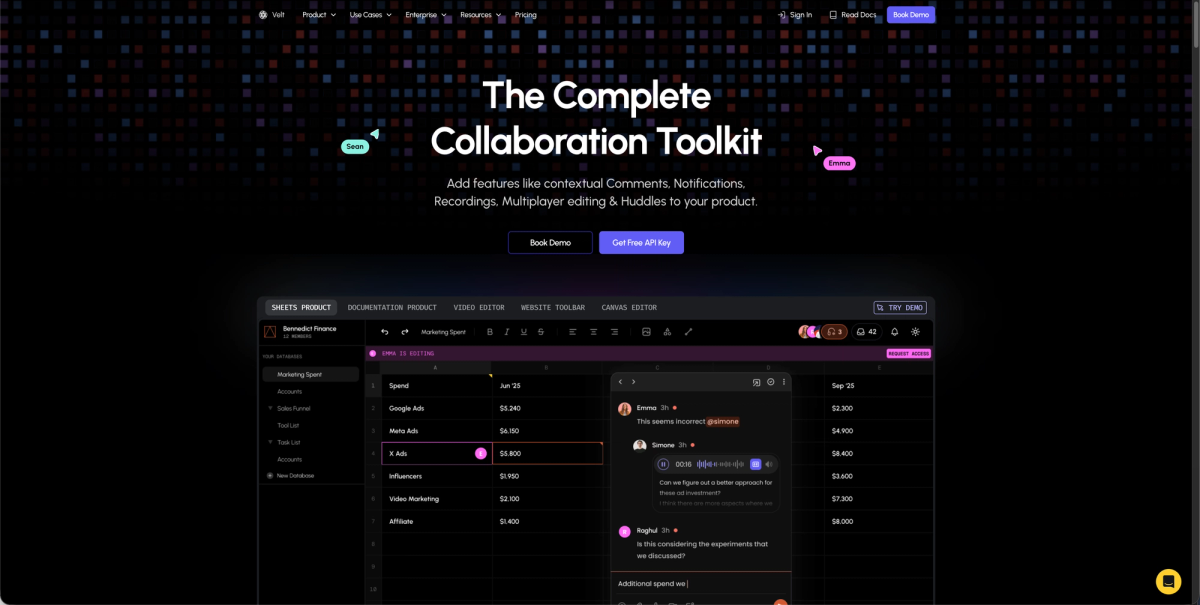
With Velt, real-time infrastructure, CRDT sync, permission inheritance, and a global notification system come handled out of the box. The SDK integrates in minutes. But you're not locked into any default UI. 115+ primitive components let your team build fully custom collaboration experiences without touching the sync layer beneath.
Enterprise requirements are already covered: data self-hosting, SOC 2 Type II, HIPAA, and 45+ data regions. Pricing follows a Monthly Active Collaborator model, so you pay for users who actually collaborate.
Final Thoughts on Building vs Buying Collaboration Features
Most teams overestimate how much they need to build and underestimate what maintaining collaboration software actually costs long-term. The SDK approach gives you production-ready infrastructure in days, not months, while your engineers focus on the product decisions that set you apart. Book a demo to see how buying the stack doesn't mean giving up control of the experience. Your collaboration features should ship fast and feel native, and there's no rule that says you need to build both layers yourself.
FAQ
How long does it take to build collaboration features from scratch?
Most teams need three to six months to ship real-time collaboration features in-house, covering WebSocket infrastructure, conflict resolution, permission logic, and UI components. An SDK cuts that timeline to days or weeks, which matters when competitors can pull users away during those months of development.
What's the real difference between building and buying collaboration software?
Building means your team owns the entire stack (real-time infrastructure, CRDT sync, permission inheritance, and notification systems) plus all the maintenance that comes with it. Buying means integrating a pre-built SDK that handles the infrastructure layer while your team controls how it looks and behaves in your product.
When does building collaboration in-house actually make sense?
Building makes sense when real-time collaboration is your core product (like Figma or Linear), your workflows are genuinely novel and no SDK fits your data model, or you have strict proprietary constraints that prevent third-party infrastructure. You also need the engineering depth to maintain it long-term.
How much does it cost to maintain collaboration infrastructure over time?
Industry benchmarks put software maintenance at roughly 60% of total lifecycle costs. For collaboration infrastructure, you're looking at ongoing costs for WebSocket server ops, CRDT state management, security audits, compliance certification, feature parity work, and incident response; on top of the initial build.
Can you customize an SDK enough to avoid a generic collaboration UI?
The best SDKs expose primitives that let you build completely custom interfaces on top of battle-tested infrastructure. Look for solutions offering 100+ primitive components so you can construct fully custom collaboration UIs without rebuilding the sync layer, WebSocket management, or permission inheritance yourself.