


Velt vs Ably: Real-Time Collaboration Infrastructure Compared (February 2026)
Compare Velt vs Ably for real-time collaboration infrastructure. Learn about features, pricing, security, and implementation differences in February 2026.
You've narrowed your collaboration infrastructure search down to Ably and Velt, and now you're trying to figure out which one fits your project. Here's the core difference: one gives you message delivery and expects you to build the features, the other gives you the features with message delivery included. Let's look at what that means for security, pricing, and how fast you can actually ship.
TLDR:
- Ably provides pub/sub messaging infrastructure; Velt delivers ready-made collaboration features like comments and notifications without custom engineering
- Velt bills on Monthly Active Collaborators (users who actually collaborate), while Ably charges per connection whether users interact or not
- Velt's real-time permission provider enforces access changes immediately; Ably's JWT tokens create security delays until reconnection
- Velt is a JavaScript SDK that adds comments, presence, and multiplayer editing to B2B SaaS apps with native permission inheritance across document hierarchies
What is Ably?
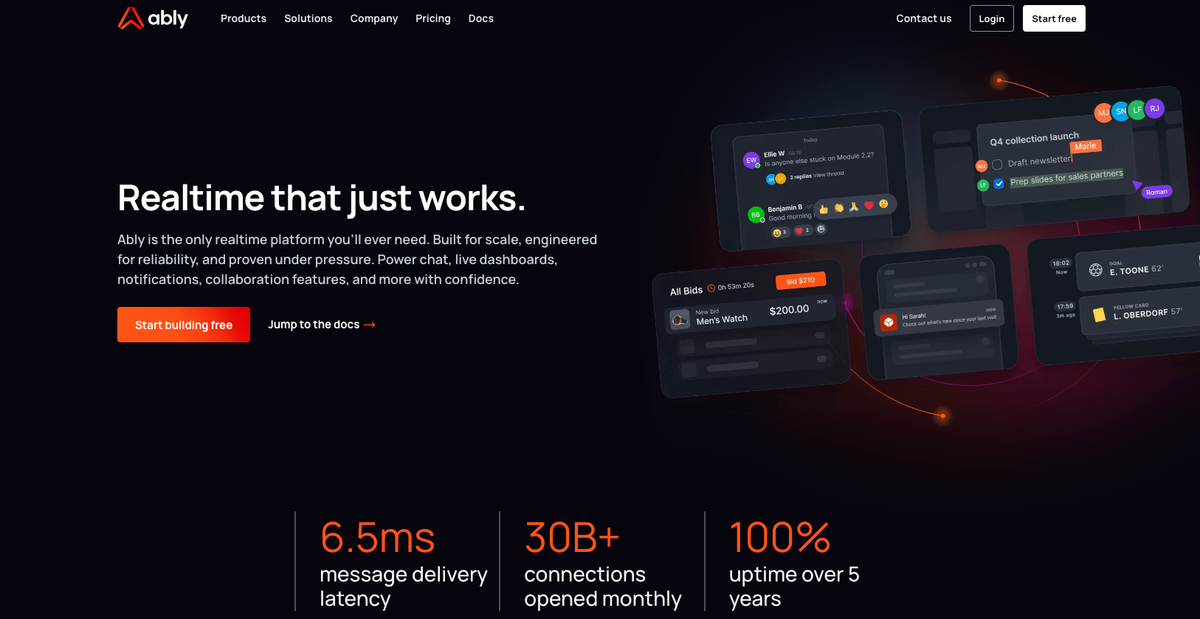
Ably is a pub/sub messaging infrastructure service that delivers real-time data streaming over WebSockets and other transport protocols. At its core, Ably provides channels where you can publish messages and subscribe to them, broadcasting updates across connected clients. The service offers APIs for presence (who's online), message history, and connection state recovery, but the logic for what to do with those messages lives in your codebase. Think of it as the pipes and protocols, not the features themselves.
Ably targets teams building custom real-time experiences who want control over the entire stack. If you're creating a chat app, live dashboard, or multiplayer game, Ably handles the message delivery while you build the UI, data models, and business logic. The tradeoff: you get full flexibility but you're responsible for turning those message streams into actual collaboration features like comments, notifications, or cursor tracking.
What is Velt?
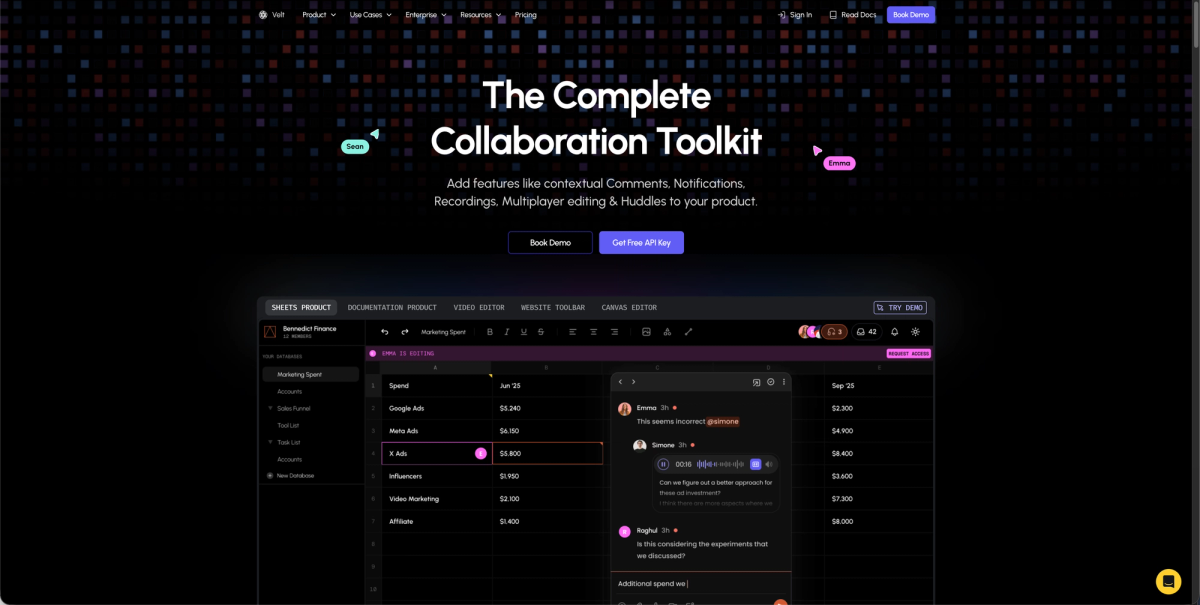
Velt is a JavaScript SDK that adds real-time collaboration features to web apps. We provide pre-built components for comments, notifications, live presence, cursor tracking, and multiplayer editing that you can drop into your product. The key difference: Velt is a collaboration stack, not a messaging layer. Where Ably gives you channels and message delivery, Velt gives you the full feature. Install the Velt SDK, add a few React components or HTML elements, and you have working comments with @mentions, threaded replies, and rich text. Same for live cursors, notifications, or CRDT-based multiplayer editing.
Velt was built for B2B SaaS teams who need collaboration features but don't want to spend months engineering them. The SDK handles both the UI (comment boxes, notification panels, user avatars) and the backend (storage, permissions, real-time sync). You control the styling and behavior, but the core logic is done.
Infrastructure Approach: Primitives vs. Complete Collaboration Stack
Ably Spaces launched in October 2023 to help developers build features like avatar stacks and live cursors, but the foundational product remains pub/sub messaging. When you need collaboration, you work with channels that broadcast events. Building a comment system requires custom data schemas, writing the logic to handle @mentions, and creating the UI from scratch.
But, this is the "Glue Code Tax." You spend weeks connecting primitives into features, then more weeks building folder structures, cross-document search, and aggregated notifications. These are product problems that every collaboration feature needs solved.
Velt skips that work. The Velt SDK understands your app's hierarchy (Organizations → Folders → Documents) and handles permission inheritance automatically. Comments bind to specific DOM elements, staying contextually anchored when your UI changes. The notification inbox aggregates activity across every document without writing aggregation queries.
Security and Access Control Models
With global security spending reaching $212 billion in 2025 amid rising collaboration software vulnerabilities, security architecture matters more than ever. Ably handles authorization through JWT tokens with channel-level permissions defined in the token claims. Each channel maps to a document or resource, with users receiving tokens granting access to specific channels. This works for simpler apps but creates friction in B2B SaaS with nested structures. The token-based approach creates a timing problem. When you revoke a user's access in your database, changes don't take effect immediately until their token expires or they reconnect. For apps handling sensitive data or frequent permission changes, this latency window can violate security requirements.
Velt, on the other hand, uses a real-time permission provider. Every collaboration action checks your backend for authorization, making your database the source of truth. Revoke access to a folder, and the user loses access immediately across all nested documents without waiting for token refresh. The native inheritance model mirrors Google Drive. Grant folder-level access once, and it cascades automatically to every document inside. With Ably's channel model, you need individual tokens for each document or build your own inheritance layer.
Pricing Philosophy: Connection-Based vs. Collaboration-Based
Of course, any choice about collaboration infrastructure should include price. Let's look at how these two options, Ably and Velt, deal with pricing.
Ably charges for infrastructure consumption: messages sent, active channels, and concurrent connections. This maps directly to server usage but disconnects from business value. Opening a document creates a channel connection whether the user comments, edits, or simply views content. The economics break down in B2B apps with document-heavy architectures. A user might connect to 20 documents during a session for presence awareness but only leave comments in two. You're paying for 20 connections when only 2 generated collaboration value.
Velt, though, bills on Monthly Active Collaborators. A user only counts when they perform CRUD operations on features like comments, notifications, or multiplayer editing. Connecting to Velt or opening documents generates no charge. Read-only users browsing content don't trigger billing. The model removes architectural penalties. Create infinite folder structures, auto-generate rooms per document, or keep users connected for presence without inflating costs. We include unlimited storage, unlimited version history, and unlimited projects in core pricing. Your bill scales with engaged users, not with how many documents exist in your database.
Developer Experience and Time to Market
What you want is a collaboration infrastructure that's priced appropriately, has a great developer experience, and doesn't take an eternity to deploy. So how do Ably and Velt make your life easier?
Ably delivers well-documented SDKs for pub/sub, presence, and message history with clean APIs and thorough examples. However, you receive transport infrastructure without ready-made collaboration features: building threaded comments requires designing data schemas for replies, modeling thread attachments, and writing logic for @mentions and notifications. But, you need frontend components for comment boxes, reply chains, and user avatars, plus notification aggregation, permission filtering, and read/unread state management. Teams typically spend 3-6 months completing this work, with development costs reaching $250,000 to $700,000 or more for data-heavy systems with live editing and comments.
Velt, though, collapses that timeline with pre-built components that include working collaboration features. A single comment component delivers threading, rich text, @mentions, and resolution workflows. Notifications aggregate automatically across your app without custom queries. Agent Skills teach AI coding assistants correct Velt implementation patterns. Prompt Claude or Cursor with "add comments to my React app" and receive working code without documentation review. The Chrome DevTools extension debugs collaborative sessions locally by simulating multiple users before deployment.
Side-By-Side Comparison
| Feature | Velt | Ably |
|---|---|---|
| Core Product | Complete collaboration SDK with pre-built components for comments, notifications, presence, cursors, and multiplayer editing. Includes both UI and backend logic. | Pub/sub messaging infrastructure providing channels, presence APIs, and message delivery. Requires custom development for collaboration features. |
| Security Model | Real-time permission provider that checks your backend for every action. Permission changes take effect immediately across all nested documents and folders. | JWT token-based authorization with channel-level permissions. Access persists until token expiration even after database revocation, creating security latency. |
| Pricing Structure | Monthly Active Collaborators model. Only users who perform CRUD operations count toward billing. Read-only users, connections, and document creation are free. | Infrastructure consumption pricing based on messages sent, active channels, and concurrent connections. Every document connection incurs cost regardless of collaboration activity. |
| Permission Inheritance | Native hierarchical permissions that mirror Google Drive. Grant folder-level access once and it cascades automatically to all nested documents. | Channel-based model requires individual tokens for each document or custom inheritance layer. No native support for nested resource structures. |
| Implementation Time | Days. Drop-in components with working features including threading, rich text, @mentions, and notifications. Agent Skills available for AI coding assistants. | 3-6 months typical. Requires designing data schemas, building UI components, writing feature logic, and creating notification systems from messaging primitives. |
| Best For | B2B SaaS teams needing production-ready collaboration features without months of engineering work. Apps with document hierarchies and complex permission requirements. | Engineering teams building custom messaging systems who need low-level pub/sub control and plan to architect all collaboration features themselves. |
Why Velt is the Better Choice
At the end of the day, Velt is the stronger choice for B2B SaaS companies that need to ship production-ready collaboration features without diverting engineering resources from core product improvement. The complete collaboration stack removes the glue code tax of primitives-based solutions while providing enterprise-grade security, predictable value-based pricing, and implementation timelines measured in days instead of quarters.
Final Thoughts on Velt vs Ably
When you compare real-time collaboration infrastructure, the choice depends on what you're building and how much time you have. Ably delivers messaging primitives that give you control but require a lot of development work to turn into collaboration features. Velt ships complete features that work immediately, saving your team months of engineering time. Book a demo and we'll walk you through adding collaboration to your product.
FAQ
How should I decide between Velt and Ably for my app?
Choose Velt if you need to ship collaboration features like comments, notifications, or live cursors in days. Choose Ably if you're building custom messaging infrastructure from scratch and have months to architect the collaboration layer yourself.
What's the main difference in how Velt and Ably handle permissions?
Ably uses JWT tokens where access persists until the token expires, even after you revoke it in your database. Velt checks your backend in real-time for every action, so permission changes take effect immediately without waiting for token refresh.
Who is Ably best for versus who is Velt best for?
Ably works for engineering teams building bespoke messaging systems who need low-level pub/sub control and plan to code all collaboration features themselves. Velt works for B2B SaaS teams who need ready-made collaboration components (comments, presence, notifications) that work out of the box without months of engineering.
Will my costs explode as users create more documents?
With Ably's connection-based pricing, yes, each document creates a new channel connection you pay for regardless of whether users collaborate. Velt bills only when users actually comment, edit, or interact, so creating thousands of documents costs nothing if they're unused.
How long does it take to add comments with each tool?
Ably requires designing data schemas, building UI components, writing @mention logic, and creating notification systems, typically 3-6 months. Velt provides working threaded comments with @mentions and notifications as a drop-in component you can ship in a day.