


Angular Text Editor: Getting Started Guide for March 2026
Learn how to set up an Angular text editor in March 2026. Compare options, features, and collaboration tools to find the best fit for your Angular app.
Your Angular app needs text editing, so you start looking at options. What you'll find is that getting formatting to work is easy, but adding collaboration is where things fall apart. Most Angular text editors focus on single-user editing and treat features like comments or presence indicators as afterthoughts you'll build yourself. We ranked the main editors based on Angular compatibility, setup time, and whether they actually include collaboration features or just leave you to wire them up manually.
TLDR:
- Angular text editors range from basic formatting tools to full collaboration SDKs
- Velt provides real-time multiplayer editing, comments, and voice calls built-in for Angular apps
- CKEditor and TinyMCE need paid add-ons for collaboration; Quill and ProseMirror lack it entirely
- Setup time varies from minutes (Velt) to days (ProseMirror) depending on feature requirements
- Velt is a collaboration SDK with text editing included, handling backend sync and storage automatically
What is an Angular Text Editor?
An Angular text editor is a rich text editing component that works inside Angular apps. With over 51,737 companies worldwide using Angular and the framework commanding a 48.24% market share among specialized front-end frameworks as of 2026, text editing capabilities remain a core requirement for enterprise applications. It lets users format text, add images, create lists, and build structured content without touching HTML directly. These editors vary in scope. Basic ones handle formatting like bold, italics, and links. More advanced options include tables, code blocks, and custom styling. Some support real-time collaboration for multi-user editing. When choosing an editor, consider features, bundle size, and how it fits with Angular's component architecture and change detection.
How We Ranked Angular Text Editors
We ranked these editors across six criteria that matter when building Angular apps:
- First, Angular compatibility. We checked whether the editor ships with native Angular bindings or requires wrapper components. Editors built for React or vanilla JavaScript can work in Angular, but the integration path varies in complexity.
- Second, setup friction. We measured how quickly you can get from npm install to a working editor in your component. This includes TypeScript support, module imports, and configuration overhead.
- Third, customization depth. We looked at styling flexibility, toolbar configuration, and plugin architecture. Some editors lock you into preset themes while others expose granular control over every UI element.
- Fourth, feature scope. Basic formatting is table stakes. We checked whether each editor supports tables, media embeds, markdown shortcuts, and collaborative features like comments or live cursors.
- Fifth, documentation clarity. We assessed whether the docs include Angular-specific examples, migration guides, and troubleshooting sections.
- Finally, maintenance health. We reviewed release frequency, issue response times, and whether the project is actively developed or in maintenance mode.
Best Overall Angular Text Editor: Velt
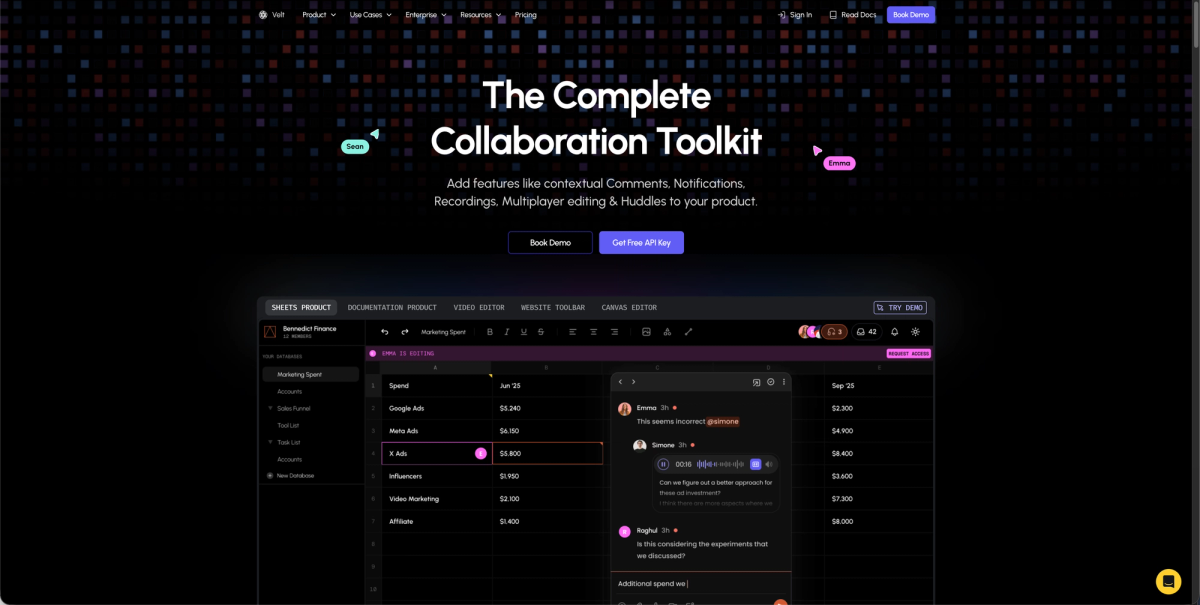
Velt is a collaboration SDK that brings text editing and real-time multiplayer features to Angular apps. Research shows that teams using collaborative platforms see a 25% increase in project completion speed compared to traditional methods, with 85% of remote workers relying on collaboration tools for daily check-ins. Call the init function with your API key, and you get a text editor with comments, live cursors, and presence indicators already wired up. The SDK handles what takes most teams months to build: commenting infrastructure, notifications, voice and video calls, and screen recording.
Key Features
- Official Angular support with init function integration using API key
- Real-time collaboration features including comments, live cursors, and presence indicators built-in
- Voice and video calls with AI-powered transcription and comment categorization
- Backend synchronization, storage, and real-time updates handled automatically without custom code
- Enterprise security with SOC 2 Type II compliance and data self-hosting across 45+ regions
Limitations
- Usage-based pricing model may differ from traditional per-seat licensing expectations
- Requires API key and account setup compared to purely open-source alternatives
- Designed for collaboration-heavy apps instead of simple single-user editing
- Learning curve for teams unfamiliar with collaboration SDK architecture
- Newer solution compared to existing editors like CKEditor or TinyMCE
Bottom Line
Velt is best used for Angular applications requiring real-time multiplayer editing and complete collaboration features from day one. Teams building collaborative tools, design platforms, project management apps, or any SaaS product where users need to work together in real-time will benefit most from Velt's pre-built collaboration infrastructure that eliminates months of custom development work.
CKEditor
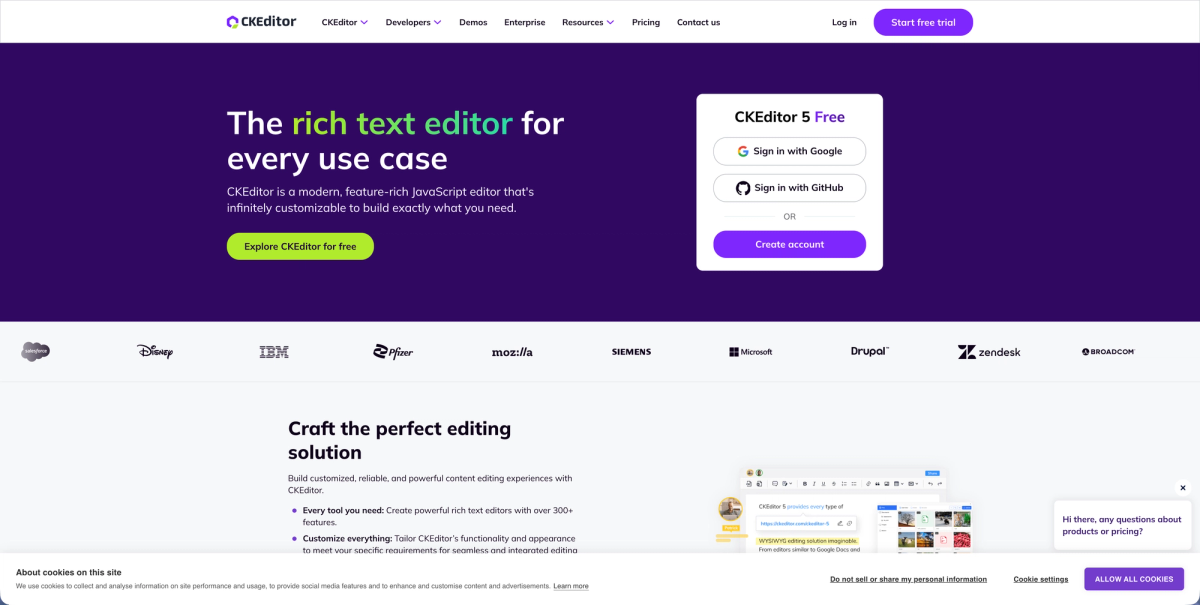
CKEditor is a mature rich text editor with official Angular support through dedicated npm packages. The official Angular component for CKEditor 5 supports Angular 13+ and includes WYSIWYG editing with customizable toolbars, plugin architecture for extending functionality, and image upload with table management capabilities. CKEditor works well for content management systems or blog apps that need reliable formatting options without real-time collaboration.
Key Features
- Official Angular integration through npm packages with TypeScript support for Angular 13+
- Customizable toolbar and plugin architecture for extending functionality
- Built-in image upload and table management capabilities
- WYSIWYG editing interface with reliable formatting options
- existing ecosystem with extensive documentation and community support
Limitations
- CKEditor 4 support ends in December 2028, requiring migration planning
- Real-time collaboration features require purchasing separate commercial add-ons
- No native support for presence indicators, live cursors, or multiplayer editing
- Comment systems and notifications need separate implementation or paid plugins
- Backend synchronization for collaboration requires manual integration work
Bottom Line
CKEditor is best used for content management systems, blogging platforms, or documentation tools where single-user editing with reliable formatting is the primary requirement. Teams building traditional CMS applications or internal tools that don't need real-time collaboration will benefit most from CKEditor's mature feature set and straightforward Angular integration.
ProseMirror
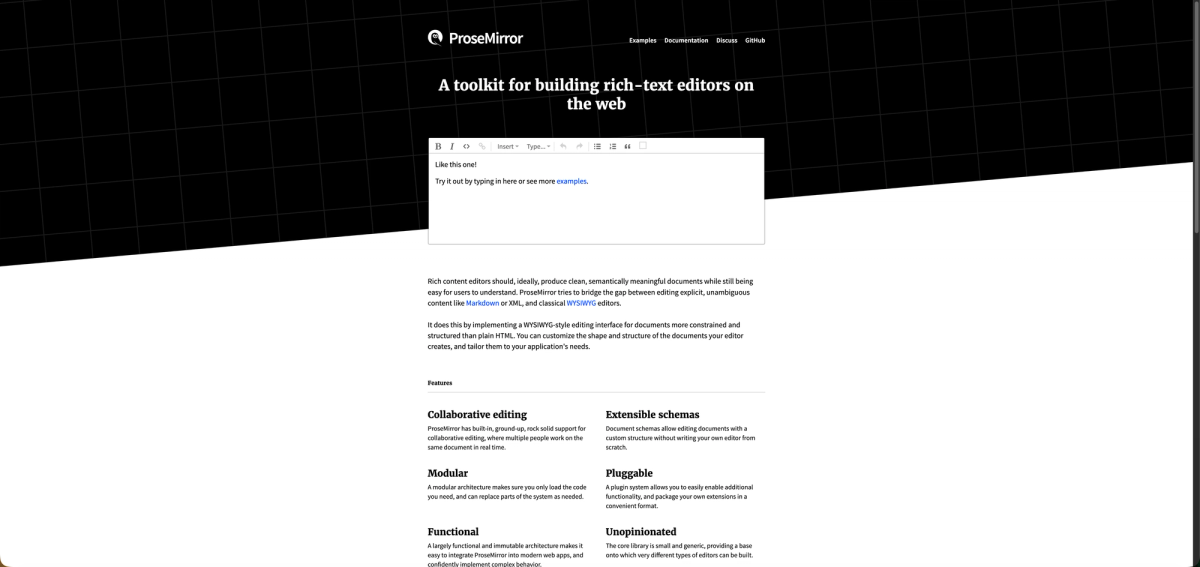
ProseMirror is a toolkit for building rich text editors that works in Angular through custom implementations. Unlike drop-in editors, it gives you primitives and concepts to construct your own editing interface from the ground up. The library provides a schema-based document model that defines custom content structures, a plugin system for extending functionality, and a tree-like node structure for representing documents.
Key Features
- Schema-based document model that allows defining custom content structures
- Plugin system for extending functionality with granular control
- Tree-like node structure for representing documents programmatically
- Framework-agnostic design that can be integrated into Angular applications
- Deep customization capabilities for teams needing complete control over editor behavior
Limitations
- No pre-built UI components or Angular bindings included out of the box
- Requires thousands of lines of custom code before users can type formatted text
- Steep learning curve requiring deep JavaScript expertise to implement
- No collaboration features provided, requiring separate implementation from scratch
- Setup and development time measured in weeks or months instead of hours
Bottom Line
ProseMirror is best used by engineering teams with deep JavaScript expertise who need complete control over editor behavior and can dedicate months to building a custom solution. Teams with specific technical requirements that off-the-shelf editors cannot meet, or those building highly specialized editing experiences, will benefit most from ProseMirror's low-level primitives and flexibility.
Draft.js
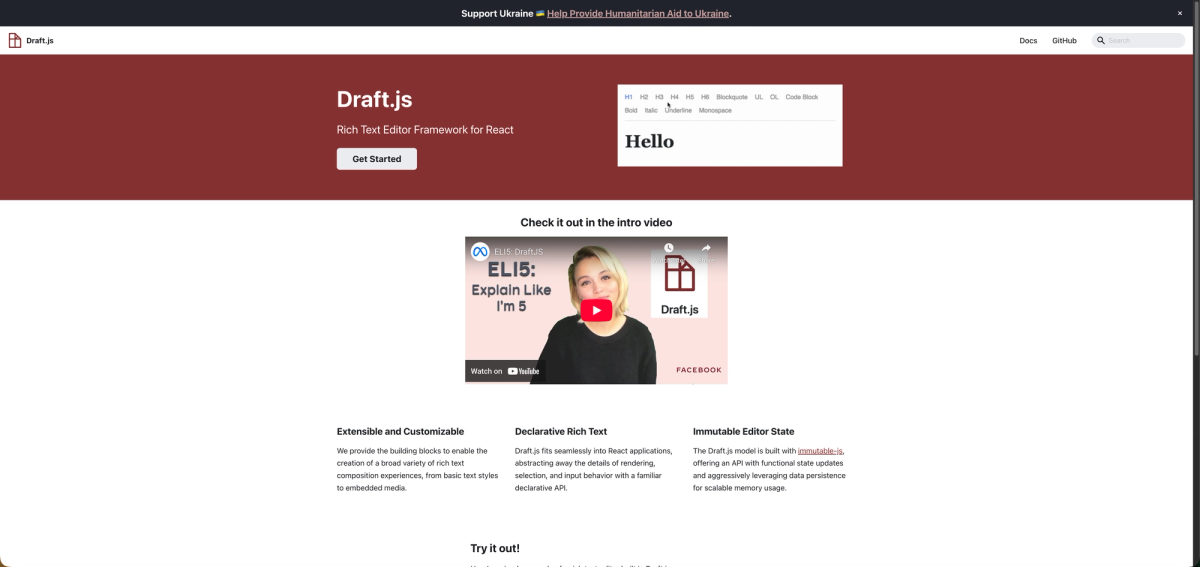
Draft.js is a React-based rich text editor framework from Facebook that can be integrated into Angular apps with additional wrapper libraries. The framework uses an immutable data model and provides extensible building blocks for creating rich text composition experiences, including an entity system for embedding media and custom content. Meta recommends migrating to Lexical as Draft.js is no longer actively maintained.
Key Features
- Immutable data model for predictable state management
- Entity system for embedding media and custom content types
- Extensible building blocks for creating custom rich text experiences
- Strong typing support with TypeScript definitions
- Mature framework with existing patterns from Facebook's production usage
Limitations
- No longer actively maintained by Meta, with official recommendation to migrate to Lexical
- Built for React only, requiring complex Angular wrappers for integration
- No native collaboration features or real-time editing capabilities
- Lacks official Angular support or documentation
- Integration complexity makes it impractical for Angular projects in 2026
Bottom Line
Draft.js is not recommended for Angular apps in 2026 given its deprecated status and React-only focus. Teams currently using Draft.js should plan migration to actively maintained alternatives, while new projects should choose editors with native Angular support or framework-agnostic architectures that provide straightforward integration paths.
Quill
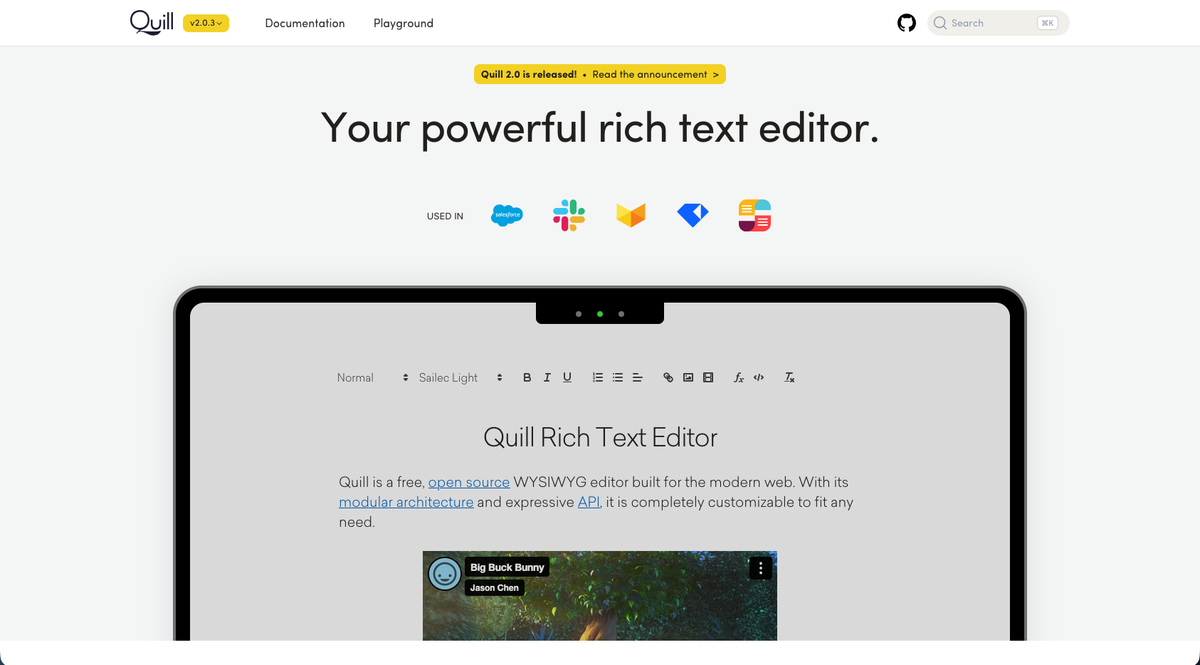
Quill is a framework-agnostic rich text editor with Angular integration through community wrapper packages like ngx-quill. The editor provides a modular architecture where developers can add or remove features through its module system, including support for code formatting, mathematical formulas, and custom content types. Quill offers built-in themes and a straightforward API for implementing WYSIWYG editing in Angular applications.
Key Features
- Angular components via ngx-quill for straightforward integration
- Theme system with Snow and Bubble themes included
- Module system for code formatting and formulas
- Customizable toolbar configuration
- Framework-agnostic core that works across different JavaScript environments
Limitations
- Quill v2 has known issues with HTML output and list formatting
- Relies on third-party Angular wrappers instead of official support
- No native collaboration features like real-time editing or live cursors
- Comment systems and presence indicators need separate implementation
- Backend synchronization for multiplayer editing requires manual integration work
Bottom Line
Quill is best used for content creation tools, blogging platforms, or documentation systems where single-user WYSIWYG editing is the primary requirement. Teams building straightforward content editors that don't need real-time collaboration will benefit most from Quill's simple API and lightweight footprint, though the community wrapper dependency should be considered for long-term maintenance.
TinyMCE
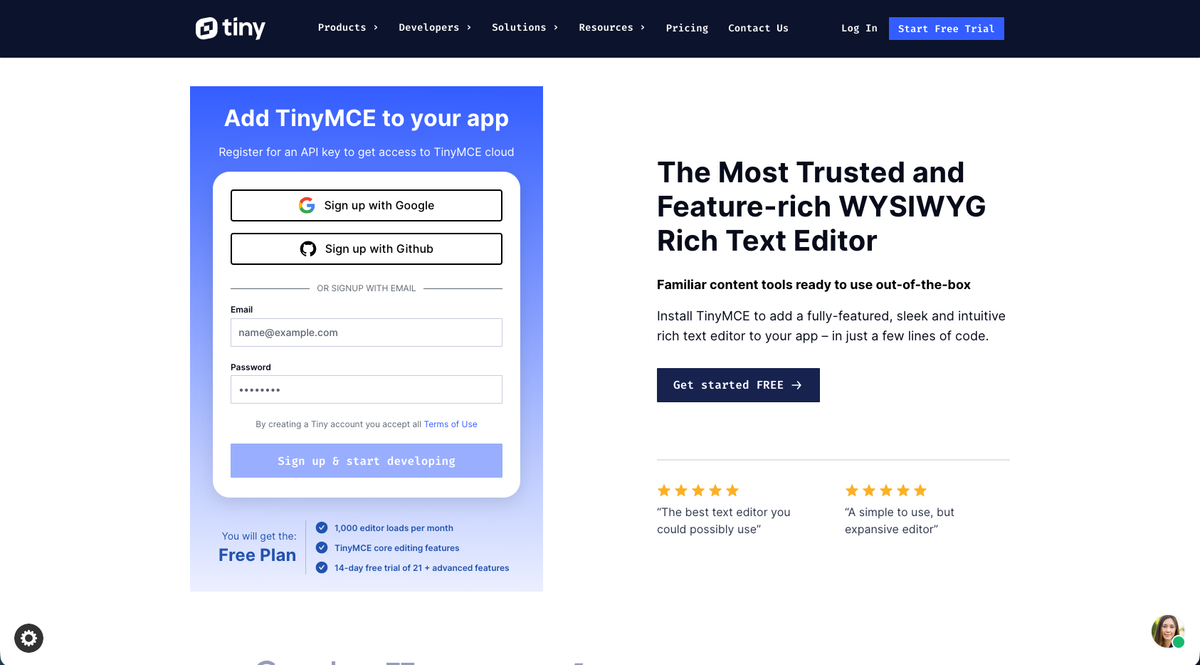
TinyMCE is a commercial WYSIWYG editor with an official Angular component wrapper available through npm as @tinymce/tinymce-angular. The editor provides over 400 APIs and 12+ framework integrations, with options for cloud-hosted or self-hosted deployment and premium plugins for AI assistance, advanced paste handling, and spell checking. TinyMCE works well for enterprise Angular apps that need document editing features like Word import/export but don't require real-time multiplayer collaboration.
Key Features
- Official Angular component wrapper through @tinymce/tinymce-angular package
- Over 400 APIs with support for 12+ framework integrations
- Cloud-hosted or self-hosted deployment options available
- Premium plugins for AI assistance, advanced paste handling, and spell checking
- Document editing features including Word import/export capabilities
Limitations
- Production use requires paid licensing for commercial applications
- Real-time collaboration features need separate premium add-ons
- Focuses on single-user editing instead of multiplayer experiences
- Comment systems and presence indicators require additional paid plugins
- Backend synchronization for collaboration requires manual integration work
Bottom Line
TinyMCE is best used for enterprise Angular applications requiring extensive document editing capabilities and Word integration where single-user editing is the primary use case. Teams building content management systems or document-heavy applications with budget for commercial licensing will benefit most from TinyMCE's extensive API and enterprise-grade features, though collaboration requires additional investment.
Feature Comparison Table of Angular Text Editors
Here's how these editors stack up across the features Angular developers care about when building collaborative or content-rich apps.
| Feature | Velt | CKEditor | ProseMirror | Draft.js | Quill | TinyMCE |
|---|---|---|---|---|---|---|
| Official Angular Support | Yes | Yes | No | No | Community Package | Yes |
| Real-time Collaboration | Yes | Add-on | No | No | No | Add-on |
| Contextual Comments | Yes | No | No | No | No | No |
| Live Cursors & Presence | Yes | No | No | No | No | No |
| Voice/Video Calls | Yes | No | No | No | No | No |
| AI Features | Yes | No | No | No | No | Premium |
| Screen Recording | Yes | No | No | No | No | No |
| Setup Time | Minutes | Hours | Days | Days | Hours | Hours |
| Backend Required | No | No | Yes | Yes | Yes | No |
| Active Maintenance | Yes | Yes | Yes | No | Yes | Yes |
| Pricing | Usage-based | Free/Commercial | Open Source | Open Source | Open Source | Commercial |
Why Velt is the Best Angular Text Editor
Velt solves the collaboration problem that other Angular text editors ignore. Traditional editors like CKEditor and TinyMCE provide formatting and content creation, then leave you to build the collaboration layer yourself. That means months of engineering work to add comments, presence indicators, notifications, and real-time sync.
Belt was built as a collaboration SDK that includes text editing, not a text editor with collaboration tacked on. You get WYSIWYG editing, contextual comments, live cursors, voice calls, and screen recording from a single SDK that handles backend sync and storage automatically. The alternative is assembling pieces: pick an editor, add a websocket provider for real-time features, build your own commenting system, wire up notifications, and manage state conflicts across users.
For Angular developers building collaborative apps in 2026, Velt removes the choice between building collaboration from scratch and skipping collaboration features entirely.
Final Thoughts on Text Editing in Angular Apps
The right Angular text editor depends entirely on whether your users work alone or together. For solo content creation, open-source options like Quill or CKEditor give you formatting tools without much overhead, but they leave collaboration as an exercise for your engineering team. Velt flips that equation by starting with multiplayer features and including text editing as part of the package, so you skip the months of building comments, presence, and sync logic yourself. See it in an Angular app during a short demo.
FAQ
How do I choose the right Angular text editor for my project?
Start by defining whether you need single-user or multi-user editing. If you need real-time collaboration (comments, live cursors, presence), Velt provides these features out of the box. For basic formatting without collaboration, CKEditor or Quill offer simpler implementations. Match your choice to your feature requirements and engineering bandwidth.
Can I add real-time collaboration to CKEditor or TinyMCE?
Yes, but it requires purchasing separate commercial add-ons from these vendors, then integrating them into your Angular app. You'll still need to handle notifications, presence indicators, and backend sync yourself. Velt includes all collaboration features in a single SDK without additional add-ons.
Which Angular editor works best for teams without extensive JavaScript experience?
Velt and CKEditor offer the fastest setup paths with official Angular support and pre-built components. Both include documentation with Angular-specific examples. ProseMirror and Draft.js require deep JavaScript expertise and weeks of custom development before you have a working editor.
What's the difference between a text editor SDK and a collaboration SDK?
Text editor SDKs like CKEditor and Quill focus on formatting and content creation for single users. Collaboration SDKs like Velt include text editing plus real-time features like comments, live cursors, notifications, and voice calls, with backend sync handled automatically. The second approach removes months of engineering work.
Do I need to build my own backend for these Angular text editors?
It depends on the editor. ProseMirror, Quill, and Draft.js require you to build backend infrastructure for storage and real-time sync. CKEditor and TinyMCE handle storage but need separate backend work for collaboration. Velt includes backend sync, storage, and real-time updates without custom server code.