


Audit Trails for AI Decisions: Why Regulators Will Require Them (June 2026)
Learn why regulators will require AI decision audit trails in June 2026. EU AI Act fines reach €30M for non-compliance. Get the requirements now.

Your AI denied a job applicant last quarter. A regulator wants to see the decision chain: what data the model used, which version ran, how confident it was, and whether anyone reviewed it. You check your logs. Nothing. Just an output with no reasoning, no context, no audit trail. This is where most AI compliance audits break down in 2026. EU and US regulators require AI decision audit trails for high-risk systems, with EU AI Act fine details. If you're running AI that affects hiring, lending, healthcare, or content moderation, review and approval infrastructure that captures this decision chain automatically is the only way to stay ahead of enforcement.
TLDR:
- AI audit trails are structured records of AI decisions (inputs, model version, outputs, human reviews) that let you reconstruct exactly why a system made a specific choice.
- EU AI Act fines hit €30M or 6% of revenue by mid-2026 for non-compliant high-risk AI systems. Regulators want timestamped logs, model version tracking, and human review records.
- Retention floors range from 3 to 10 years depending on jurisdiction. EU AI Act sets the longest: 10 years post-deployment for high-risk systems.
- Tamper-evident storage requires cryptographic chaining and append-only logs. Standard databases fail compliance because records can be silently altered.
- Velt provides review and approval infrastructure with built-in audit trails that log every comment, approval, and annotation automatically.
What an AI Audit Trail Is and Why It Matters in 2026
An AI audit trail is a chronological, structured record of every decision an AI system makes, including the inputs it received, the model version that processed them, the reasoning steps involved, and the output it returned. Think of it as a commit history for AI behavior, one that lets engineers, compliance officers, and regulators reconstruct exactly what happened and why. In 2026, this matters because AI is no longer running low-stakes tasks. Loan approvals, medical triage recommendations, content moderation decisions, and hiring screens are all being handed to AI systems at scale. When something goes wrong, "the model decided" is not an acceptable answer for regulators, auditors, or the people affected.
The core components of a useful AI audit trail include:
- The input data and its source, so reviewers can check whether the model received biased, incomplete, or unauthorized information before reaching a conclusion.
- The model version and configuration at the time of the decision, because a model updated last Tuesday may behave differently than the one that ran six months ago.
- The decision output and confidence score, giving auditors a concrete record of what the system concluded and how certain it was.
- The human review step, if any, documenting who reviewed the AI output, what they changed, and when they approved or rejected it.
Without this record, there's no way to answer the questions regulators are already asking.
Regulatory Deadlines Driving AI Audit Trail Requirements
Regulators are moving fast, and the compliance window is narrowing. The EU AI Act, effective August 2024, requires high-risk AI systems to maintain logs of their decision-making processes, with documentation requirements scaling by risk tier. In the US, the NIST AI Risk Management Framework and a growing stack of state-level AI bills are pushing similar expectations onto companies deploying AI in hiring, lending, healthcare, and content moderation.
The timeline pressure is real. By mid-2026, non-compliant organizations in the EU face fines of up to €30 million or 6% of global annual turnover, whichever is higher. That's not a distant hypothetical. Here's what regulators want to see:
- A complete record of what data an AI model used to reach a decision, so auditors can verify the input set wasn't biased or improperly curated.
- A timestamped log of who reviewed, approved, or overrode an AI output, creating a clear human-in-the-loop accountability chain.
- Version tracking for the model itself, so an auditor can match a specific decision to the exact model weights and configuration active at that moment.
- Evidence of ongoing monitoring, showing the system was tested for drift and bias after deployment, and continuously afterward.
No single deadline covers every jurisdiction, but the direction is consistent: if your AI makes decisions that affect people, you need a provable record of how it made them.
What Must Be Captured in an AI Audit Trail

Every AI audit trail needs to capture enough information to reconstruct why a decision was made, beyond simply what the decision was. Regulators care about the full chain: inputs, model version, confidence scores, and any human overrides that occurred along the way.
Here's what that looks like in practice:
- Inputs and context at decision time: the exact data fed into the model when the decision was made, including any retrieved context or user-supplied prompts that shaped the output.
- Model identity and version: which model produced the output, pinned to a specific version or checkpoint so you can reproduce the decision even after the model is updated.
- Confidence and uncertainty signals: probability scores or uncertainty estimates that show how "sure" the model was, since a low-confidence decision warrants a different level of scrutiny than a high-confidence one.
- Human review actions: any override, approval, rejection, or escalation by a human reviewer, along with who did it and when.
- Timestamps at every stage: when the request came in, when inference ran, and when any downstream action was triggered.
- Data lineage: where the input data originated and whether it was flagged, filtered, or modified before reaching the model.
Without all of these elements, an audit trail is really just a log. Logs tell you something happened. A proper AI audit trail tells you enough to defend the decision in front of a regulator or reconstruct it for an internal investigation.
Retention Requirements Across Jurisdictions
Retention timelines for AI audit records vary by region, sector, and the type of decision being logged. There's no single global standard yet, but the direction regulators are moving in is clear enough to plan around.
| Jurisdiction / Framework | Sector | Minimum Retention Period |
|---|---|---|
| EU AI Act (high-risk systems) | Cross-sector | 10 years post-deployment |
| GDPR (automated decisions) | Cross-sector | Duration of processing + dispute window |
| FDA AI/ML guidance (draft) | Medical devices | Device lifecycle + 2 years |
| SEC Rule 17a-4 | Financial services | 6 years |
| CCPA enforcement guidance | Consumer-facing AI | 3 years |
The EU AI Act sets the most aggressive baseline. For high-risk AI systems, logs must be retained for 10 years after a model stops being used. For a model deployed in 2024 and retired in 2030, that means records stay live until 2040.
Financial services face a different constraint. SEC Rule 17a-4 requires records to be immutable and auditable, not just stored. A log that can be edited after the fact doesn't satisfy the rule, even if the underlying data is retained for the full six years.
Healthcare sits somewhere in between. Draft FDA guidance ties retention to the device lifecycle, which can stretch well past a decade for long-lived diagnostic tools.
The practical takeaway: if your AI system touches any of these compliance-heavy domains, you're likely looking at a retention floor of at least six years, with immutability requirements on top.
Tamper-Evident Storage Architecture
Audit trails built for compliance can't rely on standard database logs. A determined insider, a compromised admin account, or a cascading system failure can all silently alter conventional logs before anyone notices. Regulators know this, which is why tamper-evident architecture is increasingly showing up in the technical annexes of AI governance frameworks.
The core requirement is immutability at the storage layer. Each logged event gets cryptographically hashed and chained to the previous entry, so any modification to a historical record breaks the chain and becomes immediately detectable. Think of it like a blockchain-adjacent pattern applied to a compliance log: you can always prove the record hasn't changed since it was written.
What a Tamper-Evident AI Audit Trail Actually Requires
A few properties separate a real tamper-evident log from a database table with an "updated_at" column:
- Append-only writes with no update or delete permissions at the application level, so no code path can silently overwrite a prior AI decision record.
- Cryptographic chaining where each entry includes a hash of the previous entry, making out-of-order insertion or deletion arithmetically detectable.
- Separate storage credentials and access controls, so the system writing decisions cannot also read or modify the audit log directly.
- Periodic external attestation, where a trusted third party or automated process independently verifies chain integrity on a schedule regulators can audit.
Getting this right from scratch takes real engineering time. Plan for it early, since retrofitting tamper-evident storage into an existing system is harder than building it in from the start.
The Governance Gap: AI Agent Audit Trails
The gap between how AI agents make decisions and how those decisions get recorded is growing fast. Many AI systems, by default, generate outputs with no durable record of the reasoning steps, data inputs, or confidence signals that produced them. When a model flags a transaction as fraudulent, denies a loan application, or routes a support ticket, that decision often exists only as an output with no way to trace back to why it was made.
This is the governance gap. Regulators reviewing AI-assisted decisions have no chain of custody to inspect. Compliance teams can't reconstruct what the agent knew at the time. Legal teams can't defend outcomes they can't explain.
The problem compounds with agentic workflows. When multiple AI models hand off tasks sequentially, a single uninspected decision can propagate through an entire pipeline before anyone flags it. Here's what the governance gap looks like in practice:
- No decision provenance: the model that flagged a transaction as high-risk was updated three weeks ago. The log shows the output. It doesn't show which model version produced it, what features it scored on, or what threshold it crossed. That's not a trail; it's a receipt.
- Silent handoffs between agents: in a multi-step pipeline, Agent A classifies a document, Agent B summarizes the classification, and Agent C routes it to a human queue. If Agent A made an error, that error travels through B and C with no flag. By the time a human sees it, the original decision is buried two layers deep with no pointer back to its origin.
- Reviewer context loss: human reviewers see the final output of an agentic chain but not the intermediate steps. They're approving a conclusion without visibility into the reasoning that produced it. Under EU AI Act Article 14, human oversight must be "meaningful": reviewing an output stripped of its decision context doesn't clear that bar.
- Retroactive reconstruction failure: when a regulator requests the full decision record 18 months later, engineering discovers that ephemeral agent state was never written to durable storage. The data is gone. At that point, there's nothing to reconstruct and no way to demonstrate compliance after the fact.
Fixing this requires capturing state at every handoff, not just the final output. Each agent in the chain needs to write its inputs, reasoning signals, and outputs to an append-only log before passing control to the next step. That log becomes the spine of the audit trail.
Building Audit Trails Into Review and Approval Workflows
Audit trails don't appear out of thin air. They're the byproduct of structured review and approval workflows where every action, comment, decision, and sign-off gets recorded as it happens.
Velt is built for exactly this. As review and approval infrastructure, Velt captures the full annotation and decision lifecycle: who left a comment, when they left it, what element it was attached to, how the thread resolved, and who gave final approval. That record exists natively, without any custom logging layer your team has to build. Organizations using Velt for AI compliance workflows benefit from automatic audit trail generation that meets regulatory requirements without custom engineering effort.
Here's why that matters for AI compliance. When an AI system generates output that feeds into a human review process, the trail of what reviewers saw, questioned, and approved becomes the evidentiary record regulators will ask for. Velt's audit trail ties that human oversight directly to the AI decision. The table below provides information about audit trail components and what's captured.
| Audit Trail Component | What Velt Captures | Compliance Value |
|---|---|---|
| Comments and annotations | Timestamped, user-attributed, element-bound | Proof of human review on specific AI outputs |
| Approval state changes | Actor, timestamp, state transition | Clear chain of custody from draft to sign-off |
| Thread resolutions | Full discussion history and resolution status | Reconstruction of decision-making process |
| Status transitions | Complete workflow progression log | End-to-end audit trail for regulators |
That's the foundation an AI compliance audit trail needs: proof that a decision was made, that a qualified human reviewed it, raised concerns if any existed, and signed off with full context.
Velt: Review and Approval Infrastructure With Built-In Audit Trails
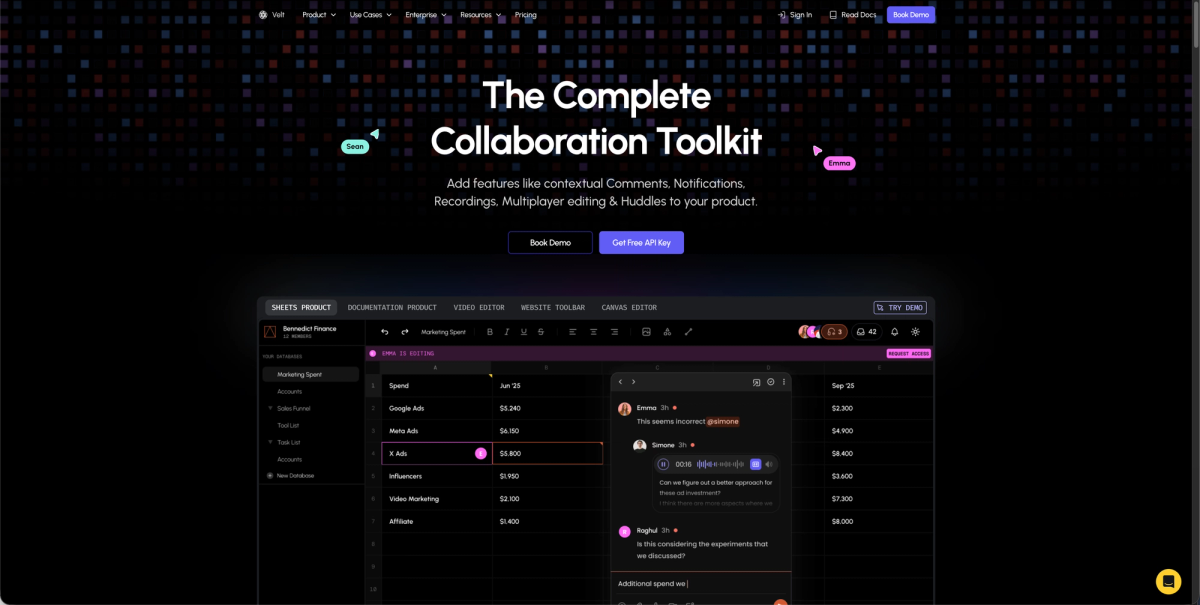
Velt is built for review and approval infrastructure, and audit trails are a first-class feature, not an afterthought bolted on later.
Every comment, approval, rejection, and annotation gets logged automatically. You get a full timestamped record of who reviewed what, when they reviewed it, what they changed, and what decision was made. For teams operating under compliance requirements, that's exactly the kind of documentation regulators are starting to ask for.
Here's what Velt's audit trail infrastructure gives you out of the box:
- Every user action tied to a document or AI-generated output is captured with a timestamp, user identity, and the exact state of the content at the time of review.
- Approval workflows create structured checkpoints, so you can show a clear chain of custody from AI output to human-reviewed final decision.
- Comments and annotations are bound to specific elements, not floating coordinates, so the audit record stays accurate even as layouts change.
- The full history is queryable, meaning your compliance or legal team can pull records without asking engineering to write a custom export.
Velt also supports collaboration infrastructure with built-in audit trails, so the review layer and the audit layer are the same system. You're not stitching together a separate logging tool on top of a separate review tool.
For AI compliance use cases, that matters. Auditors want to know what decision was made and see the review process that produced it.
Final Thoughts on AI Compliance Infrastructure That Ships With Your Product
AI audit trails are moving from optional to mandatory, and the timeline is tighter than most teams think. If you're building products where AI outputs get reviewed before they go live, your review workflow is your audit trail. Velt captures every step of that process automatically, so compliance documentation isn't a separate system you bolt on later. You ship review infrastructure, you get audit trails that regulators will accept.
FAQ
What's the difference between an AI audit trail and a standard application log?
An AI audit trail is a structured, immutable record of every decision an AI system makes, including inputs, model version, reasoning steps, confidence scores, and any human review actions, all timestamped and chained cryptographically to prevent tampering. Standard application logs record system events but typically lack cryptographic chaining, immutability guarantees, or the structured decision metadata regulators need to reconstruct AI behavior.
Can I use a Postgres table for AI audit trail storage?
Yes, but with specific constraints. A Postgres table with an INSERT-only policy and a CHECK constraint blocking updates gives you basic immutability, but you'll need to index on (document_id, created_at) for compliance queries and plan for table bloat once you hit millions of rows per day. At that scale, a separate time-series store like TimescaleDB or ClickHouse will perform better for historical queries without competing with your production workload.
How long do I need to retain AI decision records under the EU AI Act?
Ten years after the AI system stops being used. For a model deployed in 2024 and retired in 2030, records must stay live until 2040. Financial services face different constraints: SEC Rule 17a-4 requires six years of immutable, auditable records, and healthcare ties retention to the device lifecycle, which can exceed a decade for long-lived diagnostic tools.
AI audit trail vs. activity log: which one do regulators want?
Regulators want an AI audit trail: a cryptographically chained, immutable record of AI decisions with inputs, model version, confidence scores, and human review actions. Activity logs typically capture user interactions and system events but lack the decision-specific metadata, cryptographic integrity, and tamper-evident architecture required for compliance audits under frameworks like the EU AI Act or SEC Rule 17a-4.
What review infrastructure do I need to make AI audit trails defensible?
You need structured approval workflows that capture who reviewed the AI output, what they changed, when they approved or rejected it, and what the content state was at each checkpoint, all timestamped and tied to specific users. Velt provides this out of the box: every comment, annotation, approval state change, and resolution is logged automatically with full audit trail generation, so compliance teams can reconstruct the review process without asking engineering to build a custom export.