


Designing Human-in-the-Loop Workflows for AI Products (June 2026)
Learn how to design human-in-the-loop workflows for AI products with review infrastructure, compliance requirements, and routing patterns. June 2026 guide.
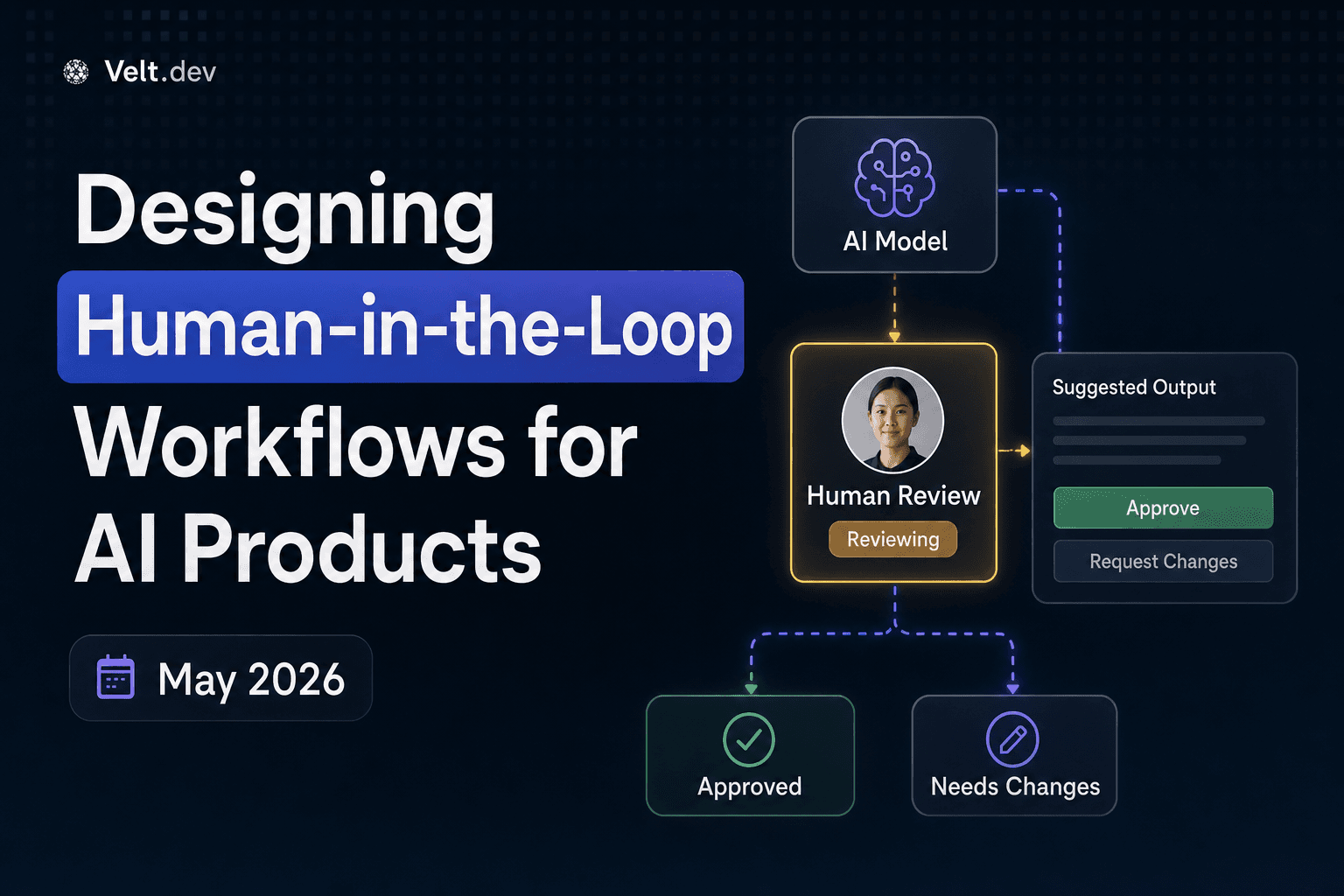
Everyone building AI products reaches the same inflection point: the model is fast, the outputs are mostly good, but you can't ship them without human review because the error rate on edge cases is too high or the decision carries liability you can't automate away. Designing a human in the loop workflow means deciding where review happens, who sees what, and how their corrections feed back into the system. The pattern shows up in fraud detection, clinical triage, content moderation, contract review, anywhere the cost of a wrong AI decision outweighs the cost of human time. What separates a working HITL system from one that collapses under load is review and approval infrastructure: routing logic that sends only uncertain outputs to reviewers, interfaces that surface the AI's reasoning alongside its answer, and audit trails that satisfy regulators. That's what we're covering here: the architecture, the design patterns, and the compliance requirements that went from optional to mandatory in 2026.
TLDR:
- HITL workflow design routes AI outputs to humans for review, approval, or correction at defined checkpoints before those outputs take effect in production systems.
- Human review workflows achieve 99.9% accuracy compared to 80% for fully automated AI systems, with consultants using HITL producing 40% higher quality results.
- The EU AI Act Article 14 requires human oversight for high-risk AI systems (credit scoring, employment screening, medical devices) starting in 2026, with 700+ U.S. bills moving in the same direction.
- Confidence-gated routing keeps human reviewers focused on low-confidence outputs and edge cases while auto-approving high-confidence decisions, preventing reviewer burnout and queue overload.
- Velt provides review and approval infrastructure (DOM-aware comments, approval workflows, audit trails) that ships the human oversight layer in days instead of the 4-6 weeks teams typically spend building it from scratch.
What Is Human-in-the-Loop Workflow Design
Human-in-the-loop (HITL) workflow design is the practice of building AI systems where humans review, correct, or approve AI outputs at defined points in the process before those outputs take effect. The core idea is straightforward: AI handles the high-volume, repetitive work, and humans step in where judgment, accountability, or accuracy requirements exceed what the model can reliably deliver on its own.
HITL workflow design isn't a single pattern. It spans a range of intervention styles depending on how much trust you've extended to the AI system and what the cost of an error looks like in your product.
There are three broad approaches teams use when structuring human review into an AI workflow:
- Human-on-the-loop: the AI acts autonomously, but a human monitors outputs and can intervene if something looks wrong. This works well for lower-stakes tasks where speed matters and errors are recoverable.
- Human-in-the-loop: a human must review and approve before the AI output moves downstream. This is the standard model for compliance-sensitive or customer-facing decisions.
- Human-in-command: humans retain full decision authority at every step. The AI surfaces options or drafts, but nothing executes without explicit human sign-off.
Choosing between these isn't simply a product decision. It's a risk calculation tied to your error tolerance, regulatory context, and how much your users trust the AI's outputs at a given point in the product's maturity.
When Human Oversight Becomes Critical
Not every AI decision needs a human in the loop. But some absolutely do.
The cases where oversight matters most tend to share a few properties: the cost of a wrong answer is high, the AI's confidence doesn't reliably predict its accuracy, or the output carries legal, financial, or reputational weight that can't be undone after the fact.
Think medical triage recommendations, loan underwriting, content moderation at scale, or contract clause generation. In each of these, an AI error is a liability, not simply a bad user experience.
Three situations consistently call for structured human review:
- The output affects a real person's access to something (credit, healthcare, employment) and regulations require an explainable decision trail.
- The AI is operating near the edge of its training distribution, where hallucination risk climbs and confidence scores stop being useful signals.
- The stakes of a false positive or false negative are asymmetric enough that catching one type of error matters far more than throughput.
Human-in-the-loop workflows exist for exactly these conditions. The goal isn't to slow AI down. It's to put human judgment where it actually changes outcomes.
Core Components of HITL Architecture
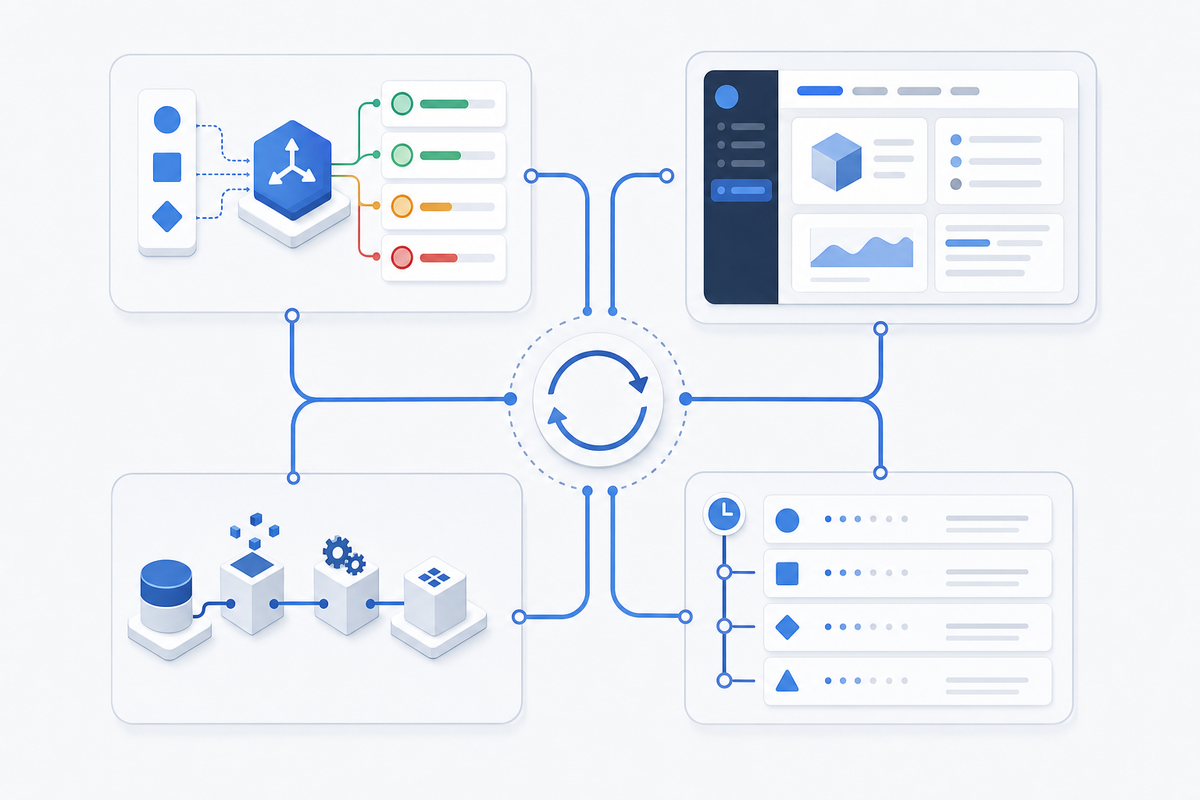
Every HITL workflow rests on four building blocks:
- a trigger layer that routes AI outputs to human reviewers when confidence falls below a threshold,
- a review interface for approval workflows,
- a feedback loop that writes reviewer decisions back into the model's training data, and
- Route by uncertainty score: auto-approve, flag, or escalate outputs immediately. This keeps reviewer queues focused on decisions where human judgment actually changes the outcome.
Get any one of these wrong and the whole system breaks down, whether that's reviewers missing context, feedback never reaching the model, or an audit trail too sparse to satisfy regulators.
Accuracy and Performance Benefits
The performance data on HITL is clear. Structured human review workflows can achieve 99.9% accuracy, which matters most when you consider fully automated document processing typically lands around 80%. Add human review stages and accuracy reaches 95% or higher. Consultants using AI with human oversight produced results of more than 40% higher quality compared to peers working without it. Human review catches what the model misses, and the compounding effect on output quality is real.
Design Patterns for Production HITL Systems
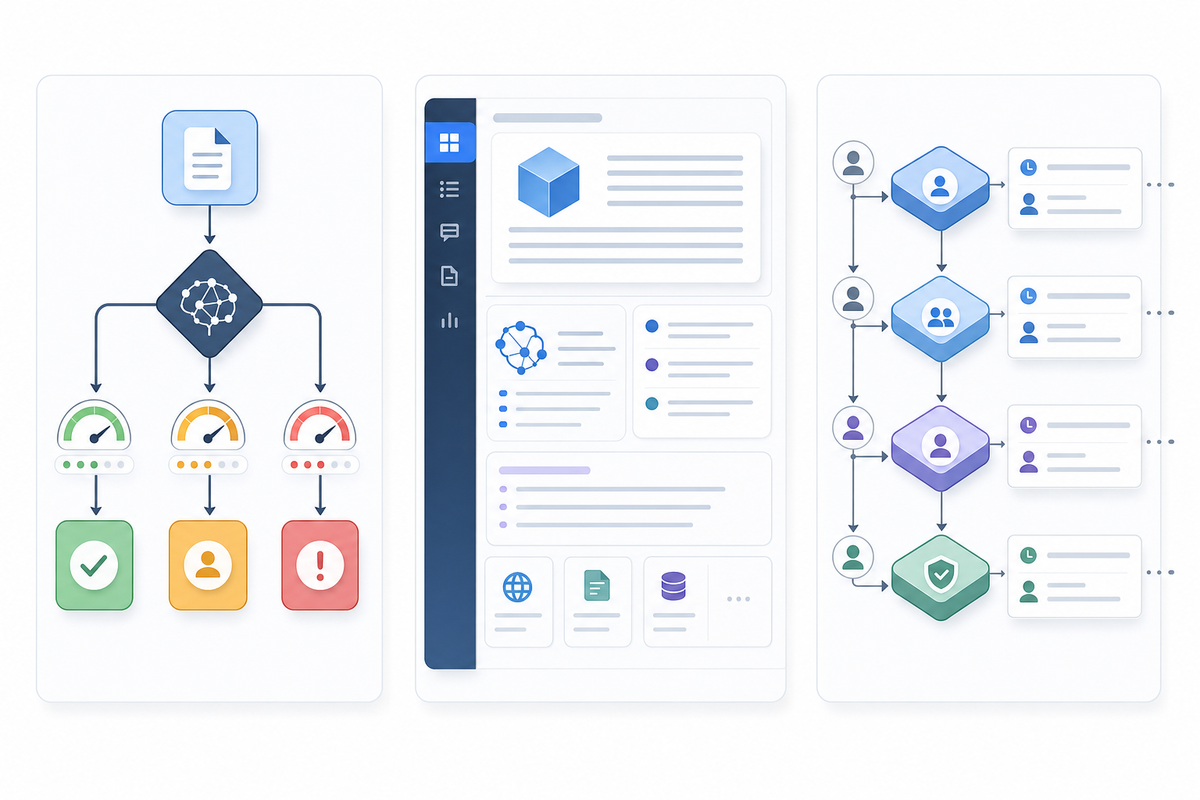
Three patterns show up consistently in production HITL systems, each solving a different failure mode.
Confidence-Gated Routing
Not every AI output needs a human reviewer. Route by uncertainty score: auto-approve high-confidence outputs, flag borderline cases for review, and escalate low-confidence ones immediately. This keeps reviewer queues focused on decisions where human judgment actually changes the outcome.
Contextual Review Interfaces
Reviewers make better decisions when they see the AI's reasoning alongside its output. Surfacing confidence scores, source references, and flagged reasoning gaps in the review UI cuts both review time and error rates.
Audit-Ready Approval Chains
Every decision in a HITL workflow needs a full audit paper trail. This satisfies compliance requirements and, after a few hundred reviewed decisions, generates labeled data you can feed back into model fine-tuning.
Regulatory and Compliance Drivers
The EU AI Act's Article 14 requires human oversight for any high-risk AI system, with enforcement actively underway in 2026. Categories that qualify include credit scoring, employment screening, medical devices, and critical infrastructure. For products in those spaces, HITL went from best practice to legal requirement.
The United States is catching up quickly. More than 700 AI-related bills have been introduced across federal and state legislatures. Most share a common thread: AI making decisions that affect people needs a defined human review mechanism and an auditable record of that review. If you're building AI products that touch any regulated domain, assuming the legal environment stays permissive is a bad bet.
Implementation Challenges and How to Solve Them
Even well-designed HITL workflows run into predictable friction points. Knowing where things break down is the first step to building something that holds up in production.
Reviewer fatigue and queue overload
When every AI output gets routed to a human, reviewers burn out fast. The fix is smarter routing: send only low-confidence outputs, edge cases, or high-stakes decisions to the queue. Let the AI handle clear-cut cases autonomously and reserve human attention for the work that actually needs it.
Latency bottlenecks
Human review adds time. If your workflow can't tolerate that, build parallel processing paths so AI tasks that don't require review keep moving while flagged items wait. Set SLA targets for review completion and monitor queue depth in real time.
Inconsistent reviewer decisions
Two reviewers seeing the same output and reaching different conclusions is a data quality problem. Structured review interfaces, shared rubrics, and calibration sessions reduce variance. Audit trails that capture reviewer reasoning alongside the final call make it easier to spot drift over time.
Feedback that never reaches the model
Human corrections lose their value if they don't feed back into training or prompt refinement. Wire reviewer decisions directly into your retraining pipeline. Even a lightweight tagging system that logs correction categories gives your ML team actionable signal.
Common Use Cases Across Industries
The pattern holds across industries, but what HITL is protecting against varies considerably by domain.
| Industry | Use Case | Role of Human Review |
|---|---|---|
| Finance | Fraud detection | Analyst confirms AI-flagged transactions before account action |
| Healthcare | Clinical decision support | Physician reviews AI triage before treatment routing |
| Social platforms | Content moderation | Human moderator resolves ambiguous policy violations |
| Legal / Compliance | Document review | Attorney signs off on AI-extracted contract clauses |
| Customer service | Escalation routing | Agent handles conversations the AI can't confidently resolve |
In each case, the AI is doing the heavy lifting on volume, and the human is covering the tail risk where a wrong call has real consequences.
Building Effective Feedback Loops
Human corrections only compound if they're captured deliberately. Every reviewer decision should be tagged with a correction category and written to a structured log: approval, rejection, edit, plus the original AI output attached. That schema is what separates a feedback loop from a feedback pile. Without it, your ML team gets a stack of corrected outputs with no signal about why or where the model keeps failing.
Active learning sharpens this further. Route uncertain outputs to your strongest reviewers first, instead of annotating uniformly across the queue. Track correction rate by output category over time: a declining rate signals the model is learning from the feedback; a flat or rising rate means either the corrections aren't reaching retraining, or the input distribution has shifted and your training data no longer reflects what the model is seeing in production.
Human-in-the-Loop vs Human-on-the-Loop vs Full Automation
Before picking a workflow pattern, it helps to understand what each one actually means in practice. These three models sit on a range from full human control to full AI control, and the right choice depends on your error tolerance, latency budget, and regulatory context.
- Human-in-the-loop (HITL) means a human reviews and approves AI output before it takes effect. The AI generates; a person decides. This is the most conservative pattern and the right default for high-stakes decisions.
- Human-on-the-loop means the AI acts autonomously, but a human monitors in real time and can intervene. Think of it like a co-pilot setup: the system runs, you watch, you override if something looks wrong.
- Full automation means the AI acts with no human review at all, typically reserved for narrow, low-risk tasks where the model has held above 95% accuracy over at least 30 days of production traffic: spam filtering, receipt parsing, image tagging, or routing support tickets to the right queue.
The table below provides a quick overview of each model, what they are best for, and what to watch for when using them.
| Model | Best For | Watch Out For |
|---|---|---|
| Human-in-the-loop | High-stakes outputs, regulated industries, low error tolerance | Bottlenecks if review volume exceeds reviewer capacity |
| Human-on-the-loop | Repetitive tasks with occasional edge cases | Alert fatigue; reviewers stop paying attention |
| Full automation | Narrow, well-defined tasks with measurable accuracy | Silent failures; hard to catch model drift over time |
Most real products don't pick one and stick with it. A common pattern is to start HITL, measure where the AI is consistently right, then graduate those cases to human-on-the-loop or full automation while keeping human review for the genuinely ambiguous ones.
Designing HITL for AI Products With Velt
The review layer is where most HITL implementations stall. Building contextual annotations, approval state machines, and immutable audit logs from scratch typically takes 4-6 weeks before a team writes any AI logic.
Velt is review and approval infrastructure that ships this layer in days. The SDK delivers DOM-aware contextual comments that bind to AI-generated content without pixel drift, configurable approval workflows with assignment routing and resolution tracking, audit trails that log every reviewer decision with timestamp and attribution, and programmatic presence that lets you display AI agents alongside human reviewers in the same interface. Teams building AI products use Velt to replace Slack-based approval chains with structured, in-product review checkpoints, and the compliance infrastructure ships with it. Your engineers focus on the AI logic instead of the glue code connecting human oversight to automated pipelines.
Final Thoughts on Making HITL Work in Production
HITL workflows fail when reviewers lose context, corrections never reach the model, or the audit trail is too sparse to satisfy regulators. Getting it right means treating the review layer as infrastructure, not an afterthought bolted onto the AI pipeline. If you're building AI products that need structured human oversight, book a demo to see review and approval infrastructure that ships with the compliance layer built in.
FAQ
What's the best framework for building human-in-the-loop workflows?
There's no single best framework. The right choice depends on your error tolerance, latency budget, and regulatory context. For high-stakes outputs in regulated industries, start with human-in-the-loop where reviewers approve before outputs take effect, then graduate to human-on-the-loop or automation for cases where the AI proves consistently reliable.
Can I build HITL workflows without custom backend infrastructure?
Yes. Review and approval infrastructure like Velt ships the approval state machines, audit trails, and contextual annotation interfaces as prebuilt components. You connect your AI outputs to the review layer, and the assignment routing, decision logging, and approval tracking work out of the box.
Human-in-the-loop vs human-on-the-loop: which should I use?
Human-in-the-loop requires reviewer approval before AI output takes effect: use it for high-stakes decisions where errors carry legal, financial, or reputational weight. Human-on-the-loop lets the AI act autonomously while a reviewer monitors and can intervene. It's better for repetitive tasks with occasional edge cases where throughput matters more than perfect accuracy.
How long does it take to implement a production HITL system?
Teams building review infrastructure from scratch typically spend 4-6 weeks on state management, permission checks, real-time sync, and audit logging before writing any AI logic. Using review infrastructure that ships those components as prebuilt primitives, most teams complete integration in days.
What accuracy improvement should I expect from human review workflows?
Structured human review workflows achieve 99.9% accuracy compared to roughly 80% for fully automated document processing. Adding human review stages pushes accuracy to 95% or higher, and consultants using AI with human oversight produce results of more than 40% higher quality compared to peers working without it.