


Financial Software Audit Trails: SOX, SEC, FINRA Requirements (June 2026)
Financial compliance audit trail guide for June 2026. Covers SOX, SEC, FINRA, MiFID II requirements, retention periods, and immutable storage specs.

Everyone building financial software knows audit trails matter for compliance, but the gap between logging events and satisfying regulators is wider than most teams expect. You need immutable records with proper timestamps, before-and-after field capture, retention windows that vary by regulation, and storage that proves tampering didn't happen. A log stored in a mutable database fails under SOX and SEC frameworks no matter how detailed the entries are. Building review and approval infrastructure that meets these requirements means capturing authenticated users, precise actions, timezone timestamps, field-level changes, and cryptographic integrity proof. We're covering the specific requirements from SOX Section 404, SEC Rule 17a-4, FINRA, MiFID II, and GDPR so your audit trail financial software passes review without last-minute architecture changes.
TLDR:
- Compliant audit trails need five elements: authenticated user ID, precise action, timezone timestamp, before/after data state, and cryptographic integrity proof.
- Retention periods range from 1 year (PCI DSS) to 7 years (SOX), with SEC requiring the first 2 years in hot or warm storage, not cold archive.
- Most audit trail failures happen because logs miss field-level change tracking or store timestamps without timezone context, not because logs are missing entirely.
- Tamper-evidence detects alterations after the fact; immutability prevents them. Auditors expect both: append-only storage plus SHA-256 hash chaining.
- Velt ships review and approval infrastructure with immutable audit trails built in, so financial software teams get queryable, cryptographically verified logs without building custom storage pipelines.
What Financial Regulators Actually Require from Audit Trails
Regulatory requirements for audit trails vary by jurisdiction and industry, but several frameworks set the baseline that most financial software teams end up building toward. Here's how the major regulations break down in practice:
| Regulation | Who It Covers | Core Audit Trail Requirements |
|---|---|---|
| SOX Section 404 | US public companies | Immutable logs of all financial data changes, access events, and approvals with timestamps |
| SEC Rule 17a-4 | Broker-dealers | WORM (write once, read many) storage, minimum 6-year retention, third-party audit access |
| FINRA Rule 4511 | FINRA member firms | Complete books and records, indexed and accessible within 24 hours of regulatory request |
| MiFID II | EU investment firms | Full order lifecycle capture, microsecond timestamps, 5-year retention minimum |
| GDPR Article 30 | Any firm handling EU data | Records of processing activities, documented access controls, breach-ready log exports |
What "Immutable" Actually Means to Regulators
Regulators don't accept audit logs that can be edited after the fact. Under SEC Rule 17a-4, records must be stored in non-rewriteable, non-erasable format. SOX Section 404 auditors look for cryptographic integrity controls or write-protected storage that makes retroactive tampering detectable.
The practical bar is high:
- Every change event must capture who acted, what changed, the previous value, the new value, and a server-side timestamp
- Access logs must record read events alongside writes, since unauthorized viewing of financial data is itself a compliance event
- Retention windows range from 3 years (basic FINRA records) to 7 years (SOX-relevant financial statements), with some SEC categories requiring permanent retention
The Five Elements Every Compliant Audit Trail Must Capture

Regulators across jurisdictions align on a core set of data points that any audit log must capture. Getting one wrong can invalidate the entire record. Before digging into each element, though, it's worth knowing that most audit trail failures in compliance reviews aren't about missing logs entirely. They're about logs that capture the wrong level of detail or store it in a way that can't be verified as tamper-free.
- Who took the action: The record must tie every event to a specific, authenticated user identity, not a shared account or a system process label. SOX and SEC Rule 17a-4 both require identifiable actors. "Admin" is not a compliant entry.
- What action was taken: The log must record the precise operation, whether that's a record view, an edit, an approval, or a deletion. Vague action categories like "modified" fail when regulators ask what field changed and from what value to what value.
- When it happened: Timestamps must include timezone context and be sourced from a synchronized clock. Audit trails with inconsistent or local-time-only timestamps have been rejected in SEC examinations.
- What data was affected: The specific record, document, or transaction must be identified, along with the before and after state where applicable. Field-level change tracking is a baseline expectation under GDPR Article 5 and PCI DSS Requirement 10.
- Whether the record is unaltered: Cryptographic integrity verification, such as hashing or write-once storage, must prove the log hasn't been modified after the fact. A log that an administrator can edit is not a compliant audit trail under any of the major frameworks covered here.
Retention Periods by Regulation: SOX, SEC, HIPAA, and PCI DSS
Retention periods vary more than most teams expect, and the difference between "minimum retention" and "immediately accessible" shapes your storage architecture as much as the number of years does.
| Regulation | Retention Period | Accessibility Requirement |
|---|---|---|
| SOX | 7 years | Records must be indexed and retrievable on regulatory request |
| SEC Rule 17a-4 (Broker-Dealers) | 6 years | First 2 years must remain in an accessible on-site location |
| SEC (Investment Advisers) | 5 years | First 2 years on-site or readily accessible |
| HIPAA | 6 years | Measured from creation date or last effective date, whichever is later |
| PCI DSS Requirement 10.7 | 1 year minimum | Most recent 3 months must be immediately available for analysis |
A few things worth calling out here. SOX's 7-year window is non-negotiable, and "retrievable on request" means searchable: stored somewhere on a backup tape doesn't cut it. SEC's two-tier accessibility rule catches teams off guard: archiving everything after day one doesn't work. The first two years need to remain reachable without a restoration process. The first two years need to remain reachable without a restoration process. HIPAA's clock starts from creation or last effective date, whichever is later, which can quietly extend your retention obligations beyond what teams initially budget for.
What "Immediately Accessible" Actually Means
Regulators don't define this term loosely. For financial compliance audit trail purposes, immediately accessible generally means records must be retrievable on short notice without a restoration process: hot or warm storage tiers, not cold archival. Your audit log compliance strategy needs to account for tiered storage costs alongside raw retention timelines.
Tamper-Evidence vs. Immutability: What the Difference Means for Compliance
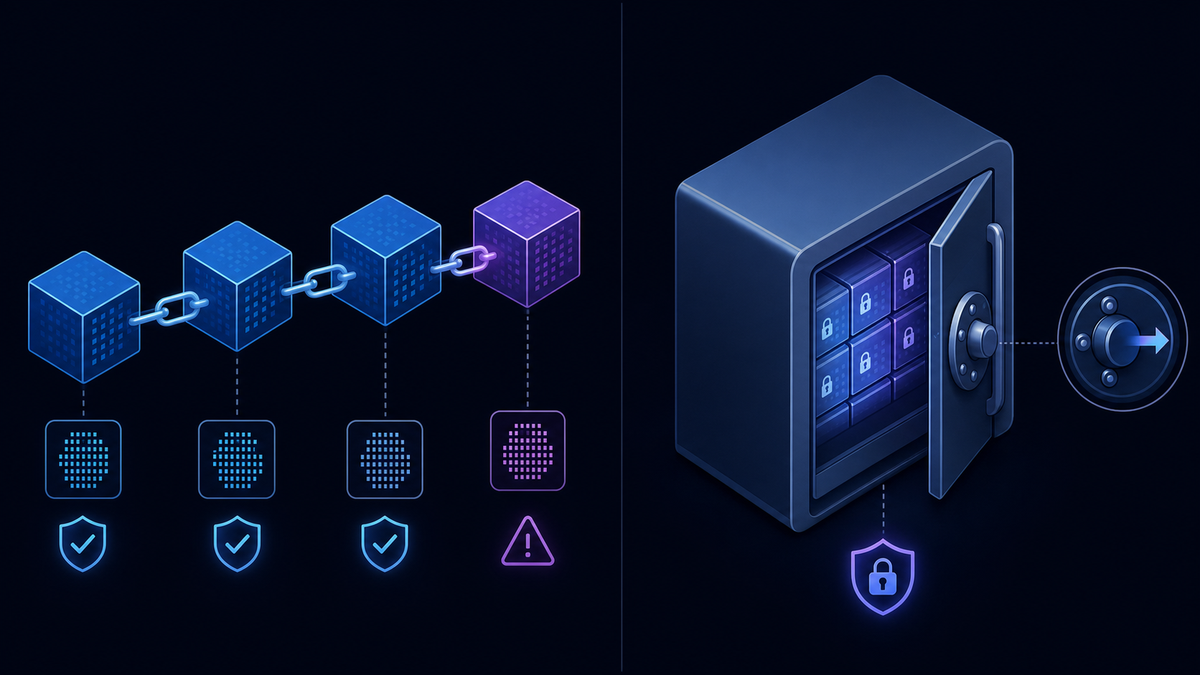
Regulators and auditors often use "tamper-evident" and "immutable" interchangeably, but they mean different things in practice, and the distinction affects how you architect your audit trail. A tamper-evident log can detect whether records have been altered after the fact while an immutable log physically prevents alteration from happening in the first place. Requirements vary by framework: SEC Rule 17a-4 explicitly mandates write-once (WORM) storage, while other frameworks focus on integrity verification without specifying the storage mechanism. In either case, immutable storage is widely regarded as best practice and gives you a stronger compliance position than tamper-evidence alone.
This is why that matters in a compliance context:
- Tamper-evidence through cryptographic hashing (SHA-256 chaining, for example) satisfies SEC Rule 17a-4 and most SOX audit requirements, since any modification breaks the hash chain and becomes detectable during review.
- Immutability through write-once storage (WORM drives, append-only cloud storage) provides a stronger guarantee because there's no window between a modification occurring and its detection.
- PCI DSS v4.0 Requirement 10.3 calls for protection of audit logs from destruction and unauthorized modifications, which in practice means implementing cryptographic integrity controls at minimum to meet that standard.
For financial software operating under multiple frameworks simultaneously, the practical answer is to implement both: immutable storage as the foundation, with cryptographic hash chaining as a verification layer on top. Tamper-evidence gives you the audit proof; immutability gives you the defense-in-depth that examiners increasingly expect to see during reviews.
Common Audit Trail Failures That Trigger Regulatory Findings
Audit trail failures rarely stem from missing logs entirely. More often, regulators find that logs exist but fall short in ways that are surprisingly consistent across organizations.
Here are the failure patterns that show up most frequently in regulatory findings:
- Incomplete event capture: Logs record that a record was changed but not what it contained before the change. Without before-and-after field values, auditors can't reconstruct what actually happened, which fails requirements under SOX, SEC 17a-4, and most banking regulations.
- Timestamps without time zones: A timestamp reading "14:32:07" is ambiguous across global operations. Regulators expect UTC or a clearly documented local time standard, and findings get issued when audit logs can't be matched across systems.
- Logs stored in mutable systems: If the same team that can edit financial records can also modify or delete the audit log, the log has no evidentiary value. Immutability isn't optional for financial software under regulatory oversight.
- Missing user context: Logging that a record changed is insufficient if the log doesn't capture which authenticated user made the change. Shared service accounts with no individual attribution are a recurring finding.
- Gaps during system migrations or outages: Regulators expect continuity. A six-hour gap in audit coverage during a database migration is treated the same as no audit trail at all.
- Retention cutoffs applied incorrectly: Deleting logs at the system's default retention period instead of the applicable regulatory minimum is a common and avoidable finding.
Knowing these failure modes before an examination is far more useful than finding them during one.
Building Review Infrastructure That Satisfies Audit Requirements
Most financial software teams treat audit logging as a checkbox: store some events, expose a table, call it done. That approach fails fast when regulators show up.
What auditors actually want is a system where every material action leaves an immutable, timestamped record tied to a specific user identity. That means write-once storage, cryptographic integrity checks, and log retention that matches your regulatory exposure. SOX requires seven years for public companies. FINRA Rule 4511 requires three years, with the first two in an immediately accessible format. MiFID II Article 25 requires five years. If your logs live in a mutable database table, none of those requirements are satisfied regardless of what your documentation says.
What a Compliant Audit Trail Actually Looks Like
There are four properties regulators look for in practice:
- Immutability: records written once and never modified. In practice, that requires cloud object storage configured with an object lock policy (S3 Object Lock in compliance mode, for example), or an append-only log service where the write path has no update or delete operation. SHA-256 hashing per event with the hash input covering event ID, timestamp, user ID, and payload lets you prove during an audit that a specific record hasn't changed since it was written. Soft-deletable database rows with an
is_deletedflag do not satisfy this, regardless of access controls. - Completeness: every action captured, including errors, exceptions, and read events. "Every meaningful interaction" is broader than most teams expect: a reviewer opening a document without making changes, a failed login attempt, a bulk export, a permission change on a record. All of these are compliance-relevant events under SOX and SEC frameworks. If your logging fires only on successful writes, you have gaps an examiner will find.
- Timeliness: logs generated at the moment of the action, not batched or reconstructed after the fact. The write to the audit log should happen synchronously, before the API response returns to the client. Async log pipelines introduce a window where the action occurred but the record doesn't exist yet. That window is a compliance gap if the system fails during it. Batch-reconstructed logs from application logs after the fact don't meet the "contemporaneous record" standard that regulators expect.
- Queryability: auditors need to pull records by user, date range, document, or action type without waiting for engineering support. That requires indexed fields on user ID, timestamp, document or record ID, and action type, not a flat log file that requires a custom query to parse. When a regulator requests all activity on a specific account between two dates, your compliance team should be able to produce that export in minutes, not days.
Building this from scratch in financial software typically takes 3 to 6 months of engineering time: write-once storage configuration, SHA-256 hash chaining per event, tiered retention policies across hot and cold storage, and indexed query layers for user ID, timestamp, and record ID. Velt ships review and approval infrastructure with audit trails built in, so teams get compliant logging on day one without custom log pipeline work.
Final Thoughts on Financial Software Audit Trail Compliance
Audit trail compliance isn't about logging more events. It's about capturing the right level of detail in a format regulators can verify as tamper-proof. Every action needs who, what, when, what data changed, and cryptographic proof the record is unaltered. Retention periods range from one year under PCI DSS to seven years under SOX, with the first two years in immediately accessible storage for firms under SEC oversight. If you're building financial software and need audit trails that satisfy regulatory requirements from day one, book a demo to see how Velt's review infrastructure handles this.
FAQ
What's the minimum retention period for audit trails in financial software?
It depends on your regulatory exposure. SOX requires 7 years for public companies, SEC broker-dealer rules require 6 years, and PCI DSS requires just 1 year with the most recent 3 months immediately accessible. The key is matching your retention window to the strictest regulation that applies to your operation.
Audit trail financial software: tamper-evident vs immutable storage?
Tamper-evident logs detect modifications after the fact through cryptographic hashing, while immutable storage physically prevents alterations using write-once technology. Most financial compliance audit trail requirements technically accept tamper-evidence, but auditors increasingly expect immutable storage as the foundation with cryptographic verification on top.
Can I store audit logs in a regular Postgres table and stay compliant?
A Postgres table with INSERT-only policy and a CHECK constraint blocking updates satisfies basic financial compliance audit trail requirements, but you'll hit performance and bloat issues at scale. Most teams handling millions of audit events daily eventually move to a separate time-series store or purpose-built audit log service to keep queries fast and storage costs under control.
What information must every compliant audit log entry capture?
Every entry needs five elements: who took the action (authenticated user identity, not a shared account), what action occurred (specific operation with before/after values), when it happened (timezone-aware timestamp from synchronized clock), what data was affected (specific record and field-level changes), and cryptographic proof the record hasn't been altered.
How do I build review infrastructure that actually passes financial audits?
Velt provides review and approval infrastructure with compliant audit trails built in, so teams get immutable logging, cryptographic integrity checks, and configurable retention on day one without building custom log pipelines. Velt's system captures every review action, approval decision, and access event with full user attribution and timestamps, stored in write-once format that satisfies SOX, SEC, and FINRA requirements out of the box.