


FP&A Collaboration Tools: Why Slack Fails for Budget Sign-Offs (June 2026)
Why Slack fails FP&A budget sign-offs: 65% cite miscommunication as top barrier. Learn what budget approval workflows need beyond messaging apps in June 2026.

Budget approvals break the same way every time in Slack. The CFO posts a request, three approvers chime in at different times with conflicting comments, and nobody can agree on which version of the model they're reacting to. Finance leaders consistently cite communication gaps and repeated budget iterations as top causes of delays. The problem is context collapse: messaging apps strip away the document, the numbers, and the version history. What's left is a thread about a thread with no record of what got approved. FP&A collaboration tools need infrastructure messaging apps can't provide. This translates to feedback anchored to the actual model, version control that tracks what changed, and sign-off that's a recorded action, not a reply buried in a channel.
TLDR:
- Budget sign-offs that should close in two days routinely stretch into two weeks when approvers work across disconnected tools.
- Workers spend 30% of their week chasing down information, pushing budget cycles out by weeks.
- Slack lacks approval states, spending thresholds, and sequential routing for budget workflows.
- Budget approvals need timestamped records tied to exact model versions to satisfy auditors.
- Velt anchors comments to line items and logs approvals automatically as review infrastructure.
Why FP&A Teams Are Moving Beyond Messaging Apps for Budget Approvals
The root cause is context collapse. When budget approvals run through messaging apps, the document, the numbers, and the version history get stripped away. What remains is a conversation about a conversation, with no audit trail and no clear approval state.
FP&A teams need a workflow where feedback lives on the actual budget model, approvers can see exactly what changed, and sign-off is a recorded action instead of a buried reply.
The Hidden Cost of Scattered Budget Conversations

When finance teams rely on Slack threads, email chains, and shared spreadsheets to run budget approvals, the real cost doesn't show up in any line item. It shows up in delays. A budget sign-off that should close in days can drag on for weeks when a key stakeholder misses a notification, a revised model gets attached to the wrong thread, or someone approves an outdated version of the forecast. These aren't edge cases. They're the default state for most FP&A teams without a structured approval workflow.
The compounding effect is real. Research from IDC finds that workers spend nearly 30% of their workday searching for information or chasing people down for input. For FP&A teams, that friction lands hardest during budget cycles, when version confusion and approval bottlenecks can push planning timelines out by weeks.
A budget sign-off that should close in days can drag on for weeks when a key stakeholder misses a notification, a revised model gets attached to the wrong thread, or someone approves an outdated version of the forecast. These aren't edge cases. They're the default state for most FP&A teams without a structured approval workflow.
The compounding effect is real. Research from IDC finds that workers spend nearly 30% of their workday searching for information or chasing people down for input. For FP&A teams, that friction lands hardest during budget cycles, when version confusion and approval bottlenecks can push planning timelines out by weeks.
The gap isn't effort. Most finance teams work hard. The gap is infrastructure: the absence of tools purpose-built for financial planning collaboration, where approvals are tracked, context stays attached to numbers, and every stakeholder knows exactly what they're signing off on.
What Budget Approval Workflows Actually Require
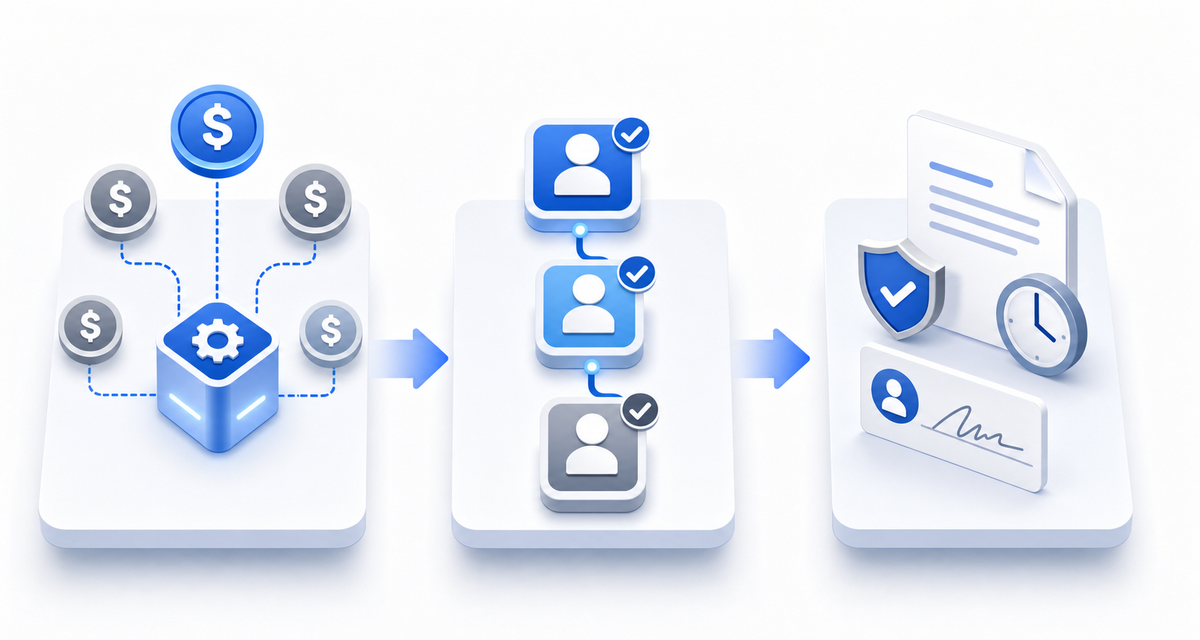
Real budget approval workflows aren't complicated because finance teams are bureaucratic. They're complicated because the stakes are real: a misrouted request, a missing signature, or an undocumented approval can create audit exposure that far outweighs whatever time was saved by keeping things informal.
Here's what a proper budget approval workflow actually requires:
- Spending thresholds that route requests automatically, so a $5,000 line item doesn't sit waiting for a CFO who should only see requests above $50,000.
- Sequential multi-stage routing that enforces approval order, so a department head can't accidentally approve something before the finance controller has weighed in.
- Compliance documentation that creates a timestamped, immutable record of who approved what and when, with enough context attached to satisfy an auditor who wasn't in the room.
These aren't nice-to-haves. Regulators and internal audit teams expect a clear chain of custody for budget decisions. Without it, FP&A teams spend hours reconstructing approval history from Slack search results and email threads before every audit cycle.
The Gap Slack Can't Close
Slack's read receipts and emoji reactions don't produce audit trails. There's no native concept of an approval state, a spending threshold, or a sequential routing rule. Every workaround, whether that's a pinned message, a dedicated channel, or a manual Google Sheet tracker, requires someone to maintain it and introduces a new place for things to fall through.
The structural requirements of budget sign-offs need purpose-built financial planning collaboration workflows, not a messaging layer stretched past what it was designed to do.
Why Audit Trails Matter More Than You Think
When a budget approval gets challenged six months after the fact, "we discussed it on Slack" doesn't hold up. Auditors, boards, and finance leadership need a documented record of who approved what, when, and with what information in front of them. Budget compliance audits check whether spending aligns with approved budgets and governance policies, which requires clear documentation trails.
This is where general-purpose messaging tools structurally fail FP&A teams. Slack conversations expire, get archived, or simply get lost across threads. There's no native way to tie a specific approval message to the version of the forecast that was under review at that moment.
What a Real Audit Trail Looks Like in Budget Workflows
A defensible record for any budget sign-off should capture:
- The exact version of the financial model or forecast that was presented for approval, with full context beyond a simple file attachment in a chat thread that may have been updated after the fact.
- A timestamped approval from each required stakeholder, tied to their identity and role, so there's no ambiguity about who signed off and whether they had the authority to do so.
- Any comments, questions, or conditions that were raised during review, preserved in context next to the relevant line items instead of scattered across a separate conversation.
- A clear record of any revisions made after initial review, along with who requested them and who approved the revised version.
Without this structure, finance teams end up reconstructing approval history manually when it matters most, which is exactly the wrong time to find out the record doesn't exist.
Context Loss: When Budget Decisions Lose Their Paper Trail
When a CFO asks "why did we approve this number?", the answer rarely lives in one place. It's buried across a Slack thread from six weeks ago, a comment in a Google Doc that someone resolved, and an email chain that three people were CC'd on. Piecing it together takes hours, and even then the full context is often gone.
This is the core problem with using general messaging tools for budget sign-offs. Decisions get made, but the reasoning behind them doesn't survive in any structured way.
What Gets Lost
- The specific version of the model that was approved, since spreadsheets get overwritten and no link between approval and state at that moment.
- The conditions attached to an approval, like "this headcount is approved contingent on Q2 hitting plan," which live as plain text in chat and are easy to miss when revisiting months later.
- Who actually had sign-off authority, since Slack threads don't capture organizational hierarchy or delegation chains in a way that holds up to scrutiny.
Without a structured audit trail, FP&A teams face real risk during board reviews, external audits, and reforecasting cycles where traceability isn't optional.
The Three Components Every FP&A Approval System Needs
When a budget approval stalls, it's rarely because the numbers are wrong. It's because the right people couldn't find the right version, couldn't leave feedback in context, or couldn't confirm they'd actually signed off. Any FP&A approval system that works has to solve three distinct problems.
Structured Sign-Off Tracking
Someone needs to own each approval step, and the system needs to record approvals. Not a Slack message that says "looks good" buried in a thread from two weeks ago, but an explicit, timestamped record tied to a specific version of the model. Without this, finance teams spend more time confirming confirmations than reviewing the actual numbers.
Version-Aware Commenting
Budget models change constantly. Comments left on version 3 of a spreadsheet become noise by version 7. Feedback needs to stay anchored to the specific cell, assumption, or line item it references, and the system needs to carry that context forward as the model evolves.
A Clear Audit Trail
Finance needs decisions it can defend to an auditor six months later: who approved what, against which version of the data, and with what authority. That record matters for internal governance and for any external audit or compliance review that follows the budget cycle.
How Cloud FP&A Tools Handle Real-Time Collaboration
Cloud FP&A tools have moved well beyond spreadsheet handoffs and email chains. Purpose-built solutions now offer features designed for the financial planning and budget approval workflow problems that general productivity tools never solved.
Here's how the leading cloud FP&A tools approach real-time collaboration today:
Concurrent Editing and Version Control
Most modern cloud FP&A tools allow multiple users to work inside the same model simultaneously, with changes tracked at the cell or assumption level. This removes the "who has the master file" problem entirely. Version histories are automatic, so finance teams can see exactly what changed, when, and who made the edit.
Structured Budget Approval Workflow
Unlike Slack threads, purpose-built FP&A tools tie approval actions directly to the financial data. Reviewers can approve, reject, or request changes without those decisions getting buried in chat history. Approval states are recorded, which matters for audit purposes.
Contextual Commenting
Comments in FP&A tools attach to the relevant row, cell, or scenario instead of floating in a separate channel. When a CFO questions a headcount assumption, that question lives next to the assumption itself, not three days back in a Slack thread.
| Feature | Generic Chat Tools | Cloud FP&A Tools |
|---|---|---|
| Approval tracking | None | Built-in, per line item |
| Comment context | Thread-based, disconnected | Anchored to financial data |
| Audit trail | Partial at best | Full, timestamped record |
| Version control | Manual | Automatic |
When Messaging Tools Work and When They Don't
Slack genuinely works for a subset of finance communication. A quick status update before a board call, a question about where the revised deck lives, a heads-up that the updated forecast is ready for someone to look at. For low-stakes coordination between people who already trust each other, messaging tools are fast and good enough.
The line breaks when a conversation moves from informing to deciding. Once the question becomes "do you formally approve this for Q3 spend," the requirements change entirely. You need a named approver, a recorded state, and a clear link between that decision and the specific version of the data it was based on. A chat thread where someone typed "yes" doesn't satisfy any of those conditions, and no amount of channel organization changes that.
Building Review Infrastructure That Finance Teams Actually Use
Slack threads don't have approval states. Email chains don't bind feedback to a specific cell in a model. Most FP&A teams know this, yet the average budget cycle still runs through a patchwork of messaging apps, spreadsheets, and forwarded PDFs because no one has wired the approval layer directly into the financial workflow.
Velt is built as review and approval infrastructure, with comments, approval workflows, presence, notifications, audit trails, and recording baked in. For finance teams, that means reviewers can leave feedback anchored to the exact line item in question, approvers can move a budget from "in review" to "approved" without a separate email, and every decision gets logged automatically.
The result: fewer cycles, faster sign-offs, and a complete record that survives the next audit.
Final Thoughts on Building Review Workflows Finance Teams Trust
Budget approval infrastructure either exists or it doesn't. When it doesn't, your team spends hours reconstructing decisions that should have been recorded the first time. Velt gives you review and approval infrastructure that handles comments, workflows, and audit trails without making approvers learn a new system. Your next budget cycle doesn't have to look like the last one.
FAQ
FP&A collaboration tools vs Slack for budget approvals?
Slack works for quick status updates and informal coordination, but breaks down once the conversation moves from informing to deciding. FP&A collaboration tools tie approval actions directly to financial data, record approval states with timestamps, and anchor comments to specific line items instead of burying decisions in chat threads. You need named approvers, recorded states, and clear links between decisions and data versions for audit purposes.
Can I build a budget approval workflow without custom backend logic?
Yes. Cloud FP&A tools now provide structured approval workflows out of the box, including multi-stage routing, spending threshold rules, and automatic audit trail generation. Review and approval infrastructure like Velt ships approval states, assignment tracking, and timestamped decision logs as built-in features, so finance teams can move budgets from "in review" to "approved" without building workflow orchestration from scratch.
What makes a budget approval audit trail defensible?
A defensible audit trail captures the exact version of the financial model that was approved, timestamped approvals from each required stakeholder tied to their identity and role, all comments and conditions raised during review preserved in context next to the relevant line items, and a clear record of any revisions made after initial review along with who requested and approved them. Chat threads and email chains don't survive scrutiny because they lack version binding and immutable state tracking.
How long does the average budget cycle take without structured approval infrastructure?
Budget sign-offs that should take two days typically stretch into two weeks when finance teams rely on Slack threads and email chains. Research from IDC finds that workers spend nearly 30% of their workday searching for information or chasing people down for input, and for FP&A teams that friction lands hardest during budget cycles when version confusion and approval bottlenecks can push planning timelines out by weeks.
What's the difference between comment anchoring and threaded chat for budget review?
Comments in FP&A tools attach to the relevant row, cell, or scenario instead of floating in a separate channel. When a CFO questions a headcount assumption, that question lives next to the assumption itself and survives as the model changes versions. Chat threads disconnect feedback from the data, so by the time you're on version 7 of a budget model, comments from version 3 have become noise with no clear link to what they originally referenced.