


The HITL AI Stack: From Generation to Approval to Audit (June 2026)
Learn how to build a HITL AI stack connecting generation to human approval and audit. Covers review infrastructure, compliance, and workflow patterns (June 2026).

AI generates outputs in milliseconds, but your review process measures time in hours or days. You need a HITL AI architecture that connects generation to human decision-making without creating bottlenecks, and that means treating review and approval infrastructure as a first-class layer instead of an afterthought you patch in later. Velt provides that layer.
TLDR:
- HITL AI stacks fail at handoff, not generation. Most teams bolt on review and audit layers after, breaking workflows under production load.
- Knowledge workers switch context every 3 minutes. Every AI review interrupt compounds latency in high-volume pipelines fast.
- EU AI Act, SEC, and HIPAA now mandate immutable audit trails linking reviewer identity, decision state, and timestamps to every AI output.
- Risk tiering routes AI outputs by confidence score. Low-confidence goes to mandatory review, high-confidence auto-approves with logged audit events.
- Velt provides contextual commenting, approval state management, and audit trails for the review layer where most HITL workflows break.
What Is the HITL AI Stack
The HITL AI stack is the set of layers that sit between an AI's raw output and the moment that output becomes an official record or decision, forming what is review infrastructure for AI systems. It covers generation, review, approval, and audit in a connected sequence instead of isolated tools bolted together after the fact.
Each layer has a distinct job. The generation layer produces AI output. The review layer routes that output to the right human at the right time. The approval layer captures the human's decision with a clear status. The audit layer records what happened, who decided it, and when.
Here's how the four layers break down:
- Generation: an LLM or AI agent produces a draft, suggestion, flag, or action. This is the entry point into the stack.
- Review: the output is surfaced to a human reviewer with enough context to make a judgment. Without this layer, feedback gets lost in Slack threads or email chains.
- Approval: the reviewer accepts, rejects, or modifies the output. The system records the outcome as a durable state instead of a chat message. This layer is where humans review, annotate, and approve or reject what the AI produced and where quality actually gets enforced.
- Audit: every action in the chain gets logged with timestamps, user IDs, and version history so the workflow is reconstructable after the fact. This layer sits beneath both: a persistent record of every decision, who made it, and why.
To see how the layers connect, consider a fintech company using an AI model to generate dispute summaries for customer service agents. The generation layer produces a draft summary in under a second. The review layer surfaces that draft to a trained agent with the original transaction data alongside it, so the agent isn't reviewing in a vacuum. The approval layer records the agent's decision (accepted, edited, or rejected) as a durable state tied to the customer record. The audit layer logs every step with timestamps and agent IDs so compliance can reconstruct exactly what happened if a dispute is escalated to arbitration.
Remove any one layer and the workflow breaks in a predictable way. Without the review layer, agents see AI output stripped of context and make worse calls faster. Without the approval layer, decisions live in a chat log nobody queries at 2am during an audit. Without the audit layer, you have no defensible record when a regulator asks who approved a disputed AI-generated summary and on what basis.
The stack is a design pattern, not a single product. Teams assemble it from several components, and the integration choices they make determine whether the workflow holds together under real production conditions. But engineering teams typically scope the generation layer first and find that approval state tracking and audit logging need separate infrastructure only after the model is already in production. At that point, adding them means rebuilding handoff logic that was never designed to carry state. That's where things fall apart.
Why Each Layer Needs Its Own Infrastructure
These layers have genuinely different requirements:
- The generation layer needs speed and scale, since AI can produce thousands of outputs per hour and the infrastructure has to keep up without creating bottlenecks upstream.
- The approval layer needs context, threading, and state management so reviewers can annotate specific elements, discuss ambiguous cases, and record a clear decision without losing the thread of why a call was made.
- The audit layer needs immutability and queryability, because a log nobody can search or export is just compliance theater.
Treating all three as one undifferentiated system is where HITL pipelines get fragile.
HITL Workflow Patterns: Pre-Processing, In-Process, Post-Processing, and Feedback Loop
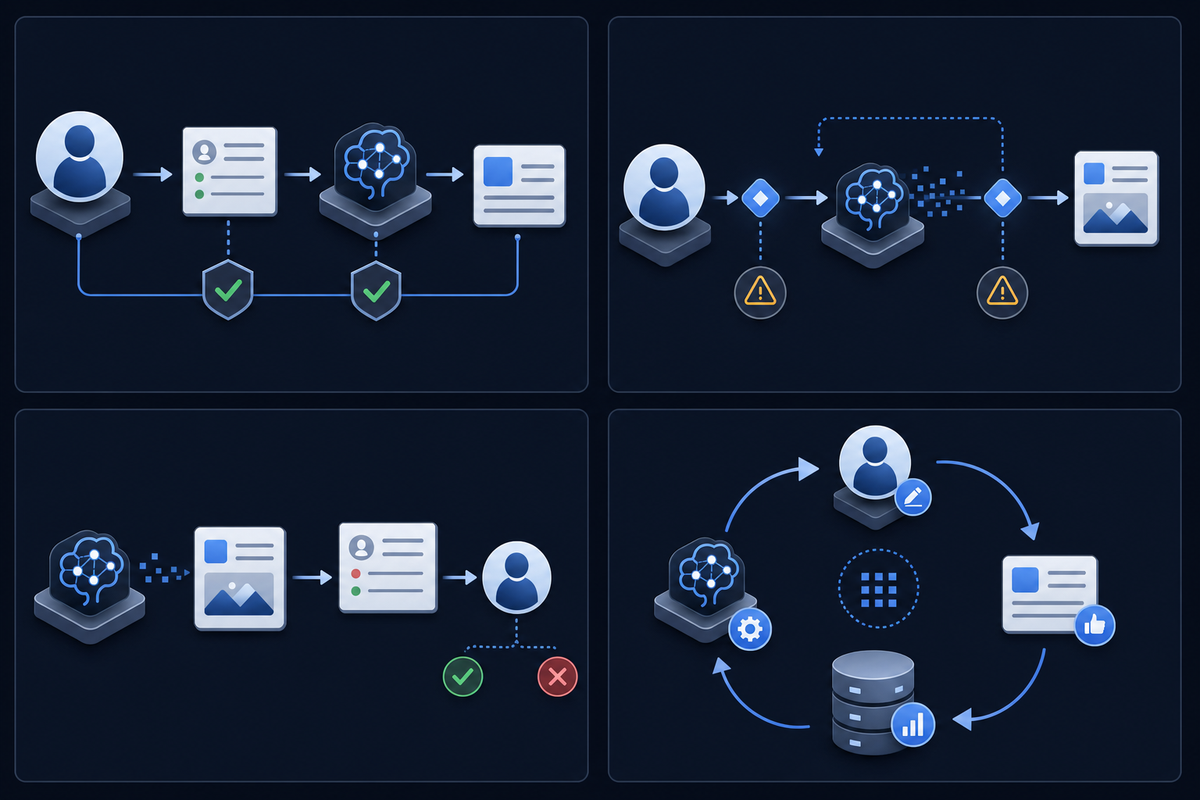
Pre-processing, in-process, post-processing, and feedback loop patterns each solve a different coordination problem between AI systems and human reviewers. Getting the pattern right matters because the wrong one either creates bottlenecks or lets errors through unchecked.
Pre-Processing
Human review happens before the AI acts. A content moderator sets thresholds, a compliance officer approves prompt templates, or a data team validates training sets before a model runs. This pattern is common in compliance-driven industries where human sign-off is a legal requirement beyond quality preference.
In-Process
Humans intervene mid-generation. A reviewer flags a partially generated document, an analyst corrects a data extraction mid-run, or a legal team member redirects an AI-drafted contract clause before the output finalizes. Latency is the trade-off here.
Post-Processing
The AI generates a complete output, then a human audits it. This is the most common pattern because it preserves throughput. The risk is that errors accumulate before anyone catches them, especially in high-volume pipelines.
Feedback Loop
Human corrections feed back into model behavior over time. Reviewers approve outputs while training the next version. This closes the gap between what the model produces today and what the team actually needs, and it's the pattern most teams underinvest in building.
| Pattern | When Review Happens | Primary Trade-off | Best Use Case |
|---|---|---|---|
| Pre-Processing | Human review occurs before the AI acts on any input | Legal compliance requirements outweigh throughput concerns | Clinical decision support and financial reporting where sign-off is legally required |
| In-Process | Humans intervene during generation while the AI is still producing output | Latency increases because the workflow pauses mid-generation for human input | Partially generated documents or data extractions that need mid-run corrections |
| Post-Processing | The AI completes generation first and humans audit the finished output | Errors can accumulate before anyone catches them in high-volume pipelines | Content production and sales enablement where throughput matters and errors are correctable |
| Feedback Loop | Human corrections are captured during review and fed back to improve future model behavior | Requires investment in building the feedback mechanism most teams skip | Closing the gap between current model output quality and actual team needs over time |
Confidence-Based Escalation and Risk Tiering
Not every AI output carries the same risk. A model autocompleting a product description has a very different failure profile than one flagging a compliance violation or generating a contract clause. Treating all outputs as equally review-worthy creates bottlenecks; treating them all as safe creates liability.
Confidence-based escalation solves this by routing outputs to the right level of human attention based on risk tier.
How risk tiering works in practice
Most HITL stacks assign outputs to one of three tiers:
- Low-confidence or high-stakes outputs go to mandatory human review before any action is taken, covering things like legal language, financial recommendations, or safety-critical decisions.
- Mid-confidence outputs get flagged for spot-check review, where a human samples outputs instead of reviewing every one.
- High-confidence, low-stakes outputs pass through automatically, with actions logged for later audit without blocking the workflow.
The routing logic typically pulls from model confidence scores, output category classifiers, and business rules defined by the team. A compliance team might require human review for any output below a 0.95 confidence score, while a content team routes only outputs below 0.70 to mandatory review and spot-checks the rest. A fintech app generating transaction dispute summaries might auto-approve nothing above $10,000 regardless of confidence score, while a marketing tool generating ad copy auto-approves anything above 0.80 with no dollar threshold at all.
Why this matters for audit
Tiering decisions are themselves auditable events. Every routing call, whether an output was escalated, spot-checked, or auto-approved, should be logged with the confidence score and the rule that triggered it. Without that record, a post-incident review can't reconstruct why a given output bypassed human eyes.
Human review tooling that captures reviewer decisions in context, tied to the specific output and the escalation reason, makes that audit trail useful instead of merely present.
State Management and Pause-Resume Infrastructure
When an AI generates a draft and a human reviewer steps in, the system needs somewhere to hold that in-between state. The output is no longer a queue item waiting to be processed, but it's not approved either. Managing that liminal state cleanly is where most HITL implementations break down.
A well-designed pause-resume layer tracks a few things:
- What the AI produced, versioned so reviewers can compare against edits made during review.
- Where in the review cycle the item sits, including who has claimed it, what feedback has been left, and whether it's been escalated.
- How long it's been sitting, since stale review items are a silent quality risk that compounds over time.
State here is more than a database field. It's the coordination layer between asynchronous humans and synchronous AI output pipelines.
The Latency Problem: Why Human Review Creates Bottlenecks
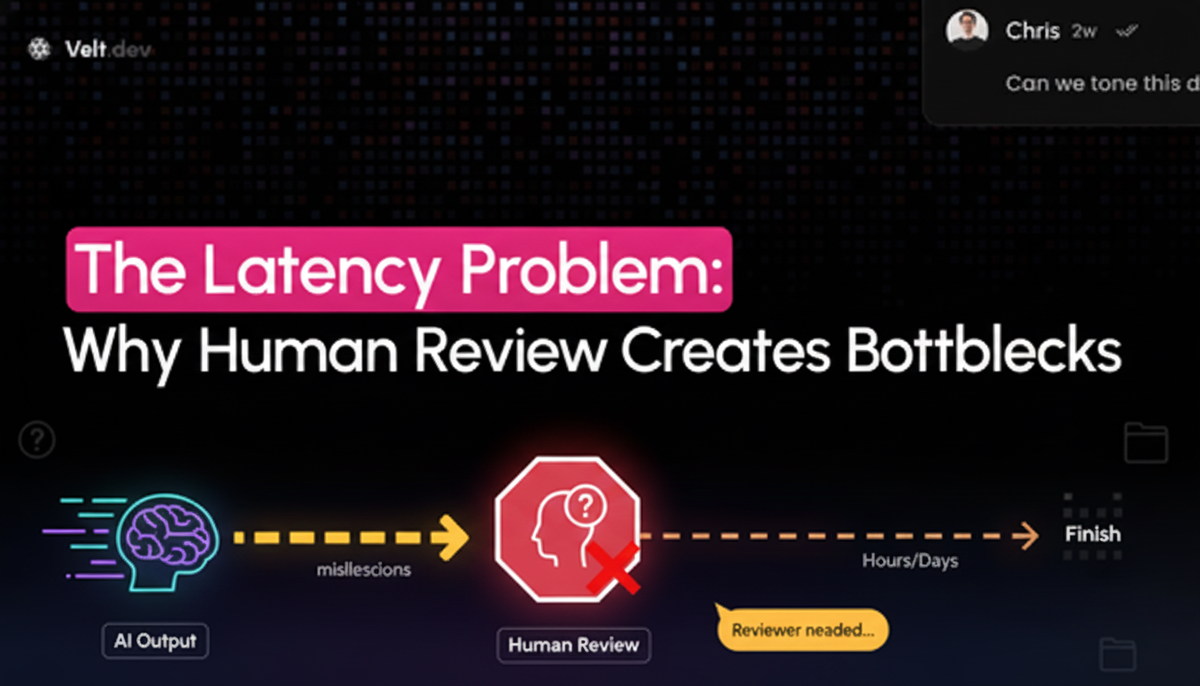
Human review is the bottleneck in almost every AI workflow. The model generates output in milliseconds, but then it waits. A reviewer needs to find it, read it, decide on it, and route it somewhere. That gap between generation and decision is where latency accumulates, and in high-volume pipelines it compounds fast. Best practices for maintaining human oversight focus on reducing this coordination overhead without compromising decision quality.
Gloria Mark's UC Irvine research found that knowledge workers switch context an average of every 3 minutes and 5 seconds. Every interrupt to review an AI output is a context switch with a recovery cost attached. Multiply that across a team processing hundreds of AI-generated items per day and the throughput loss gets real quickly. Context switching increases 47% with AI use, as parallel workstreams multiply and review queues expand.
The bottleneck has three root causes: reviewers lack context when making decisions, there's no structured handoff between AI generation and human judgment, and there's no audit trail connecting decisions back to outputs.
Human-in-the-loop AI doesn't fail at the model layer. It fails at the handoff layer.
Immutable Audit Trails: From Logs to Evidence
Audit trails in HITL AI systems go beyond logs. They're the evidentiary record that answers the hardest question any compliance workflow faces: who approved what, when, and why?
Every human decision in the loop needs to be captured with enough fidelity to reconstruct the full context later. That means the timestamp of the review, the version of the AI output that was reviewed, the identity of the reviewer, the action taken (approved, rejected, edited), and any comments attached to that action.
What a Complete Audit Record Looks Like
Most teams assume their existing logging covers this. It rarely does.
Application logs capture system events. Audit trails for HITL workflows need to capture human intent. The difference matters in a compliance review or a post-incident investigation.
A complete audit record for each HITL decision should include:
- The exact AI-generated output the reviewer saw, instead of a reference ID pointing to a database row that may have since been modified.
- The reviewer's identity tied to an authentication source, not a self-reported username field anyone can edit.
- The decision state before and after review, so you can see whether an edit was minor or substantive.
- A timestamp anchored to a trusted clock source, not client-side time that can drift or be manipulated.
- Any attached rationale, particularly for rejections, since rejection reasoning is often the most valuable signal for retraining.
Immutability as a Structural Property
Immutability can't be bolted on after the fact. Once a record is written, it needs to be structurally protected from modification. Append-only storage, cryptographic hashing of log entries, and write-once archival policies all serve this purpose depending on your compliance requirements.
The audit trail also needs to be queryable. An immutable log that takes three days to extract during an audit provides little practical value. Teams building HITL stacks should treat auditability as a first-class query concern from day one.
Regulatory Mandates Driving HITL Adoption in 2026
Three regulatory frameworks are reshaping how AI systems get built and deployed in 2026, and all three treat human oversight as a hard requirement instead of a best practice.
- The EU AI Act classifies high-risk AI systems across sectors like hiring, credit scoring, and medical devices, making review and approval workflows the missing layer in compliance strategies. Systems in these categories must log every decision, support human override, and pass conformity assessments before going live. Noncompliance carries fines ranging from 1.5% to 7% of global annual turnover depending on the violation type.
- The SEC's AI disclosure rules require public companies to document how AI-generated outputs in financial reporting were reviewed and approved before submission.
- HIPAA guidance issued in late 2025 tightened audit expectations for AI tools used in clinical decision support, requiring traceable human sign-off on any AI recommendation that affects patient care.
Across all three, the pattern is the same: regulators want a record of who reviewed what, when, and what they decided. That's an audit trail requirement, which means the HITL workflow stack has moved from an engineering preference to a compliance dependency.
Building Review and Approval Infrastructure for AI Workflows
The review and approval layer is where most HITL AI stacks fall apart. Generation is the easy part. Getting a human to see the output, make a judgment call, leave structured feedback, and pass it downstream with a clear record? That requires infrastructure most teams haven't built.
Here's what that layer actually needs to handle:
- Contextual commenting tied directly to the AI output being reviewed, not a separate Slack thread or email chain where feedback loses its connection to the artifact.
- Approval state management and workflow tracking, so downstream systems know what to act on.
- Audit trails that log who reviewed what, when, and what decision was made, which matters both for compliance and for training future AI iterations.
- Presence and notification routing so the right reviewer gets pulled in without manual coordination overhead.
Velt's review and approval infrastructure handles this layer directly, giving teams comments, approval workflows, presence, notifications, audit trails, and recording without building it from scratch. In a HITL stack, that's the connective tissue between AI generation and human sign-off.
Final Thoughts on the HITL AI Workflow Stack
Most HITL implementations fail between generation and audit because teams treat review infrastructure as something you can patch together from existing tools. The gap shows up the first time a regulator asks who approved a specific AI output and why, and your team realizes the decision trail lives across three systems that don't talk to each other. Velt ships review workflows, approval states, and audit trails as connected infrastructure so your HITL stack actually works in production. Book a demo if you need it deployed in days instead of built over six months. The architecture either holds or it doesn't, and the answer becomes obvious the moment compliance pressure gets real.
FAQ
What's the difference between review infrastructure and approval workflow software?
Review infrastructure handles the contextual feedback layer first (anchored comments, presence, discussions tied directly to the artifact being reviewed), then tracks formal approval state and audit trail. Approval workflow software like Jira or DocuSign routes tasks and tracks sign-offs but doesn't keep the conversation attached to the thing being reviewed.
Can I build a HITL AI stack using separate tools for each layer?
Yes, but integration overhead becomes the bottleneck. Generation happens in one system, review in another (often Slack or email), approval state lives in a third, and audit trails get scattered across all three. Teams that treat these as separate systems spend more time managing handoffs than improving the actual workflow.
How long does it take to build review and approval infrastructure from scratch?
Teams building review infrastructure from scratch spend 4-6 weeks on infrastructure alone (state management, permission checks, real-time sync, and audit logging) before writing any business logic. That timeline assumes experienced developers and doesn't include approval state tracking or audit trail generation.
HITL workflow stack with or without confidence-based escalation?
Confidence-based escalation routes outputs to the right level of human attention based on risk tier, preventing bottlenecks while maintaining quality control. Without it, you either review everything manually (creating latency) or auto-approve everything (creating compliance risk). The routing logic itself becomes an auditable event that compliance reviewers will ask about.
When should I use pre-processing versus post-processing review patterns?
Pre-processing (human review before AI acts) is required in compliance-driven industries where sign-off is a legal requirement, like clinical decision support or financial reporting. Post-processing (review after generation) preserves throughput and works for content production or sales enablement where errors are correctable without compliance consequences.