

Compliance Teams Switch to In-App Approvals (June 2026)
Compliance teams are adopting in-app approval workflows to fix email chain failures, speed reviews, and meet audit requirements in June 2026.

Your compliance team spends more time hunting down approvals than reviewing the actual documents. Email chains fragment across inboxes, Slack threads add commentary with no formal sign-off state, and shared drives hold three versions of the same file with no indication which one legal actually approved. Moving to review and approval infrastructure collapses all of that into a single compliance review workflow where routing, feedback, and audit logs happen automatically in the tool where the work already lives.
TLDR:
- Email approvals fail audits because version confusion, missing accountability, and scattered records leave no reliable chain of custody for SOX, HIPAA, and SEC compliance.
- In-app approval systems cut cycle times from weeks to days by anchoring comments to document elements and routing reviews in parallel instead of serial email chains.
- Contextual anchoring ties approval requests to specific clauses or data fields, so reviewers see exactly what they're signing off on without hunting through attachments.
- Role-based routing automates multi-step workflows with pre-configured escalation paths, logging every state change with timestamps and identity verification for regulatory review.
- Velt provides review and approval infrastructure that integrates comments, approval workflows, presence, notifications, audit trails, and recording directly into SaaS products.
Why Email-Based Compliance Approvals Create Risk
Email threads don't hold up in audits. When a compliance approval lives in someone's inbox, there's no reliable record of who reviewed what, when they reviewed it, or what version they saw. Regulators want a clear chain of custody. An inbox full of "RE: RE: FWD: Q3 Policy Draft" doesn't provide one.
The risk shows up in real numbers. Research consistently shows organizations spend considerable time managing document-related tasks, and a large share of that is chasing approvals through fragmented channels. Every handoff over email is a potential gap in your audit trail.
There are a few specific failure points that come up repeatedly:
- Version confusion is nearly inevitable when reviewers reply to different email threads or download and edit local copies. By the time approvals come in, it's often unclear which version was actually reviewed.
- Accountability gaps appear when an approval gets buried, missed, or forwarded to someone who wasn't supposed to see it. There's no system enforcing who needs to act and by when.
- No contextual record means that even when approvals are logged, the reasoning behind a decision rarely travels with it. Compliance teams later have to reconstruct intent from scattered replies.
- Access control is essentially manual. Anyone on an email thread can forward it. Sensitive policy documents or financial disclosures can end up outside the intended reviewer pool with no audit record.
These aren't edge cases. They're what happens by default when approval workflows run through email.
The Hidden Cost of Manual Approval Workflows
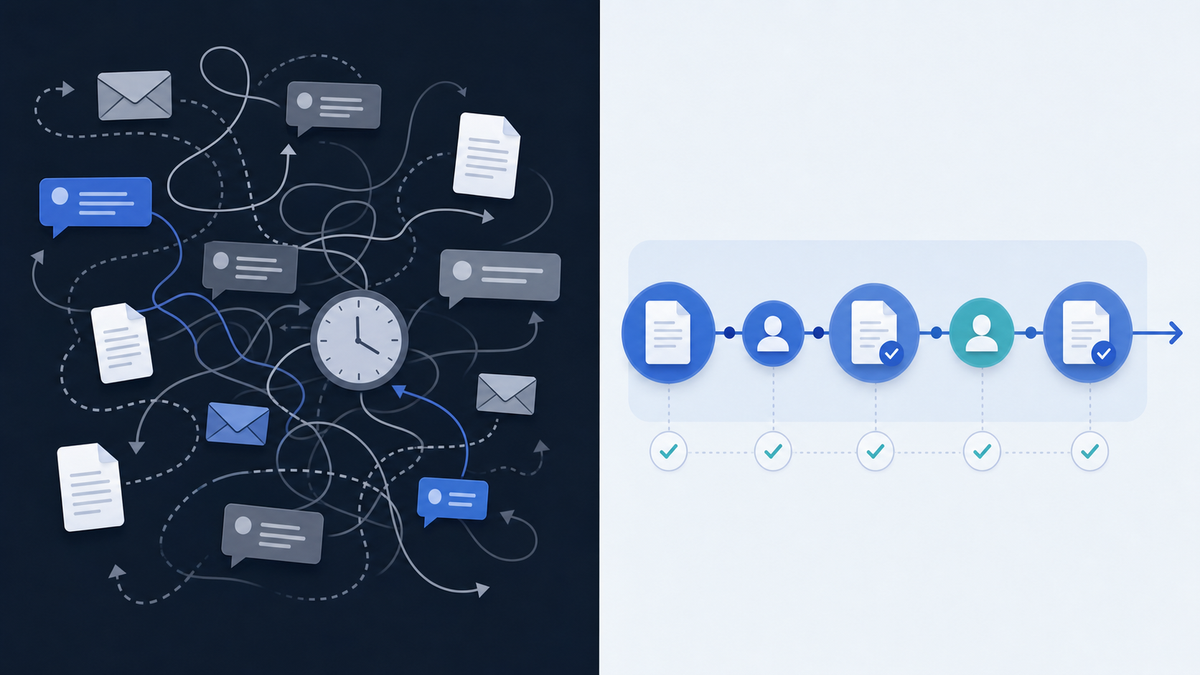
Every approval that travels through email adds invisible overhead that compounds fast. A reviewer misses a message. A document gets forwarded without the latest version attached. Someone replies to the wrong thread. By the time a decision lands, the paper trail is scattered across inboxes, Slack messages, and shared drives that nobody fully controls.
The numbers back this up. Studies consistently show that knowledge workers spend a large portion of their workweek managing email. For compliance teams, where every approval carries regulatory weight, that time sink carries real risk beyond lost hours.
Manual workflows also make audit preparation painful. When regulators ask for a record of who approved what and when, teams have to reconstruct timelines from email threads, which is slow, error-prone, and sometimes incomplete. A compliance approval system that lives inside the product itself keeps that record intact automatically.
What In-App Compliance Approval Systems Do
In-app compliance approval systems move the entire review process inside the product where work actually lives. Instead of attachments circulated over email, approval requests are anchored directly to the artifact: a specific clause in a financial disclosure, a flagged field in a compliance report. Reviewers see the context without switching tools, without downloading files, and without losing their place in a chain of replies.
That's the structural difference from both email and standalone workflow software. Email carries the document away from its context. Standalone tools (think ticketing systems or form-based sign-off apps) track status but stay disconnected from the artifact itself. In-app systems keep the approval request, the reviewer's feedback, and the thing being reviewed in the same place.
The four capabilities that define a proper in-app compliance review workflow:
- Contextual anchoring ties requests to document elements, so reviewers know exactly what they're approving and can respond in context
- Automated routing advances documents through reviewer stages based on predefined rules, with no manual forwarding required
- Real-time notifications reach reviewers inside the product, with enough context to act immediately
- Immutable audit logs record every action with timestamps and attribution automatically, ready for regulators without any assembly
Audit Trail Requirements Driving the Shift
Industries under regulatory oversight are adopting in-app review because auditors are demanding it, not convenience. SOX, HIPAA, and SEC regulations require organizations to prove who approved what, and exactly when they approved it. Email threads can be deleted, forwarded out of context, or simply lost. When an auditor asks for documentation of a financial statement approval from 18 months ago, "check my sent folder" isn't an acceptable answer.
In-app compliance approval systems solve this by generating immutable, timestamped records at the moment each action occurs. Every reviewer comment, status change, and sign-off gets logged automatically, tied to a specific user and document version, without anyone having to remember to CC an audit mailbox.
What a Complete Audit Trail Actually Captures
A well-built compliance review workflow goes beyond logging the final approval. It captures the full decision history:
- Every reviewer who accessed the document and when, giving auditors a clear chain of custody even for items that were reviewed but not changed
- Each comment, annotation, or suggested edit, tied to the exact version of the content it references so context is never ambiguous
- Status transitions with timestamps, showing when a review moved from draft to under review to approved or rejected
- Identity verification at each step, confirming that the person who clicked "approve" was the person authorized to do so
That level of granularity is what separates a system built for compliance from one that was retrofitted with a checkbox.
How Contextual Anchoring Prevents Approval Drift
When a compliance reviewer opens an email thread to approve a document, all they see is the document itself. The surrounding context, what changed, who flagged it, why it was flagged, lives somewhere else: a Slack message, a prior email chain, a sticky note in a shared drive. That fragmentation is where approvals go wrong.
In-app compliance review keeps context attached to the content. Comments left on clauses stay there when the next reviewer opens the file. Version history is visible in the same view. Approval state is tied to the specific revision being reviewed, not to whatever happens to be current when someone finally replies.
This matters because compliance decisions are often revisited. An approver needs to know what was true at the moment of sign-off, not reconstruct it from memory or a chain of forwarded emails.
Cutting Approval Cycle Times from Weeks to Days
Compliance teams that move from email chains to in-app review workflows consistently report faster cycle times, and the gap is wider than most teams expect.
The core reason is elimination of handoff latency. With email-based approvals, every step is a separate context switch:
- The reviewer receives a request and has to locate the relevant document
- They add comments and send a reply
- Then they wait for the next person to repeat the same sequence
In-app review collapses those steps: the reviewer opens the document and the approval interface is already there, with prior feedback visible in context. Here's how the timing tends to break down across a typical compliance review:
| Stage | Email-Based Workflow | In-App Review Workflow |
|---|---|---|
| Routing request to reviewer | 1-2 days (manual forwarding) | Minutes (automated assignment) |
| Reviewer locating correct version | Hours (attachment hunting) | Instant (single source of truth) |
| Feedback consolidation | 2-3 days (threading across replies) | Real-time (comments anchored in-doc) |
| Final sign-off collection | 3-5 days (serial email chain) | Same-day (parallel approval states) |
| Audit trail assembly | Hours to days (manual reconstruction) | Instant (auto-generated log) |
The parallel approval state is worth calling out. Email workflows are almost always serial: one reviewer finishes, then the next gets the document. In-app compliance approval systems can route to multiple reviewers simultaneously, which alone can cut total cycle time by half or more on reviews requiring three or more signatories. Compliance approval systems that support in-context commenting also reduce revision loops. When a reviewer's note is anchored directly to the clause or data field in question, the next editor knows exactly what to fix without a follow-up clarification email.
Multi-Step Approval Orchestration and Role-Based Routing
Compliance review workflows rarely follow a straight line. A new contract might need sign-off from legal, then finance, then a senior director, with each reviewer only seeing the document after the previous one approves. Email handles this badly. You get forwarded threads, missed reply-alls, and no reliable way to enforce the sequence.
In-app approval systems solve this by building routing logic into the review layer. You define the sequence, assign roles, and the workflow advances automatically when each stage clears.
What Role-Based Routing Actually Looks Like
A few things change structurally when approval logic lives in-app:
- Each reviewer only sees the approval action when it's their turn, which cuts down on premature sign-offs and confusion about who's currently responsible.
- Roles are tied to permissions, so a junior analyst can comment and flag issues without accidentally triggering an approval state meant for a compliance officer.
- Escalation paths can be pre-configured, so if a reviewer hasn't acted within a set window, the item routes to a fallback approver without anyone chasing it manually.
- Every state change gets logged with a timestamp and the identity of who acted, giving compliance teams an audit trail that holds up during regulatory review.
This matters because regulators don't just want an outcome. They want proof of the process: who saw what, in what order, and when.
Eliminating the Compliance Bottleneck Trap
Compliance bottlenecks show up at the end. A document gets finished, sent for review, returned with changes, then sent again. That late-stage gate is where schedules slip and audit records get thin.
According to Compliance Week, the compliance function itself isn't usually the problem. The operating model around it is. And research from ComplySafe points to the same pattern in fast-growing engineering teams: compliance gets treated as a final checkpoint instead of a thread woven through the work itself. That structural mismatch is what creates the bottleneck, not the compliance team's speed or capacity.
Review and Approval Infrastructure for SaaS Products
Most tools in this space solve one half of the problem. Task management and ticketing systems track approval state but don't keep the conversation attached to the artifact. Commenting layers add contextual feedback but lack formal sign-off states. Review infrastructure brings both layers into a single system, a meaningful structural difference from either approach alone.
The feedback layer covers anchored comments and discussions tied to specific document elements, with version-aware context that stays readable across reviewers. The approval layer covers discrete workflow states (pending, under review, approved, rejected), routing logic, and the audit trail that ties each state transition to a specific user and document version. Compliance teams need both, and splitting them across separate tools just recreates the same fragmentation that email-based workflows already produce.
Velt is built as review and approval infrastructure for SaaS products, with the feedback and approval layers treated as one system instead of two separate integrations you wire together after the fact.
How Compliance Teams Are Replacing Email-Based Approvals with Velt
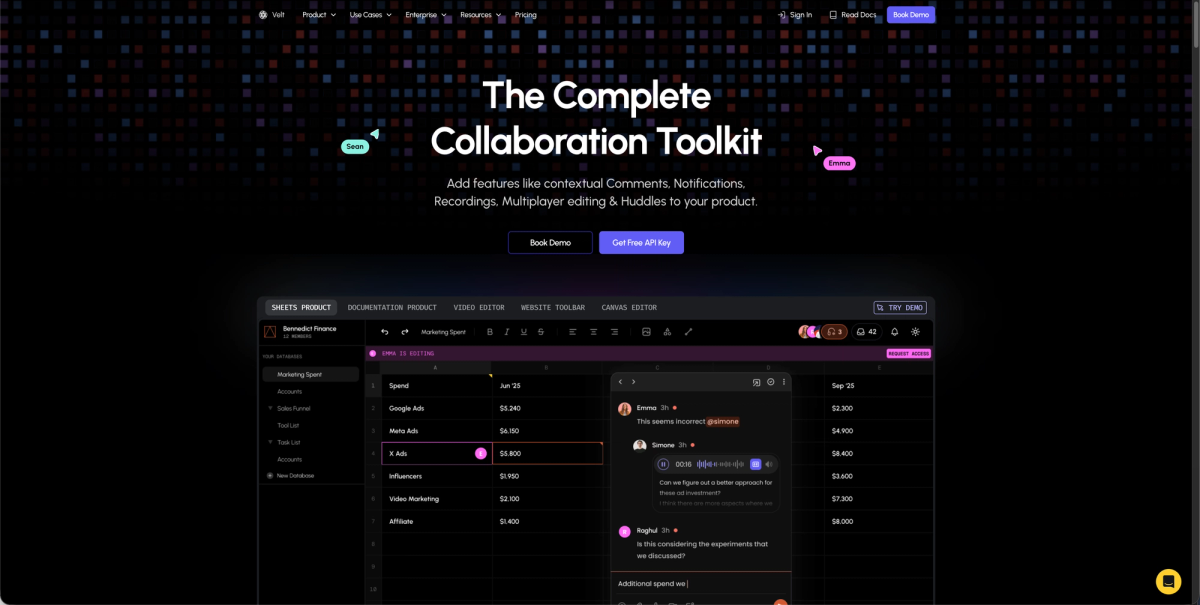
Velt's review and approval infrastructure fits directly into the tools compliance teams already use, so approvals happen in context instead of across scattered inboxes. This is how the workflow runs in practice:
- Reviewers see flagged documents, contracts, or disclosures inside the app itself, with comments anchored to specific clauses or items under review.
- Each reviewer's decision gets captured as a structured approval state, not a reply-all email thread.
- Audit trails are generated automatically, so compliance officers don't have to reconstruct a decision history from forwarded messages before an exam.
- Notifications route to the right stakeholders when a review is pending, overdue, or escalated, without anyone manually chasing status.
Velt handles the full review cycle: comments, approval workflows, presence, notifications, audit trails, and recording. Teams get that infrastructure without building it from scratch.
Final Thoughts on Replacing Email Approval Chains With Real Infrastructure
Compliance workflows that run through email fail the moment someone asks for proof of who approved what and when. Your reviewers need approval requests anchored to the actual content, not buried in forwarded threads with ambiguous version history. In-app compliance approval systems close that gap by keeping the review, the context, and the audit trail in one place. Velt ships that infrastructure so compliance teams stop reconstructing approval history from scattered inboxes.
FAQ
Can I build a compliance approval system without replacing my existing tools?
Yes. In-app compliance review systems integrate directly into your current product, so approvals happen where work already lives without requiring a separate tool or workflow system. Reviewers stay in the same interface they use daily.
What's the difference between in-app compliance approval and email-based review workflows?
In-app systems anchor approval requests directly to document elements with automated routing and immutable audit logs, while email scatters approvals across threads with manual forwarding and no structured state tracking. The structural difference is that in-app review keeps the approval request, reviewer feedback, and artifact in the same place with built-in audit trails.
How long does it take to implement an in-app compliance review workflow?
Teams using review infrastructure like Velt typically ship approval workflows in days compared to the 4-6 weeks required to build state management, permission checks, real-time sync, and audit logging from scratch. The exact timeline depends on your existing architecture and customization requirements.
What should a compliance audit trail capture for regulatory review?
A complete audit trail logs every reviewer who accessed the document with timestamps, each comment or edit tied to the specific content version, all status transitions from draft through approval or rejection, and identity verification at each step. Regulators require proof of who approved what and exactly when they approved it, along with the complete decision path.
In-app compliance approval vs email threads for audit readiness?
In-app systems generate immutable, timestamped records at the moment each action occurs, automatically tying every decision to a specific user and document version. Email threads can be deleted, forwarded out of context, or lost, and require manual reconstruction when auditors request documentation of approvals from months prior.